Showing posts with label King Arthur. Show all posts

Saturday, 27 February 2021

Talking Shakespeare Neljä (Four)

Dense, Juicy, Layered
David Oyelowo, speaking from Los Angeles, remembered a dusty (and intimidating) copy of Shakespeare’s plays in his family’s Islington council flat. He was later surprised to discover Kenneth Branagh’s film of Henry V was also written by Shakespeare, having watched it as a movie, not caring about the language. The real breakthrough for David, though, was seeing a live production at the National Theatre – the visceral production of Robert Lapage’s mudbath Midsummer Night’s Dream with Timothy Spall as Bottom. David started acting accidentally when he tried to impress a girl by joining a youth theatre and then standing in when another young actor couldn’t attend because of a tube strike. His Theatre Studies teacher, Jill Foster, encouraged him to consider acting as a profession and helped David audition (successfully) for LAMDA. His father fully expected him to “get it out of his system” when he was given small roles (seven lines in Antony and Cleopatra) at the Royal Shakespeare Company. But the bug had bitten and seeing someone like Mark Rylance in his fourth incarnation of Hamlet at The Globe deliver the language with “dexterity, musculariy and elasticity” further reinforced David’s conviction that Shakespeare is the “Everest of Acting… so dense, so juicy, so layered.” 
Greg Doran of the Royal Shakespeare Talking Shakespeare with David Oyelowo, Helen Mirren and Ian McKellen
Vulnerability and Frailty
He gave a very funny account of getting the role of Henry VI and loved “the journey” of his time on Michael Boyd’s production but became weary of the “pioneer” emphasis placed on him by the media wanting to interview him about being the first black actor at the RSC to play an English king. He detected a similarity between Dr Martin Luther King in the movie Selma and Henry VI where the abiding motivation for both characters, as he played them, was religious faith, leading to vulnerability and frailty. David felt that both MLK and Henry VI fully expected everyone around them to be imbued with the same values and were both destabilised when the. His other major Shakespeare role was playing Othello with Daniel Craig and Rachel Brosnahan (as Iago and Desdemona) in an intimate production in New York in 2015. Like Greg Doran, I hope he can be tempted away from Hollywood for more UK stage work in the future.
Selection of David Oyelowo roles: as Henry VI, Othello, Orlando in As You Like It and the movie Selma
Queen Helen
Helen Mirren is a multiple award winner: she has carried home an Oscar, a Tony and an Emmy and has famously played a line of queens: Queen Margaret in the Henry VI trilogy; and on TV and film: Catherine the Great, Elizabeth I and Elizabeth II. She also has the distinction of playing Cleopatra three times, first at the National Youth Theatre in 1963 and then later playing opposite Michael Gambon (1982) and Alan Rickman (1998) as her Antonys. I was lucky to see the 1982 Adrian Noble production (in The Other Place in Stratford-upon-Avon) and for me it became a benchmark production of how epic plays can be staged in small spaces. Helen’s early memories of working at the RSC include watching the generous Ian Richardson from the wings in Coriolanus.  She reminisced about working (warily) with the mercurial Nicol Williamson (on both stage and in the film Excalibur) and played Lady Anne, Julia in Two Gentlemen of Verona and Ophelia to Alan Howard’s Hamlet. She also vividly recounted the touring production of Troilus and Cressida which many argued brought the play back into favour in modern times and she described working with Peter Brook in the legendary project Conference of the Birds which toured the Saharan regions of Africa in 1979.
Helen Mirren as Cleopatra (three times), Cressida, Prospera in The Tempest and Rosalind in As You Like It
Sir Ian ("You shall not pass....")
Ian McKellen has had recent experience of remembering his distinguished acting career as part of his touring one-man show which raised considerable funds for small venues throughout the UK. (Tolkien, Shakespeare, Others and You.) With Greg Doran he shared early memories of seeing and loving theatre and getting involved in amateur and school productions. He always thought Shakespeare seemed fun and enjoyed travelling down from Bolton for school Shakespeare camps in Stratford-upon-Avon. He saw Laurence Olivier, Peggy Ashcroft and Charles Laughton in their prime (but also confessed to sleeping through Olivier’s Corialanus – it was a school trip, after all.) At Cambridge he joined the Marlowe Society and came under the influence of George Rylands who has mentored many of today’s great theatre directors as well as John Barton who persuaded young McKellen he could play the ancient Justice Shallow in Henry IV Part Two. He gave a moving account of working at Nottingham Playhouse with Tyrone Guthrie who gave McKellen confidence about becoming an actor and credits Maggie Smith with recommending him to Olivier to join the Old Vic. He was waspish about Franco Zefirelli and had insights into the impact of Olivier and of touring Shakespeare in the provinces and abroad with Prospect Theatre. I’ve seen many of his stage performances and been lucky to meet him both backstage after Waiting for Godot and at a UK showing of the film Gods and Monsters at Bradford’s Pictureville Cinema. Always gracious and always energetic, with a significant place in popular film history with his portrayals of Magneto and Gandalf, Sir Ian continues to be an astonishing creative force for good in the UK.
Ian McKellen as Romeo, Macbeth, Toby Belch in Twelfth Night (which I saw in Doncaster!), Coriolanus, Richard III, King Lear (twice) and Prospero in The Tempest at Leeds Playhouse


Saturday, 18 April 2020

Lockdown Time

Elastic Time
Time seems to exist in a multiverse in these times of Covid-19 Lockdown. I seem to have all the time in the world. And time passes like whispers in the wind. Is it April? Is it June? Was that Friday? Is this Saturday? Have I had breakfast? Did I sleep at all? Am I who I have always been? Or am I, my city, my country, my continent, my planet changing irrevocably? There have been personal earthquakes in recent times – some obvious political ones, but also natural disasters (The Year of the Flood) and personal convulsions (Beginning to Look Back). In my handwritten book of Helpful Life Quotations I can usually find something that fits most scenarios: in this case, Andy Warhol’s They always say time changes things, but you actually have to change them yourself.
Distraction Techniques
I thought this peculiar “Lockdown” would be a perfect time to do a hundred jobs still undone: declutter shelves and cupboards, sort out books and photographs, tidy the cellar, finish writing my trilogy of novels. Instead I seem to have a problem with concentration and with not being able to stick to the easiest of plans. Freshly-crucial activities have risen to become weirdly compelling: planning shopping like a military campaign, watching Box Sets on TV, doing jigsaws, cooking, baking, cleaning, walking, Skyping, Zooming, reading, clapping, handwashing, watching and rewatching parody songs, witty memes and entertaining tiktoks. Chinese philosopher Lao Tzu wisely said Time is a created thing. To say “I don’t have time” is to say “I don’t want to.” I’m known for spending (wasting?) time imaginatively dreaming of time-travelling, lurking in Shakespeare’s language or being absorbed in the fantasy worlds of Narnia, Middle Earth, Pern, Westeros, Marvel Comics, Robin Hood and King Arthur. Why haven’t I spent more time in Wonderland during Lockdown? Why does making a Victoria Sponge suddenly seem so important?
Luxury of circumstances
In Lockdown I have the absolute privilege and luxury of living in a great house with plenty of resources. So when needed, I can marshall support easily. I can bathe in forests, stride across meadows and walk along the River Aire within minutes. I know other people are facing Lockdown under enormous pressures with vulnerable dependents, restricted movements, money worries, job worries, underlying mental and/or physical illnesses, the demands of children out of school, genuine fears about what tomorrow will bring. The distraction techniques of the latest tiktok don’t distract everybody. The endless summers of childhood only seemed endless because the “normal” world was operating within “normal” parameters and “normal” September would come around soon enough. Charles Darwin wrote: A man who dares to waste one hour of time has not discovered the value of life. Well, Darwin, my old mucker, as my bowl says, The time you enjoy wasting is not wasted time. If Lockdown has taught us anything, it is that Time can feel Elastic but Lockdown means nothing to Time. This too shall pass.

Saturday, 16 November 2019

Hand holding mine to the end of the line

Baby Harriet meets her family (including Annie Oakley aka Wakefield Grandma) and years later Harriet takes her Dad to the German Market in Leeds....
Next year our troubles will be out of sight….
Daughter Harriet had a great idea for a New Year’s Resolution last year to plan a unique outing with each member of the family. This week was my turn: cinema, a curry, a museum – and, most importantly, just BEING with a loved one for some quality time. The day started with a delicious breakfast at New Farnley Cricket Club and a morning cinema trip to the visually audacious The Aeronauts with a compelling central performance by Felicity Jones. Who knew weather forecasting had such dangerous origins? The Royal Armouries in Leeds was our next stop for a Movie Props exhibition where highlights for me included Darth Vader’s mask and the Lancelot armour from John Boorman’s Excalibur.
The Cat's Pyjamas and the Royal Armouries

Germany to India to Missouri

Quaffing mulled wine at the German market in Leeds Millennium Square prepped us for an affable curry at The Cat’s Pyjamas in Headingley and we ended the splendid day with some 1944 nostalgia looking back to the 1904 World Fair in St Louis with the genius of Judy Garland, the sumptuous Irene Sharaff costume designs and the Vincente Minelli marshalling of many talents, cast and crew, for Meet Me In St Louis, a special screening at the Cottage Road Cinema.
Through the years we all will be together
If the fates allow…
Great resolution, Harriet. Thanks for a memorable morning, afternoon and evening.
New Farnley Cricket Club breakfast, The Aeronauts and Meet Me In St Louis


Saturday, 28 September 2019

Bays and Stones

Castle Point
Aside from Castles and Gardens in Dumfries and Galloway, we wanted to explore the coast and began with Rockcliffe village and bay, very picturesque on a wild and windy day. We climbed the Mote of Mark, a dramatic hill fort with a viewpoint across the bay (and mythical links with Merlin from the King Arthur stories.) Teetering on the pebbles along the coastal walk we were wind-whipped and rain-lashed but found a sheltering tree for a blustery picnic. Wild. As we ascended the headland we stumbled upon Joseph Nelson’s Grave; he was a victim of the shipwreck of The Ann, lost in January 1791 (Nelson’s body washed ashore in July, six months after the disaster.) Our destination was Castle Point, a high promontory with panoramic views along the coast. The return journey included an alarming herd-of-cows attack, so I had to summon my Inner Farmer to bring the family to safe haven….
Naked shingles of the world
Mossyard Beach was another memorable stop, a magical shell-covered beach with a series of dunes and the noise of waves rolling in, slurching out, relentlessly flowing and ebbing, (from Matthew Arnold's Dover Beach:)
Listen! You hear the grating roar
Of pebbles which the waves draw back, and fling,
At their return, up the high strand,
Begin, and cease, and then again begin….
Making Old Stuff Freshly New 
Frequent surprises on this trip were provided by the terrific guides or custodians of every site we visited, even when we were spending only the briefest of comfort stops, for example at Dundrennan Abbey (the last place Mary Queen of Scots stayed before leaving Scotland forever) or Carsluith Castle with its welcome coffee/Deli shop. Was it the lyrical nature of the Scottish accent, or just the well-trained tourist-friendly gift-of-the-gab? Who knew bits of old rock could be made so dramatic and inspirational? But so it was at Cairn Holy I and II, two chambered cairns with their cup-and-ring marks and tantalising glimpses into burial practices that we can only imagine. Who rested there? A religious figure? The mythical Scottish King Galdus? A famous Somebody who is famous No More?
Look on my Works, ye Mighty, and despair!
Castle Point

Saturday, 25 May 2019

Iron Ring of Castles

Peaceful Now, Iron Ring Not Needed
Knowing that Edward I built his “Iron Ring of Castles” in this area of north Wales to control the rebellious Welsh is easy to forget when you stand on Conwy beach and look across to the Great Orme (the massive chunk of limestone rising up near Llandudno.) The beach has golden sandbanks and dunes, as well as charming bluebell walks to reach it from certain directions.
Penrhyn Castle (Castle Penrhyn)
Was NOT one of Edward I’s Iron Ring – in fact is is a Victorian pile with faux medieval features, but with the attraction of enchanting William Morris decoration and pre-Raphaelite paintings. The displays about the impact of the building of the railways and the use of the local slate quarry were compelling, probably because the information honestly and imaginatively confronted the slave trade’s role in contributing to the growing economy of the Pennant family in the 17th and 18th centuries.
From “pretend” Castle Penrhyn to Fortress Caernarvon
Sturdy Caernarfon (Canarvon Castle to English tongues) is a lynchpin of the Iron Ring and has been home to several important historical events, not least of which was the investiture of Prince Charles in 1969 and, five decades earlier in 1911, the future King Edward VIII, both becoming Prince of Wales. The mighty, heavily restored Caernarvon boasts Castillian octagonal turrets (no less than three on the Eagle Tower.) 
Multimedia Castle
Imaginative multi-media displays brought different periods of the castle’s history to life. There was a circular projection that helped fill in the timeline, a giant “chess board” depicting the ownership of the title “Prince of Wales”, a shadow-puppet pageant of Eleanor of Castille’s life and a dramatic depiction of Edward I’s manipulation (to his own ends) of the myths of King Arthur.
The Museum of the Royal Welch Fusiliers
Within the Castle is an account of the distinguished Welch Fusiliers (yes, spelled with a c not an s!) The regiment was raised in 1689 and the museum contains fascinating material, including an account of Jenny Jones and Mother Ross, women who dressed as men to fight beside their comrades. A goat has been the regiment’s mascot since 1777 and, since 1844 and Queen Victoria’s “gift,” the goat has always been a “royal goat.” The new royal baby, Archie, appeared in early May, so it seemed somewhat fitting that we were visiting one of Archie’s ancestor’s large-scale Defence of the Realm F-Off castles. Will Archie ever be crowned Prince of Wales? (As Seventh in line to the throne, it is unlikely but, then again, who would have predicted Edward VIII’s life choices back in 1911?)
Harriet was off camping on this holiday; and this pic includes the longest town name in the UK

Saturday, 9 June 2018

Return to Stonehenge

Avebury
Developed and populated around 2600 BCE, Avebury is the site of a stunning concentration of Neolithic and Bronze Age remnants including West Kennet long barrow, Silbury Hill, ditches, avenues and the enigmatic circles within circles of standing stones. I went a couple of years ago on a King Arthur road trip with Emily and this time we returned with Sally.
Close Up
The astonishing feature of Avebury is that you can get super-close to the stones and walk along and amongst their grandeur. They are a perfect way, if you visit the Alexander Keiller museum on site, to introduce you to the weird landscapes in this part of the country before going on to the monumental “other” part of the World Heritage Site, site of many a battle between environmentalists, pagan worshippers and English Heritage…. Stonehenge.
The Alignment
Stonehenge’s axis runs north-east to south-west and at midsummer the sun rises in the north-east and at midwinter the sun sets in the south-west. Even on a May evening (when we were there) on a clear night the sun setting is a powerful event. It’s easy to be awestruck about how the original builders and engineers could align both solstices, six months and 180 degrees apart.
Our ancestors were not so primitive
Avebury’s stones were lifted into their positions at a similar time that the Egyptians were raising up the Great Pyramid at Giza. Given the other Great Wonders of the Ancient World, I have to conclude that just because we have no written records, it does not mean our ancestors were incapable of scientifically elaborate achievements. What would we now know about the past if the Librar(ies) at Alexandria had not burned down several times – nor indeed if other libraries throughout the world had been better preserved?
Stonehenge’s history, as far as we currently know
Long barrows in the Stonehenge landscape appeared as early 3500 BCE and by 500 years later the first wide circle (with smaller stones) had been constructed. Avebury (and the Great Pyramid at Giza) came about 500 years after that. We can place the erection of the larger stone circle with its uprights and lintels to about 2500 BCE, two generations after Avebury.
Durrington Walls
A nearby settlement either housed the builders or thrived on the trade generated by the presence of Stonehenge and a group of huts have been recreated next to the Visitor Centre.
What is Stonehenge?
Over the years Stonehenge has been proclaimed a celestial clock, a temple, a place of sacrifice, an art installation, an impressive site for civic ceremonies – the current view is that we simply do not know how it was used in its heyday. We’re not even sure it was ever completed.
Not for Druids (originally at least)
One certainty is that it could never have originally been a Druids’ Temple, as Druid practices began in the Iron Age, long after Stonehenge had appeared. Druids may have appropriated the stones in later years, but so have poets, novelists, songwriters, artists and plain old romantics….


Saturday, 15 July 2017

Bradford Literature Festival 2017

Bradford Literature Festival 2017
The cover of the booklet proclaimed 400 writers, 300 events, 10 days, 1 city
I listened to 28 speakers in 10 events over 4 days
I felt insanely proud of the city where I live for hosting such an event – the fourth year now and getting stronger each time. A thousand congratulations to the driving forces: Syima Aslam, Irna Qureshi and their superb team.
Bradford Waterstones in the old Wool Exchange

Inclusive, surprising, chock-a-block with surprising juxtapositions
I’ve been to a number of literary and writing festivals during my lifetime but I haven’t experienced one with such a variety: from Harry Potter spell-making to Pakistani politics, from Jane Austen to Rebel Girls, from Star Wars to Cricket, from LGBTIQ events to J B Priestley, from Waris Shah’s epic love love poem to lessons on how to avoid writing bad sex scenes. The organisers seem to be fearless and determined to put in something for everyone. And everyone, it seemed, turned out.
Bradford: City Square, City Hall, R C Bridgestock in the Victorian courtroom (see below)

City square in the sun
I found something on both weekends to intrigue and pull me in. But my abiding memory of the festival might be sitting in City Square watching the fountains play and being astonished (and moved) by the smiling crowds going in and out of the book tent, by the individuals, friends, strangers, families, young, old, all ethnicities, all backgrounds and all types watching the pop-up entertainments. Many, I’m sure, were as equally contented as me that, after all the metaphorical earthquakes in the political world in recent years, the evidence of people congregating at the Bradford Literature Festival shows that the human race is overwhelmingly peaceful, loving, investigative and open-hearted. Culture and the arts celebrate communities, spread ideas and, yes, it’s true, they advance civilisation. Much to learn. Much to debate. Much to ponder. Much to love.
Samantha Ellis's book, the Arabian Nights event (Abdul-Rheman Malik, Robert Irwin and S F Said); the Arthurian legends (Kirsty Logan, Reluca Radulescu and Remona Aly); and Game of Thrones: Myths and History (Tom Huddleston and Carolyne Larrington)

So what did I learn, debate, ponder and love?

Book Bidding Wars

  • Inside City Hall is as jaw-dropping as the outside, inspired as it is by the Palazzo Vecchio in Florence
  • The women from the publishing industry who spoke at this event were inspiring, funny and encouraging (thank you Ailah Ahmed, Danuta Kean, Lisa Milton and Kate Nash)
  • Update on my Rhenium Tales efforts: the arc of my second book is laid out with some material already dumped there because I’ve cut it out of Book One
  • Book One, Raydan Wakes, is in the final stretch of complete first draft at 111,000 words split into 15 chunky chapters, each divided into three sections….
  • Nothing at this event made me think I should stop writing and editing, writing and editing….

The Arthurian Legend and its Enduring Appeal

  • Remona Aly (journalist and broadcaster) was an endearing and enthusiastic chair whose expressions of her fandom articulated exactly my own Arthurian obsessions (and that's what's great about the festival: where the internal worlds of a white Roman Catholic in his 50s and a young Muslim woman can meet in an unlikely space....)
  • Kirsty Logan inspired me to buy her book The Gracekeepers 
  • I wish I’d been taught at university by Professor Reluca Radulescu
  • The three women debated the crux of the Arthurian canon: the fruitful jostle between the imaginative, the scholarly, the historical, the gender-focused, the patriotic, the European and the romantic approaches
  • The Tag “King Arthur” in the list to the right will demonstrate how much I wallowed in this event

Arabian Nights: the Original Science Fiction

  • There are way more stories in the Arabian Nights collection than I knew of
  • From oral tradition to the printed collection(s) on shelves now, the journey of The Arabian Nights is fraught with cultural, political and linguistic complexities
  • There are some wild and wonderful stories I never knew containing prophetic imaginings and leaps of technology
  • The Arabian Nights is more mind-boggling and enticing than I thought before
  • I need a new translation (thank you Abdul-Rehman Malik, Robert Irwin and S F Said)

Game of Thrones: Myths & History

  • Tom Huddleston (author and film journalist) and Professor Carolyne Larrington (Oxford) made a brilliant double act with well-prepared questions (Tom) and authoritative answers (Carolyne) and conversation that was mesmerisingly entertaining (both of them, thank you)
  • Another event, like the King Arthur session, that explored how history, geography, politics, gender studies, fiction and the imagination can work together to brew sci-fi and fantasy
  • They revelled in the North-South divide of York/Lancaster and Stark/Lannister which tickled me to bits
  • They revealed some crazy medieval anecdotes and prompted me to make four pages of notes

The Books they don’t want you to read

  • Kevin Duffy helps run Bluemoose books which published STOP! Don’t read this by Leonora Rustamova and her students, a story which is worth researching if you don’t know it (click here)
  • Melvin Burgess (who wrote two of my favourite “Young Adult” books Bloodtide and Bloodsong) is much more genial than I expected
  • Tariq Mehmood is a funny guy – and sometimes scary in his emphatic challenges – but whose book You’re not proper is one I’m looking forward to reading
  • All three men wrangled around the subject of banning books and acknowledged the empty chair reserved for Juno Dawson who had withdrawn from the festival for reasons which could be seen as ironic given the topic of this event – complex times – so I hope one day I’ll be able to hear Juno talking about her work; she would, I think, have had a different perspective to the three men on the panel, all of whom were interesting....
Branwell Brontë, Juliet Barker, the Bidding Wars panel (Lisa Milton, Ailah Ahmed, Kate Nash, Danuta Kean), Samantha Ellis, Michael Stewart, Louise Doughty and Robert Edric

And on the second weekend?

The Missing Brontë

  • Juliet Barker really is the best speaker about the Brontës on the circuit
  • She showed us extraordinary images of the Haworth Parsonage and analysed the ‘gun portrait’ in a fresh way
  • She painted a picture of Branwell that was complicated and sympathetic, believable and sad
  • She made a strong case for Branwell’s role in pushing the imaginative lives of the sisters when they were children

Inspired by the Brontës

  • Samantha Ellis, author of Take Courage (about Anne Brontë) and How to be a heroine, is an absolute delight and would be a great dinner party guest
  • Louise Doughty, author of Apple Tree Yard, won a place to be at the same dinner party; both she and Samantha Ellis spoke with humour and passion about the Brontës and how their writing had influenced their work
  • I tried to ignore Robert Edric who seemed to be there under false pretences; and Michael Stewart (writer) asked some good questions and some rubbish questions; but luckily the two women had enough to say and illuminated the theme of the event
Boyd Tonkin and Germaine Greer

Gender Expectations in the Lives of the Brontës

  • Boyd Tonkin (writer, journalist, editor) commented intelligently and asked pertinent questions
  • Germaine Greer (academic, environmentalist) said a lot, often wittily, always memorably, frequently debatable
  • On signing “To Tony” inside one of her Shakespeare books for me at the end, formidable Germaine looked me in the eye and said “I have a cousin called Tony who exposed himself to my little sister.” Which meant I forgot just about everything else she’d said earlier, except I remember that she admitted she didn’t know Wuthering Heights well, even though she was happy to deliver strong opinions about it.
  • Greer’s book Shakespeare’s Wife is a brilliant account of Elizabethan/Jacobean social history so I’ll always be a Germaine fan because of it. But I’ll avoid listening to her talking about the Brontës in the future. She ain’t got nothing useful to say about them. Entertaining. Thought-provoking. Occasionally stubbornly wrong. Juliet Barker beats her hands down. Not that it’s a competition…

A Man’s Game

  • Ross Raisin (ex Bradford Grammar School, award-winning author) is a thoughtful and philosophical speaker; his first novel God’s Own Country was (imho) an absorbing and poetic read; I got a copy of his latest A Natural signed at this event
  • David Park is a Belfast-born writer whose words inspired me to buy his collection of short stories, Gods and Angels, so I’ll look forward to reading that
  • Ellis Cashmore (sociologist and cultural critic) moderated, intervened, provoked and enjoyed his own thought processes awfully much
  • Will women’s sport ever (again) receive as much media attention and financial investment as male sport?
  • I was interested to learn how in the early part of the 20th Century women’s football flourished and was then banned by the FA….
  • Is there a modern crisis of masculinity?
  • Do fiction writers have any responsibility in attempting to portray an ‘ideal’ man?
Ellis Cashmore, Ross Raisin, David Park, A Natural, Melvin Burgess and the Banned Book event (Kevin Duffy, Melvin Burgess and Tariq Mehmood)

Realism in Crime Fiction & Tour of the Bradford Police Museum

  • Who knew there was a fascinating Police Museum housed in City Hall? I know now.
  • Who knew there were Victorian police cells to visit and an astonishing Victorian courtroom, often hired by film and TV production companies? I know now.
  • R C Bridgestock (aka husband-and-wife team Bob and Carol) gave an entertaining account of their careers in the police force, their transition to writing crime fiction and their forays into consulting on series’ like Sally Wainwright’s Happy Valley 
  • Bob and Carol were generous in their enouragement and writing tips
  • Pamela Clare, make-up artist, showed astonishing skill in demonstrating gruesome facial injuries on audience members
  • Martin Baines was an informative, entertaining and thoughtful guide round the fascinating bowels of City Hall and revealing insights into the past (and present) practices of police custody
I’m already anticipating Bradford Literature Festival 2018
The founders of the BLF: Syima Aslam and Irna Quresh


Saturday, 20 May 2017

Legend of the Sword

All things Camelot
I have blogged about King Arthur before (links at the bottom): not as many times as Shakespeare, but looking at the Label tally opposite, more often than Jesus. All things Camelot caught my imagination at a formative age and I am a sucker for lapping up Arthurian projects – not uncritically, I have to say. I was the perfect target audience for a recent book about Arthur as “dragon of the north” – yes, King Arthur from Yorkshire, count me in – but I found it unconvincing and tenuous. So, with a professional interest and a critical eye, I went to the cinema on my own to see King Arthur: Legend of the Sword, just in case it made me weep like a colicky baby. I wasn’t alone on Friday afternoon – one woman (who fell asleep in the middle) was there with a Charlie Hunnam lookalike (might have been him, I suppose); and the rest of the audience were individual men like me, looking like they spent too much time indoors reading….
Swords and Serpents….
My favourite thing in the film was Excalibur. Not just the prop, which was beautifully made, but the way Charlie Hunnam handled it, the way Guy Ritchie filmed it, its place in the story, its journey from the stone to battle to mud to water to more battles to various supernatural nuclear-Moana-goddess–Mordor-fire-Sauron-type explosions and ripples. It was a very busy sword. The script made me laugh – out loud twice. It looked excellent, as far as CGI films can. The spin on the legend was intriguing, though I would have liked more agency from Annabelle Wallis’s Maggie, a potentially beguiling character, Poppy Delevingne’s Igraine and Nicola Wren’s Lucy. The one female character who wasn’t doomed, a Mage played by Àstrid Bergès-Frisbey, certainly made her presence felt as an acolyte of (the unseen) Merlin. From my understanding of Arthurian Romance, Guy Ritchie was tapping into Welsh interpretations of Arthur as a hero who battled demons and giant serpents, although in this film, Arthur has his own serpent thing going on.
More please
I believe Guy Ritchie was hoping to use this film to launch a series of Arthurian films and, after seeing this one, I’d sign up for another in the hope that he’ll build in more scenes in the future for his daughters to enjoy. I loved the design angle that Ye Olde Londinium still had plenty of Roman ruins in evidence. And Daniel Pemberton’s score was a rumpy-pumpy blast.
  • Charlie Hunnam is a convincing reluctant hero, pulled up by his boot straps from his childhood as brothel orphan 
  • Djimon Hounsou is magnificently charismatic and noble as Sir Bedivere 
  • Aiden Gillen is always wry value as crack archer, Goosefat Bill (Bill?) 
  • Jude Law eats the scenery and swivels his eyes in demented villain mode 
  • Geoff Bell always gives great geezer, this time as someone called (I think) John 
  • Eric Bana is memorable as the ghost of old Hamlet (not quite, but if you see it you’ll know what I mean).
  • The small parts were sketched quickly and boldly: Kingsley Ben-Adir as Wet Stick, Tom Wu as George, Neil Maskell as Blue’s dad, Black Lack, David Beckham as (did they say Trigger?)
Overall it felt like a version of King Arthur that some mates down the pub might act out. (If they had a multi-million pound budget.) But it passed a rainy afternoon for this Arthurian geek quite nicely, thank you. PS, there was a very smart performance by young actor Bleu Landau as Blue.

Past blogs about King Arthur
Reading Arthurian Romance:
The Sword in the Stone
The Once and Future King
One Brief Shining Moment

Road trip with Emily to Arthurian sites:
Road to Avalon
Road to Glastonbury
Road to Stonehenge and Winchester 
Thanks, Mr Ritchie, for adding to the Arthurian canon

Saturday, 25 February 2017

Having my cake and eating it

Son, Brother, Uncle, Husband, Father, Ex-boy, Man
I thought growing up through the 1960s, 70s and 80s that the case for gender equality had been made and the world was entering a better phase as far as Being A Woman and Being A Man. But something happened during the 1980s and in the decades since so that the Twentieth Century advancement of many civilising ideas to improve international societies through gender equality has been halted. Feminism now seems to be a contentious concept rather than the patently, blatantly, unquestionably, obviously, undeniably sensible idea it really is. As a son, brother, uncle, husband, father, ex-boy and man I cannot for the life of me see why anyone thinks there is anything wrong with equal pay, equal opportunities and equal rights between women and men.
My test of Feminism
When male students tried to challenge me about being a feminist during my days as a teacher, I asked two questions:
1) Do you think ALL males are superior to ALL females?
2) Do you think a man should be paid MORE for doing the same job for the same hours as your mother, sister, niece, wife or girlfriend?
If the answer to both questions is YES, you are NOT a feminist. If the answer to both questions is NO, you ARE a feminist. If you are not sure, you need to think more about it and keep asking questions. Anyone who thinks feminism is a movement that wants anything other than equality is perverting the idea of feminism.
Perverting Feminism
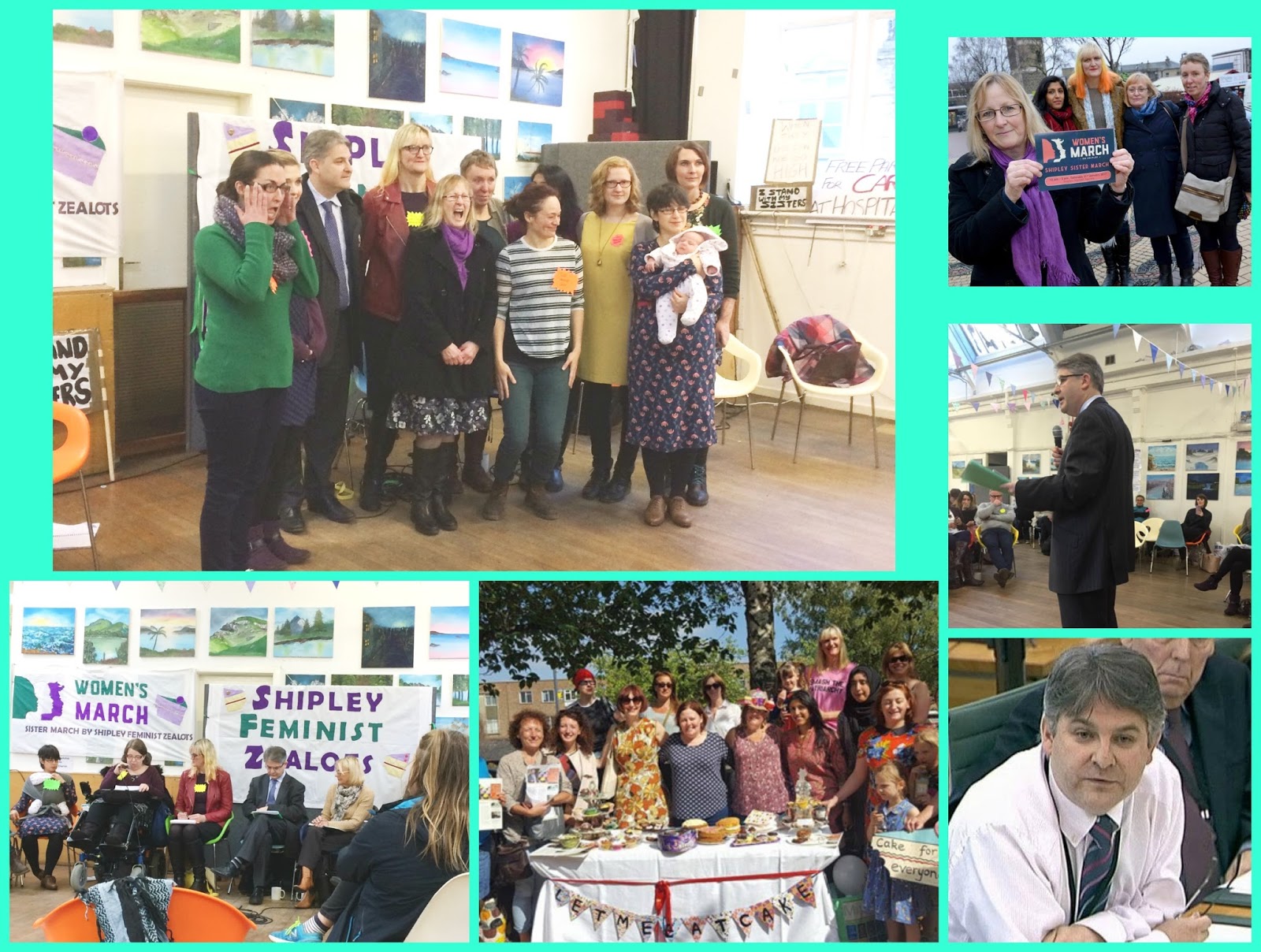
Back in August 2016 Philip Davies (Conservative MP for Shipley) made a speech at a Justice for Men and Boys (J4MB) conference. (Click here for an account.) For the record, I’m all in favour of Justice for Men, Boys, Women, Girls and Humans of All Types and Flavours. Justice is a good thing. I think everyone favours Justice. King Arthur favoured Justice, and that’s good enough for me. The trouble with J4MB as an organisation is that they issue awards for Gormless, Lying, Toxic and Whiny Feminist of the Month. It’s not an organisation, therefore, that makes the world a better place; in my opinion J4MB has calcified into a throwback group with knuckle-dragging attitudes. But my MP decided to speak there and used a phrase that has now been stolen and reclaimed as the name of a group I’ve recently joined.
Shipley Feminist Zealots
Philip Davies told the J4MB conference:
“In this day and age the feminist zealots really do want women to have their cake and eat it….They fight for their version of equality on all the things that suit women – but are very quick to point out that women need special protections and treatment on other things.” 
Davies’s misconception is that women and men are currently starting from an equal base so special protections are unecessary for women. If only that were true…. No-one is preventing Davies – or anyone else for that matter – standing up (and organising conferences and demos) for the rights of boys and men. It’s not an EITHER/OR scenario. Philip Davies claims to be in favour of democracy but his favoured attack in emails is to bully and patronise constituents who disagree with his stance on issues (I have personal experience of this, as do other members of my family.)
Having cake and eating it
To his credit Philip Davies always replies quickly and “robustly” to contacts and is willing to engage in personal appearances. So yesterday he listened and responded to the group I have felt compelled to join: Shipley Feminist Zealots. The meeting openly discussed with Philip Davies:
  • the Istanbul convention
  • sex education and PSHE in schools
  • pay rates, rights and experiences for disabled people
  • car parking for carers at NHS sites
  • honour killings
  • his regular parliamentary filibustering
  • his insults about constituents in newspaper reports and emails
Many thanks to the organisers of the meeting with Philip Davies. Many thanks to all who baked cakes (I couldn’t stop myself eating some!) And special thanks to Jenny who chaired the event with skill, patience and grace.