Showing posts with label Coriolanus. Show all posts

Tuesday, 29 August 2017

Dance for me

The art world responds to the story of the dancing princess
Playwright in prison
On 11th February 1896, at the Comédie-Parisienne in Paris, Oscar Wilde’s play of the Biblical story of Salomé received its premiere. Rehearsals for an earlier production had begun in 1892 starring the famous celebrity actress, Sarah Bernhardt, but the London production was banned, supposedly because the Lord Chamberlain (the censor of the day) decided that it was blasphemous to portray Biblical characters on the stage. By the time the play was staged in Paris, Wilde had been imprisoned as a result of a series of tragic miscalculations and the fervid homophobia of late Victorian Establishment.
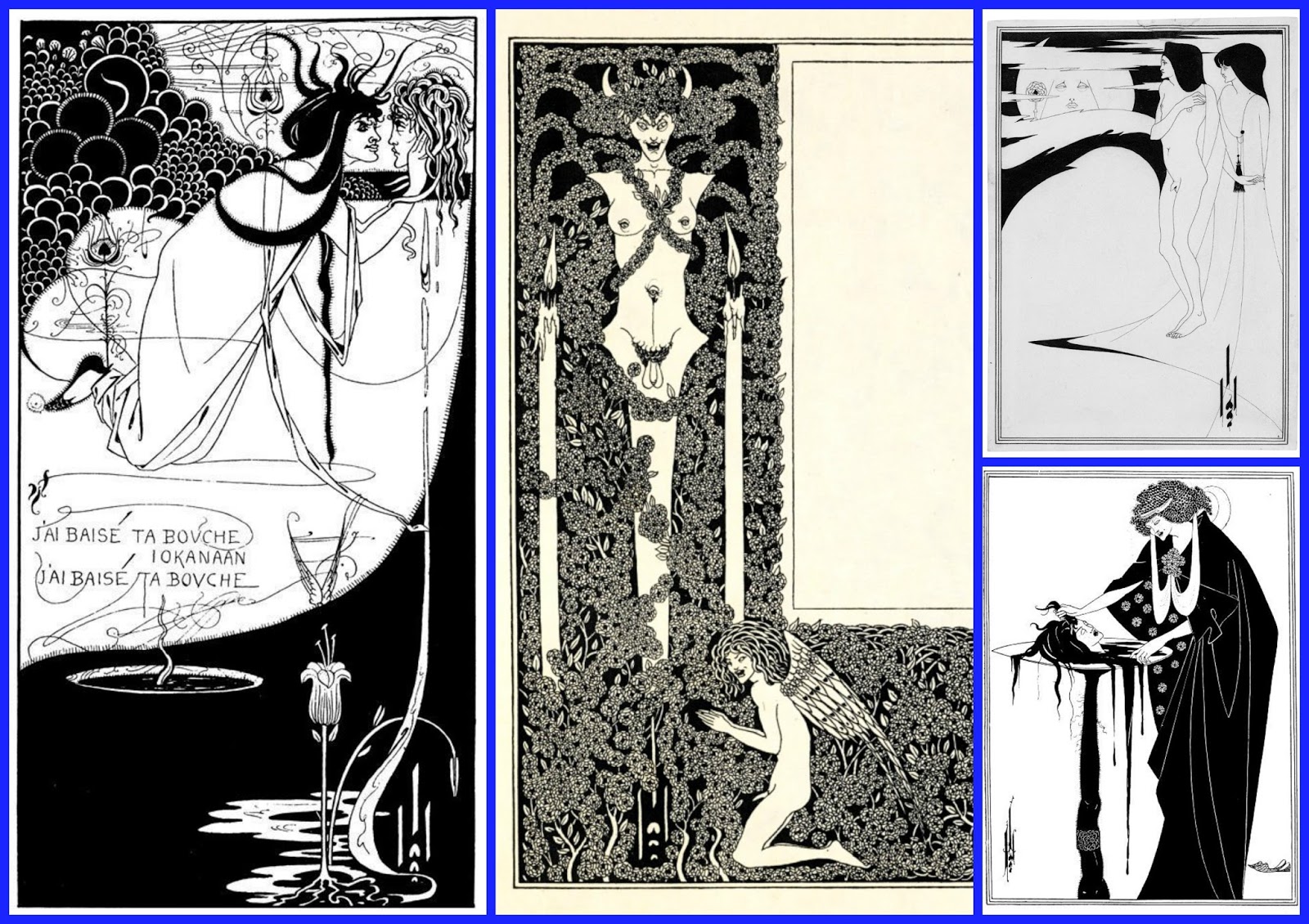
Aubrey Beardsley's original illustrations include Wilde in the moon (top right)

What the Bible says (Mark Ch 6: 14 – 28)
John the Baptist has been raised from the dead, and that is why miraculous powers are at work in him.”
15 Others said, “He is Elijah.” And still others claimed, “He is a prophet, like one of the prophets of long ago.”
16 But when Herod heard this, he said, “John, whom I beheaded, has been raised from the dead!”
17 For Herod himself had given orders to have John arrested, and he had him bound and put in prison. He did this because of Herodias, his brother Philip’s wife, whom he had married.
18 For John had been saying to Herod, “It is not lawful for you to have your brother’s wife.”
19 So Herodias nursed a grudge against John and wanted to kill him. But she was not able to,
20 because Herod feared John and protected him, knowing him to be a righteous and holy man. When Herod heard John, he was greatly puzzled; yet he liked to listen to him.
21 Finally the opportune time came. On his birthday Herod gave a banquet for his high officials and military commanders and the leading men of Galilee.
22 When the daughter of Herodias came in and danced, she pleased Herod and his dinner guests. The king said to the girl, “Ask me for anything you want, and I’ll give it to you.”
23 And he promised her with an oath, “Whatever you ask I will give you, up to half my kingdom.”
24 She went out and said to her mother, “What shall I ask for?” “The head of John the Baptist,” she answered.
25 At once the girl hurried in to the king with the request: “I want you to give me right now the head of John the Baptist on a platter.”
26 The king was greatly distressed, but because of his oaths and his dinner guests, he did not want to refuse her. 27 So he immediately sent an executioner with orders to bring John’s head. The man went, beheaded John in the prison,
28 and brought back his head on a platter. He presented it to the girl, and she gave it to her mother.
Images copyright RSC taken by Isaac James. Actors: Matthew Tennyson, Ilan Evans, Jon Tranchard, Christopher Middleton, Simon Yadoo, Bally Gill, Johnson Willis, Assad Saman, Andro Cowperthwaite, Ben Hall

Influences and imaginative transformation
In crafting the play, Wilde:
  • takes the text (above) from the Gospel of Mark and the shorter version in Matthew’s Gospel;
  • considers the many classical paintings of the scene by da Vinci, Moreau, Rubens and Titian among others (rejecting some and admiring others);
  • and, like Shakespeare, steals phrases and rhythms from a number of other writings (Scheffauer, J C Heywood, Flaubert, Huysmans, Maeterlinck) and even
  • his own brother, Wiliam Wilde, who wrote a poem about Salomé in Trinity College magazine, in 1878.
What he does, though, is transform the story into something strange and ritualistic. The language is fluid and poetic, hypnotic and surprising. Salomé, in Wilde’s play, isn’t persuaded by her mother to demand the head of Iokanaan (John the Baptist), (as occurs in the Bible) but makes her own decision to do so and is explicit in Wilde’s play that she hasn’t consulted her mother. Thus Wilde’s Salomé is breaking free, growing up, upsetting authority, dancing on her own terms….
Isaac James photographs. Actors: Assad Zaman, Matthew Tennyson, Gavin Fowler, Suzanne Burden and Company
Owen Horsley’s production
It at first glance seems perverse to give a female role to a male actor in a 2017 Roman plays season at the RSC, given the few numbers of (textually) female roles available in Antony and Cleopatra, Coriolanus, Julius Caesar and Titus Andronicus. But the decision absolutely works in the context of the rest of the production’s design and, in my opinion, gave Wilde’s play a frisson of repressed/unrequited/ambiguous/burgeoning love and sexuality that was wonderfully apt in this year of the 50th anniversary of the partial decriminalisation of gay (male) sex. Matthew Tennyson played Salomé with delicately eye-popping rage; he alternated between naïve expressions of desire, determined ferocity and intricate vulnerability. Standing up to his dementedly incestuous stepfather, Herod, played with lascivious cowardly torment by Matthew Pidgeon, Salomé was a heroic and tragic figure who struggled to know how to express her/his love. Circling them both was the accusatory Herodias played by Suzanne Burden with flamboyant gusto (often appealing to the audience directly and inviting us to judge what we were seeing.)
Isaac James photographs. Actors: Ilan Evans, Matthew Tennyson, Gavin Fowler, Matthew Pidgeon, Ben Hall, Bally Gill, Jon Trenchard, Christopher Middleton, Miles Mitchell, Andro Cowperthwaite, Robert Ginty, Byron Mondahl, Johnson Willis, Simon Yadoo

Total theatre
The moon hung over this beautifully-lit and evocatively-costumed production, literally and imaginatively as the Roman soldiers, the Jewish and non-Jewish revellers and the Roman ambassador were all mystified about how to respond to both the dancing princess and the muscular prophet, Iokanaan (John the Baptist played by Gavin Fowler), emerging from his cistern beneath the stage smeared in dirt and booming out his intense warnings. The executioner, played by Ilan Evans, got to belt out the songs of Perfume Genius, an artist I didn’t know before this production but whose anthemic, heavily-percussive music seemed to fit the awesome, longing, desperate, romantic atmosphere of this theatrical presentation of the pangs of transgressive love.
Variations of the play: film, opera, Berkoff's adaptation

Saturday, 19 August 2017

There is a world elsewhere

Productions during the 2017 summer school
70th anniversary of the summer school
I’ve just finished attending the 70th anniversary of the Royal Shakespeare Company’s Summer School. There are some attendees who remember seeing Laurence Olivier and Vivian Leigh perform in Stratford in Titus Andronicus in 1955. Four years later delegates saw a season including Paul Robeson in Othello, Charles Laughton in A Midsummer Night’s Dream and Dame Edith Evans in both All’s Well That Ends Well and Coriolanus (the latter also with Olivier.) Imagine.
Faces of the RSC summer school 2017: Janet Suzman, Katy Stephens, Ray Fearon, Tony Byrne, Nia Gwynne, David Troughton, Erica Whyman, Chuk Iwuji, Dr Elizabeth Sandis, Miles Tandy, Penny Downie, Suzanne Burden, Michael Billington, Jacqui O'Hanlon, Dr Maria Evans, Matthew Tennyson, Prof Michael Dobson, Prof Russell Jackson, Gavin Fowler
31st anniversary for me….
My first summer school was in 1986, the year I married Sally, and the year The Swan theatre opened in Stratford-upon-Avon. I haven’t been every single year since then, but more years than not and, like with Shakespeare himself, there are surprises every year.

Roman season
This year it’s all about Ancient Rome. So all four of Shakespeare’s Roman plays are being staged: Antony and Cleopatra, Julius Caesar and Titus Andronicus at the moment and  Coriolanus later in the year. There is a spoof new play based on Plautus by Phil Porter, charmingly titled Vice Versa (or the Decline and Fall of General Braggadocio at the hands of his canny servant Dexter and Terence the Monkey) which can only be described as the love child of Carry On – Up Pompeii – Panto On Weed. Sitting between these offerings was a gay-focused version of Oscar Wilde’s Salomé with a male actor in the role of the dancing princess.

Decapitations, songs, stabbings, dances, neck-breakings, love scenes….
They say variety is the spice of life and the theatrical sights veered between grisly shocks and tender vignettes. All of the productions offered a new angle or fresh perspective on the characters or themes. Over it all soared the language of Shakespeare and Wilde (and the thumping doggerel of Phil Porter, acting like a satyr dance or bergomask to the season.) During the day lectures by people like the rigorous Dame Janet Suzman and the visionary Erica Whyman commented on the season, the plays, the RSC and the state of theatre and the world in 2017. As Coriolanus himself says, “There is a world elsewhere….” There were no overt attempts to make the plays relevant to today’s political upheavals but it was impossible to ignore the parallels and hear echoes of our current world. As Ben Jonson wrote in the First Folio,
“Soul of the Age!....
He was not of an age, but for all time!”
Shakespeare Birthplace Trust Exhibition

All time and all places
As if to underline the Shakespeare Everywhere theme, a new exhibition at The Birthplace explores active involvement in Shakespeare in a group of Asian countries. To some Shakespeare is all about the overthrow of tyrants; to some he is the epitome of justice and mercy; to others he is the key to unlocking the freedom of the imagination and creativity. He is, to me, all these things and many more – a body of work, a fascinating point in history, an explosion of language and dramatic situations.
He was a man, take him for all in all,
I shall not look upon his like again.
Shakespeare Imagery: to Bard or not to Bard....

Tuesday, 10 May 2016

What country should give you harbour?

Romans in Britain, A Doll's House, Richard II, Behzti (Honour)
A play may be dangerous
Thomas Middleton’s words (in the sub-heading above) were true in Elizabethan and Jacobean times just as they can be true now: a play may be dangerous. Drama has always had the capacity to be contentious and provocative, although the Internet is the forum today where controversies are most easily stirred up. Shakespeare’s Richard II was banned in its day (because of the scene where the king is forced to abdicate on stage); Ibsen’s A Doll’s House was credited with women walking out on their husbands at the end of the 19th Century; the director of Howard Brenton’s The Romans in Britain was prosecuted under the Sexual Offences Act; and as recently as 2004 British-born playwright Gurpreet Kaur Bhatti was forced into hiding following death threats after her play Behtzi (Honour) had to close after two days of violent demonstrations outside Birmingham Rep.
Turbulent times
An Act of Parliament in 1543, while Henry VIII was establishing the Reformation in England, forbade plays that explicitly explored religious issues. 100 years later in 1642 the parliament (who seven years later would execute King Charles I) banned stage plays altogether.
Between 1543 and 1642 current affairs were in a dangerous state:
  • Who would succeed Henry VIII?
  1. Would it be the young Edward VI, who was keen on his cousin Lady Jane Grey succeeding him?
  2. The pro-Catholic (Bloody) Mary I?
  3. The daughter of beheaded Anne Boleyn, Elizabeth I? 
  4. (In the event they all did, including Jane, albeit Jane for only nine days!)
  • Could the old Catholic forces and new Protestant Church of England find a non-violent accord?
  • Could the country manage the effects of the colonisation of the Americas (the New World)?
  • Would the economic boom and bust caused by new trade routes ever stabilise?
  • How would the population of England deal with the influx of migrants from the new trading partners abroad?
  • Could the racial and sectarian conflicts, especially in London, be quelled by the authorities?
  • Would the increasing social mobility give the lower and middle classes an inflated sense of their rights and influence?
  • Would Spain invade?
  • Would the pockets of civil disobedience spread out of control?
  • Would the plague destroy the whole of society?
Turbulent times indeed.
Turbulent times in Elizabethan and Jacobean England

Ian McKellen in Stratford-upon-Avon
I enjoyed (most of) the BBC2 broadcast of the Shakespeare Live! presentation from the stage of the Royal Shakespeare Company on the 400th anniversary of Shakespeare’s death – April 23rd 1616. One “act” that struck me as blindingly contemporary was Ian McKellen’s impassioned extract from Sir Thomas More. It’s astonishing that the speech McKellen delivered is the only known example of William Shakespeare’s own handwriting.
Shakespeare's own handwriting
When I saw Sir Thomas More in Stratford-upon-Avon in 2005 it was clear that a central section was indeed by Shakespeare – it had echoes of Coriolanus, King Lear and the Henry VI trilogy and vocabulary that was recognisably Shakespearean. Scholars agree the original work was by Anthony Munday and Henry Chettle but that at least three other playwrights contributed revisions or additional scenes: Shakespeare, Thomas Dekker and Thomas Heywood.
Judi Dench as Elizabeth I and Simon Callow as Sir Edmund Tilney in Shakespeare in Love


What country should give you harbour?

The Master of the Revels, Edmund Tilney (played by Simon Callow in the movie Shakespeare in Love) is known to have banned the play unless major revisions were made – “Leave out the (riot) wholly” he demanded – a clear sign of political censorship. Within Shakespeare’s scenes is the climax of the May Day riot of 1517 when the character of Thomas More persuades the crowd to calm down by imagining the plight of the refugees and asylum-seekers:
Imagine that you see the wretched strangers,
Their babies at their backs, and their poor luggage,
Plodding to the ports and coasts for transportation,
And that you sit as kings in your desires....
....What country, by the nature of your error,
Should give you harbour?....
....would you be pleased
To find a nation of such barbarous temper
That, breaking out in hideous violence,
Would not afford you an abode on earth?
The text is timeless; Ian McKellen delivered the speech as if it were about 2016 not 1517; the sentiments and questions are as powerful now as they were in Shakespeare’s time. If you were an asylum-seeker or a migrant in another country, how would you hope to be treated? The crowd replies to Sir Thomas More:
Faith, he says true: let’s do as we may be done to.
Images of Thomas More (Paul Schofield, Anton Lesser, Nigel Cooke and "wretched strangers"


Saturday, 29 August 2015

Good company, good wine, good welcome

Adrian Smith of Drink Me Magazine with Harriet, Emily and Sally

Have we no wine here?*

August began with an unmissable invitation to a wine-tasting experience organised by the extraordinary Adrian Smith, journalist and oenophile** currently writing for Drink Me Magazine.  His articles are worth checking out if you want to dip into delicious prose and delve into the more devious tips and hints to delight your friends who like to drink wine. 
* paragraph title from Shakespeare’s Coriolanus
** Oenophile = a connoisseur of wines

Language is wine upon the lips*

Adrian greeted his guests with Lanson Père & Fils fizz, a refreshing, yeasty, lively guzzle which allowed us time to take in the ambience of his stylish office space, centrally placed above Leeds railway station. We were allowed a sneak peek of the rooftop garden with inspiring views across Leeds. Who would want to retire with such a pleasant place to work and such a genial job? Adrian is a lucky guy! His online writing provides glimpses into the variety of wining and dining he enjoys in return for his enthusiastic reviews 
* Virginia Woolf invented the title of this paragraph, though it’s a good description of the way Adrian communicates too!

Drink to the general joy of the whole table*

Groaning under a counter top was a selection of edibles (pictured above) including various cheeses and meats for all tastes, with crackers and nibbles to munchily crunch between wines. One new experience for me that will feature on treaty tables in the future is Chaource cheese, a creamy slightly crumblier alternative to Brie. I learned how different glasses release different aromas and there is such a thing as a universal wine-tasting glass. In a job long ago I was a drama teacher to Adrian but on this August afternoon, he was the expert and I was a (happy and increasingly sozzled) pupil.
* paragraph title from Shakespeare’s Macbeth


Eat and drink as friends*

The company was convivial – and of course, as the afternoon progressed and more wines were sampled, the conviviality swelled. This was aided by a very clever competition which involved an aroma test – sampling (in pairs to keep the banter flowing) some sublime, some acrid and some weird smells. The aim was, simply, to identify the kinds of flavours that can go into wine – not so simple after all!
* paragraph title from Shakespeare’s Taming of the Shrew

Come, come, good wine is a good familiar creature*

* paragraph title from Shakespeare’s Othello
Iago’s description of wine – a good familiar creature – can only be applied, of course, to social drinkers who haven’t tipped over into the state of being an alcoholic. But throughout history and literature, wine (and beer) have been constant presences in British life. I’ll write about that next time. But for now, what did Adrian serve us?
Whites:

  • Rod Easthope Sauvignon Blanc (Light, Citrussy, POPULAR WITH US!) 
  • Cloudy Bay Sauvignon Blanc (Gooseberry, Apricot, Flowery, POPULAR WITH US!)
  • Greywacke Chardonnay (Tuna, Tomato, Socks, NOT SO POPULAR….)
Rosé:
  • Manera Piemonte Rosato (With a kick, Sweet, Light, Peaches, POPULAR WITH US!)
Reds:
  • Rod Easthope Pinot Noir (Smoky, Dark Cherry, Earthy, POPULAR WITH ME, LESS SO WITH OTHERS!) 
  • Rod Easthope Moteo Syrah (Peppery, Darkly fruity, POPULAR WITH ME, LESS SO WITH OTHERS!)
  • Viña Borgia (Spanish, Fruity, Raspberries, POPULAR WITH US!)
  • Graffignia Red Blend (Black plum, Vanilla, Ripe, Dry POPULAR WITH ME, LESS SO WITH OTHERS!)
  • Graffignia Malbec (Argentinian, Chocolatey, Black pepper, Smokey, POPULAR WITH ME, LESS SO WITH OTHERS!)
  • Marques de Casa Concha Merlot (Chile, Blackberry, Full Bodied, POPULAR WITH ME, LESS SO WITH OTHERS!)
What the experience taught me is to taste with confidence and trust my palate. It’s clear that perhaps I’m less discriminating than the rest of my family when drinking wine! Many thanks, BritWit Adrian, for hosting a delectable afternoon of drinking pleasure!


Saturday, 11 April 2015

If I should tell my history....

Mythical Histories
In honour of Shakespeare's April 23rd birthday, this post is about his sensational History plays. They feel more relevant than ever because of the popularity of Game of Thrones and George RR Martin’s acknowledgement of the influence of Shakespeare's Wars of the Roses sequence.
Power of Eleven
Shakespeare wrote eleven plays dealing with English History (King John, much of Edward III, Richard II, Henry IV Part 1, Henry IV Part 2, Henry V, Henry VI Part 1, Henry VI Part 2, Henry VI Part 3, Richard III and most of Henry VIII.) Shakespeare also wrote four historical tragedies set in Ancient Rome (Titus Andronicus, Coriolanus, Julius Caesar and Antony and Cleopatra.)
Pseudo-history
Some of the other tragedies contain historical aspects: Titus Andronicus, for example, with the wars between the Romans and Goths or Othello with the Venetian/Turkish tensions. King Lear, Macbeth and Cymbeline (a comedy?!) might fall under the banner of Shakespearean history because they are based on legendary, pseudo-historical figures; and they were included in one of Shakespeare’s key source books, Holinshed’s Chronicles, a history of Britain, although even contemporary commentators thought Holinshed was inventing much of his “history.”
There weren't no mechanical clocks in Ancient Rome, not never
But how far did Shakespeare’s exploration of history colour subsequent interpretation? Richard III and Cleopatra in popular culture certainly derive from Shakespearian characterisation. There are wild inaccuracies and anachronisms in the history plays. These howlers occur either for dramatic effect or as a result of Shakespeare’s patronage and the need to stay in favour with the aristocratic sponsors of the Elizabethan and Jacobean theatre. But no theatre fan has ever claimed the History plays are documentaries. Modern TV and film dramas play equally fast and loose with police work, legal proceedings and medical treatments.
Box office hits
With the printing press still a relatively new invention, and newspapers still an invention of the unimagined future, world events in the late sixteenth century might well vanish from memory – unless they had been turned into legends, handed down mainly through oral tradition, or presented in drama. For the majority of the illiterate English populace, plays provided a vivid introduction to the history of their grandparents, piecing together the oral anecdotes that had been passed down. The original audiences flocked to the early performances of these plays; Henslowe’s diary includes fantastic box office receipts for Shakespeare’s histories.  
Elizabethan and Jacobean propaganda
But the plays also served another purpose. Even an invigorated England could not quell the growing fear and uncertainty surrounding the last years of the reign of Queen Elizabeth I. The question on people’s minds was what would happen to England when their queen died? A series of plots to assassinate Elizabeth, combined with the knowledge that there was no obvious heir to the throne, sent nervous tremors throughout the country. Would the power struggle reignite a civil strife between a new set of contenders like Henry VI, Edward IV and Richard III or would the country unite as it did behind Henry V and Henry VII? 
Universal truth interwoven into the fictional history
Using history as a foundation, Shakespeare built characters and events that explored the rich complexity of human nature. His ability to craft stories of human emotion, motivation, bravery and vulnerability is a legacy that is astonishing in its richness and variety. Thanks, fellah! And happy birthday for April 23rd.