Showing posts with label English. Show all posts

Saturday, 23 January 2021

It was the Rainbow gave thee birth

Political change for the good of civilisation, skinny Prosecco, home-baked bread, cookies and parmesan biscuits - also good for civilisation!
Watching woods fill up with snow
In the past fortnight there has been “too much weather” – bright blue skies, dull dark skies, gales, rain bursts, floods, mud pools, mud slides and snow. “It must be beautiful this time of year – all that snow!” So, I here offer some images of the woods and meadow near me, blanketed in snow. I have posted before about Robert Frost’s famous poem about stopping by woods on a snowy evening. This year, during Lockdown 3.0, there has been plenty of time to stop and stare (copyright W H Davies) at the lighting effects on the snowy crystals on the bare branches
Photos by Emily
I also love a quiet place
On one walk a miracle occurred: across a pond, above some reeds, a blue streak caught our eyes. We stood still, stared and waited. And there it was – one of my life ambitions fulfilled – a kingfisher in the wild. And, yes, it fished. And flapped. And bobbed its head. And perched. And stood. And streaked down into the pond again and back again to settle on its vantage point. It kingfished. And haunted. The last verb is inspired by Supertramp poet, W H Davies, who I’ve mentioned and quoted before. His poem below about a kingfisher is one I learned in primary school and later used as a teacher with Year 7 classes because it efficiently illustrated the use of archaic vocabulary and syntax, repetition, half rhyme, alliteration, assonance, simile, metaphor, personification, onomatopoeia – and even more sophisticated poetic techniques – all in one lovely-sounding 18-line package.
The Kingfisher
by W H Davies

It was the Rainbow gave thee birth,
And left thee all her lovely hues;
And, as her mother’s name was Tears,
So runs it in my blood to choose
For haunts the lonely pools, and keep
In company with trees that weep.
Go you and, with such glorious hues,
Live with proud peacocks in green parks;
On lawns as smooth as shining glass,
Let every feather show its marks;
Get thee on boughs and clap thy wings
Before the windows of proud kings.
Nay, lovely Bird, thou art not vain;
Thou hast no proud, ambitious mind;
I also love a quiet place
That’s green, away from all mankind;
A lonely pool, and let a tree
Sigh with her bosom over me.
What I do is me: for that I came
On the day I saw the kingfisher I also thought of one of my obsessions – one of the most brilliant poets in the English language: a poet who led a fascinating life and wrought poems like a Christ-loving-pagan blacksmith hammering golden swords whilst wrestling with fiery demons in the tattered and billowing cloud of God’s abundant, undulating duvet…. Yes, he’s a hyperbolic wordsmith, that Gerard Manley Hopkins – what a guy! Any road up, he wrote a sonnet about all things expressing their own selves, being themselves, expressing themselves (What I do is me: for that I came) and although the second half of the sonnet gets profoundly religious, he starts with three ordinary sounds: a bell, a string on a musical instrument and a stone dropped down a well; as well as two startling sights: the flaming glimpse of a dragonfly and the fiery lick of a kingfisher.
Kingfisher, Dragonfly, Stone, String, Bell

As Kingfishers Catch Fire
by Gerard Manley Hopkins

As kingfishers catch fire, dragonflies draw flame;
As tumbled over rim in roundy wells
Stones ring; like each tucked string tells, each hung bell's
Bow swung finds tongue to fling out broad its name;
Each mortal thing does one thing and the same….

Each mortal thing does one thing and the same. Snow falls. Kingfishers fish. Poets distil. What I do is me: for that I came…. We are, as people say, human beings not human doings…. So stopping, standing and staring at snow on the bare branches of trees, or watching a kingfisher haunting a lonely pool, or pausing, breathing and resting – that kind of time-wasting is not time wasted. The time you enjoy wasting is not wasted time.


Saturday, 9 January 2021

Three Resolutions

The weasel in the garden
And 2021 has begun. I resolve to Keep Walking and Keep Creatively Visualising images like the one above and the one at the end of this post. And I Resolve to only check on the news once a day. Walk. Love. Limit the News. Walk. Love. Limit the News. Winter sun. Flurries of snow. Wintery frost. Lockdown Three Point Zero. Rising Covid cases, hospital admissions and deaths. As Reignier says in Henry VI Part One
Defer no time, delays have dangerous ends.
This is a Shakespearian line that should be tattooed onto the UK government’s eyeballs. For the best part of the last year, life-saving decisions have been slow, many have been contradictory and, from the week of Cummings-gate, have been interpreted to suit everyone’s own circumstances because that was the lesson learned from BoJo’s support of the weasel in the Rose Garden. Hopefully the newest campaign to take Covid seriously will make an impact and bring down cases. Time will tell.
The coward on the hill
The President of America, in the dying days of his reign of misinformation, vulgar speechifying and inconsistently perverse decision-making, has incited a crowd of his supporters to invade and riot in the Capitol building leaving (to date) 5 dead bodies, broken glass, stolen goods, vandalised furtniture, and a (future) string of court appearances and prison sentences Although Trump shouted “We’re going to walk down Pennsylvania Avenue…. I know everyone here will soon be marching over to the Capitol building…” he only meant a “royal we” and “everyone” didn’t include his own bloated orange self, so he sent his supporters into notoriety and infamy as he returned, I imagine, to put his feet up on a padded cushion in the White House and eat a cheeseburger and pretend he was innocent.
Cartoon by John Shakespeare for The Age
The rebel without a plan
As ever, something in Shakespeare nagged at me and I realised it was Jack Cade in Henry VI Part Two inveterately boasting and inciting a mob. Even though his promises to the angry and starving peasants are impossible, the promises are still effective at rabble-rousing the mob to march and, of course, many are killed.
Valiant I am…. I fear neither sword nor fire…. When I am king, as king I shall be…. I thank you good people…. I will make myself a knight…. Burn all the records of the realm…. My mouth shall be the parliament…. I must sweep the court clean of such filth as thou art…. Thou hast men about thee that usually talk of a noun and a verb…. Away with him – he speaks Latin!.... Take him away and behead him…. I’ll defy them all…. (Jack Cade in Henry VI Part Two)
Jack Cade's rebellion
The gardener with a pruning sword 
But Jack Cade’s life becomes (like Trump’s is likely to be), not a bang but a sad whimper away from the crowds. The witness to Cade’s death (indeed his unwitting executioner) realises who Jack Cade is as he dies and calls him “monstrous traitor” and ends the scene with a grim final action:
Hence I will drag thee headlong by the heels
Unto a dunghill which shall be thy grave….
Leaving thy trunk for crows to feed upon.
The identity of Jack Cade’s nemesis is – future High Sheriff of Kent in history, working class gardener in Shakespeare’s play – Alexander Iden – an English spelling of Eden…. Let’s hope 2021 becomes more of an Eden than 2020. Walk. Love. Limit the News. Walk. Love. Limit the News.
An Edenic Future Visualisation using snapshots of the past

Saturday, 20 June 2020

Stand by me

2020 (top two) and times gone by (bottom three)
Baby Harriet Rose
And so, in the middle of a gradually-relaxing Pandemic Lockdown, it was time to celebrate the birthday of the adult daughter formerly known as Baby Harriet. And there is much to celebrate in this unsettling period of history. For a start, we’re all alive. So what to do to celebrate a birthday in June 2020?
Tramping in Wharfedale
Less industrial than Airedale, not as dramatic as Malhamdale, Wharfedale is a lovely place to walk. And so we did. The dale was formed in the last ice age, and named from the Old Norse Hverf that became the Old English Weorf, both meaning winding river. Small settlements date back to Neolithic times, working farms have been established for generations and local people and tourists alike have tramped meandering paths across the moorland countryside. Above Burley in Wharfedale we climbed up the side of the valley to enjoy cows, sheep, fields, meadows, scrubby bushes, wild foxgloves, streams, rivulets, stiles and views…. Oh, the views.
5,000 miles
We managed around 6 miles up and down, along and beyond. The 5,000 miles in the sub-heading refers to the estimated length of all the dry stone walls in Yorkshire. You can’t beat the sight of a dry stone wall: such a familiar sight, so welcome and reassuring when returning from elsewhere in the world to "God’s Own County."
Birthday 2020 and "at home" at Versailles

Picnic and Prashad

Sitting on big rocks somewhere high we revelled in a picnic with fizz (is there anything better than eating and drinking in the open air?) And later, socially distancing in the garden, we had a Gujerati Indian takeaway from the excellent Prashad in Drighlington. The main glory was being together, being healthy, reminiscing, looking forward, blowing away the cobwebs during the day and putting the world to rights as the sun set.
2020 feast from Prashad and snapshots from America, France and Italy

Stand by me

Songwriters: Jerry Lieber, Mike Stoller, Ben King
When the night has come
And the land is dark
And the moon is the only light we'll see
No I won't be afraid
Oh, I won't be afraid
Just as long as you stand, stand by me
So darling, darling
Stand by me, oh stand by me
Oh stand, stand by me
Stand by me
If the sky that we look upon
Should tumble and fall
Or the mountain should crumble to the sea
I won't cry, I won't cry
No, I won't shed a tear
Just as long as you stand, stand by me

Saturday, 9 May 2020

Lockdown VE Day (Blog 300)

Two roads diverged
Some who know me might be surprised to find I wanted to mark VE Day in some way. Those who know me well know that I’m a keen supporter of the British Royal Legion (and all its works) and have posted about Remembrance Day in past blogs, for example:
Falling Leaves Like Snowflakes
In Flanders field the poppies blow
There but not there
Teenage me spent some time with the Territorial Army Cadets and I almost joined the navy as a radar operator before I was deflected onto an alternative course and the world of English and Drama. Oh, the decisions we make and how The Road Not Taken can give us reasons to reflect: WHAT IF...!?

Badby celebrations, Alex's bunting, Joyce's afternoon tea, Sally's scones, Tony's Victoria Sponge
Remembrance and Victory Over Evil
This year’s VE Day was the 75th anniversary and much of the celebrations were constrained by the country’s attempts to restrict the spread of Covid-19. But there were still plenty of scones to be baked, bunting (makeshift and otherwise) to be raised, and monarchs to behold the swelling scene. Numpties stupidly referred to the day as Victory Over Europe rather than what it was: Victory In Europe or, as some Germans wisely call it, Victory Over Evil. How will we “celebrate” in August on the 75th anniversary of Japan signing an unconditional surrender to the Allies following the dropping of two atomic bombs on Hiroshima and Nagasaki? All in good time…. What was clear about VE Day in 1945 is that the mood of the country led to the Labour government that founded the NHS: populations across the world longed for unity and international cooperation; it was a time that promised the end of divisions, inequality and differences. It was a time of hope. It was going to be a brave new world….

Monday, 11 November 2019

The Last Post

2019 Remembrance
Today is 11.11.19 – and exactly 100 years since the very first Remembrance Sunday in 1919. At the weekend, the great and the good (in particular the surviving veterans – very few now from The Great War, The War To End All Wars) laid wreaths at the Cenotaph in London and remembered “The Glorious Dead.” In addition to the current (imo unworthy) office holder, five former prime ministers attended – Sir John Major, Tony Blair, Gordon Brown, David Cameron and Theresa May – and, overlooking the ceremony from a balcony the one queen who has presided over 15 prime ministers (and grown up under a further six.)
No brainer
For me, I respect the concept of Remembrance. Apart from anything else, I believe the Royal British Legion to be a fantastically effective charity. Its campaigning and support – practical, financial, and emotional – are all essential, especially given the way successive governments have treated and continue to treat veterans and their families. All wars produce great art, and the poetry of the First World War is rightly lauded. In 2009, to commemorate the deaths of Henry Allingham and Harry Patch, two of the last few combatants surviving, Carol Ann Duffy used an extract from Wilfred Owen’s Dulce et Decorum Est to produce a poignant and cinematic rewinding riff on remembrance – if we could only wind back time and the dead could “lean against a wall.”
Last Post
by Carol Ann Duffy

'In all my dreams, before my helpless sight,
He plunges at me, guttering, choking, drowning.'

If poetry could tell it backwards, true, begin
that moment shrapnel scythed you to the stinking mud…
but you get up, amazed, watch bled bad blood
run upwards from the slime into its wounds;
see lines and lines of British boys rewind
back to their trenches, kiss the photographs from home –
mothers, sweethearts, sisters, younger brothers
not entering the story now
to die and die and die.
Dulce – No – Decorum – No – Pro patria mori.
You walk away.

You walk away; drop your gun (fixed bayonet)
like all your mates do too –
Harry, Tommy, Wilfred, Edward, Bert –
and light a cigarette.
There's coffee in the square,
warm French bread
and all those thousands dead
are shaking dried mud from their hair
and queuing up for home. Freshly alive,
a lad plays Tipperary to the crowd, released
from History; the glistening, healthy horses fit for heroes, kings.

You lean against a wall,
your several million lives still possible
and crammed with love, work, children, talent, English beer, good food.
You see the poet tuck away his pocket-book and smile.
If poetry could truly tell it backwards,
then it would.


Saturday, 6 April 2019

Colemanballs

For no other reason than I think they’re funny (and I have a fondness for the perpetrators)
The magazine Private Eye coined the phrase Colemanballs to mean the funny verbal phrases and sentences that come out of the mouths of sports commentators. It was originally applied to David Coleman whose enthusiasm and involvement in his job meant he made many endearing gaffes during his 46 years as a highly respected sports commentator. 
Chaucer's The Canterbury Tales - a medieval text full of language fun
Honourable History
Ballsing up the English Language has a long history with deliberate language jokes as far back as Chaucer’s medieval Canterbury Tales and embodied in the misspeaking of Mrs Malaprop in Sheridan’s 1775 play The Rivals. Apparently as early as the 1949 Oxbridge Boat Race, the BBC commentator John Snagge announced “I can’t see who’s in the lead, but it’s either Oxford or Cambridge” which falls into the category of Stating The Bleeding Obvious. Some of David Coleman’s utterances fall into this category.
Sheridan's Mrs Malaprop - the "very pineapple of politeness"

Verified Colemanballs
  • If that had gone in, it would have been a goal.
  • This evening is a very different evening from the morning we had this morning.
  • He is accelerating all the time. The last lap was run in 64 seconds and the one before that in 62.
  • He’s 31 this year – last year he was 30.
  • Forest have now lost six matches without winning.
A few of my favourite Colemanballs not by Coleman
  • They didn't change positions; they just moved the players around.
  • I don’t want Rooney to leave these shores but if he does, I think he’ll go abroad.
  • He’s one of the greatest players in the world, if not one of the greatest anywhere.
  • I never make predictions and I never will.
  • This is really a lovely horse and I speak from personal experience since I once mounted her mother.
  • Sure there have been injuries, and even some deaths in boxing, but none of them really that serious.
  • If history repeats itself, I should think we can expect the same thing again.
  • He dribbles a lot and the opposition doesn't like it – in fact you can see it all over their faces.
  • Here they come, every colour of the rainbow: black, white, brown.
  • And he missed the goal by literally a million miles.
  • He's pulling him off! The Spanish manager is pulling his captain off!
  • The game is not over until it is.
RIP David Coleman


Saturday, 5 March 2016

Road to Fatherhood

Emily and Harriet
Road to Fatherhood
I have no doubt that Being A Father is the summit of my achievements. Helping create two new human beings and marvelling at their interactions with the universe are astonishing aspects of my existence. They are both part-Me; they are both part-Sally; they are both Entirely Themselves. They are The Same and they are Entirely Different. How could two people brought up by the same parents in the same environment have such wonderful variations? And yet also display some of the same senses of humour, some of the same interests and some of the same dreams? And so proud am I that they are both intelligent, creative, responsible, compassionate, empathetic, generous, intuitive, honest, courageous, wholehearted and spirited.
“Your father’s image is so hit in you….”(Leontes in The Winter's Tale)
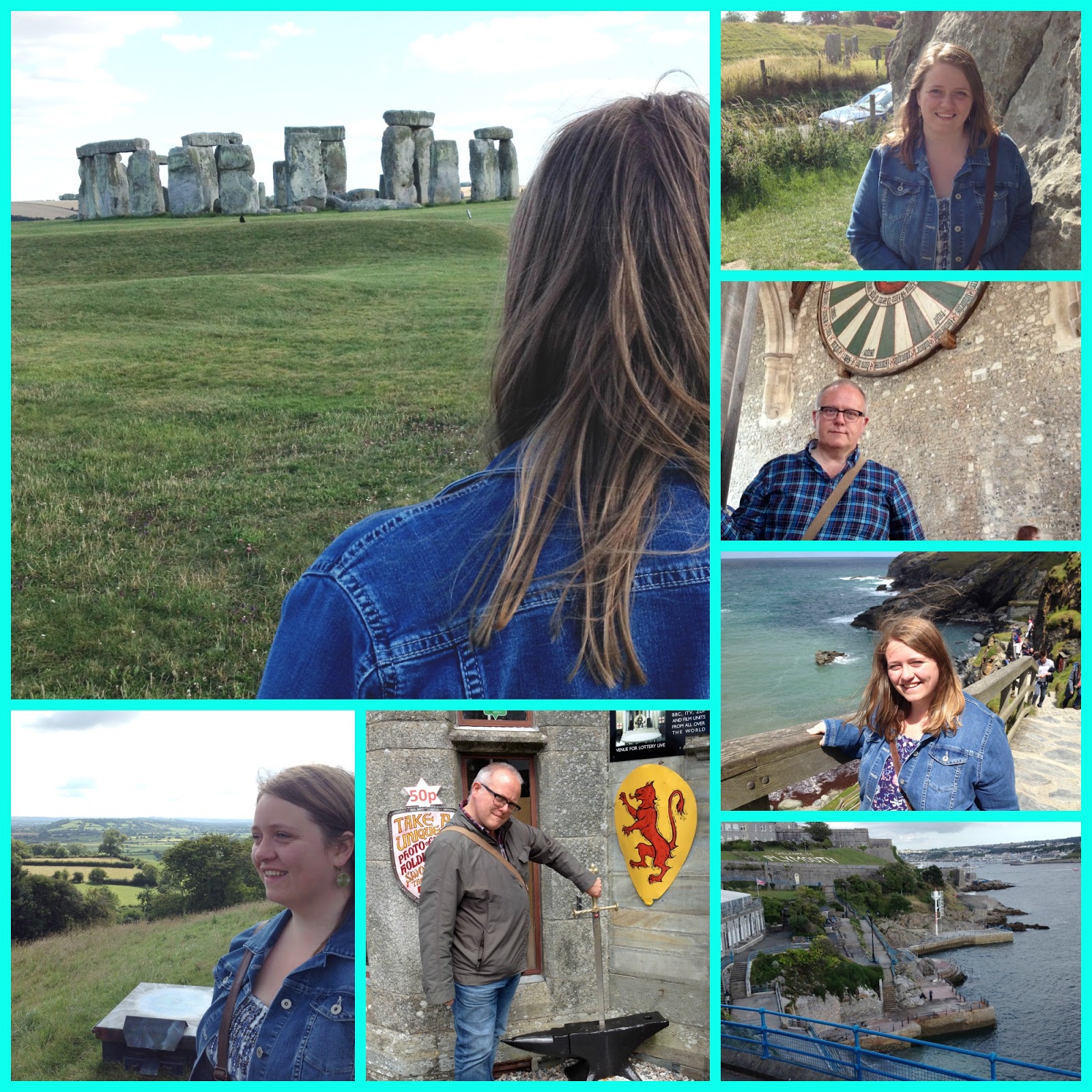
Whereas Harriet has absorbed some of my sense of the absurd and delight in the oddities of the English Language, Emily has inherited my love of history, fantasy, myths and legends. So it was that father and eldest daughter embarked on an Arthurian road trip last summer. I pretended it was a birthday present for Emily but really it was a personal pilgrimage to places I had longed to visit myself. And Emily humoured me. (And the sun shone, the plans worked out and we had a wonderful trip - full of sights and sounds that still linger in my imagination.)
Welcome to Plymouth....
“And I unto the sea from whence I came….”(Montague in Henry VI Part Three)
We began in Plymouth – by the sea – where we hired a car and met up with one of Emily’s university friends at the remarkable gin distillery. I wandered over the Hoe, admired Smeaton’s Lighthouse and imagined Sir Francis Drake’s pre-Armada game of bowls. A fitting beginning for the Odyssey ahead. Next stop Tintagel.
Views of Plymouth

Wednesday, 17 February 2016

Bring Me Sunshine

Morecambe and the Midland Hotel
The late great Eric Morecambe took his stage name from the town of Morecambe and I’m sure there are thousands of people who have posed by Graham Ibbetson’s statue of Eric since the Queen unveiled it in 1999. Last week Sally and I went away for the first time on our own since October 2014 when family illness and then bereavement and subsequent early retirements changed the trajectories of our lives. What better place than Bradford-on-Sea (as Morecambe used to be called because of the holidaymakers who flocked there from the textile mills in Bradford)? Morecambe now seems to be a faded seaside town but with an atmospheric stone jetty and a fantastic promenade which you can walk along to Heysham and visit the weird stone coffins on the cliff top by St Patrick’s Chapel. We got an internet deal and stayed for two nights in the elegant Midland Hotel, a restored Art Deco place which is full of quirks but plenty of treats.
Midland Hotel in Morecambe
Bring me sunshine in your smile
Bring me laughter all the while
In this world where we live
There should be more happiness
So much joy you can give
To each brand new bright tomorrow
Blustery Weather and February Sunsets
Make me happy through the years
Never bring me any tears
Let your arms be as warm
As the sun from up above
Bring me fun, bring me sunshine, bring me love
Pour down thy weather
Taking a February break by the English seaside is of course guaranteed to blow away cobwebs, both literal and metaphorical. But as a nation I think the English are pretty skilled at “wrapping up warm” and, as Shakespeare’s King John points out,
So foul a sky clears not without a storm:
Pour down thy weather!
After the storm comes clearer sky. Weathering a storm is part of life’s fabric. Day follows night. Spring follows Winter. And on the way back from Morecambe we took a detour to gawp at the astonishing Ribblehead Viaduct….
Ribblehead Viaduct

Saturday, 13 December 2014

I shall lose my life for want of language

The Renaissance 
Just as the visual arts in Italy gave Europe a High Renaissance 1490 to 1530, so England produced a Language Flowering 1580 to 1625 during the reigns of Elizabeth I and James I. This period turned the remnants of Middle English into Early Modern English and the wordsmiths were fed hungrily and fed each other with a kaleidoscope of utterances as a result of:
  • the expansion of printing
  • the import from abroad of goods, ideas and foreign phrases
  • the agitations and traumas of the religious and parliamentary schisms
It was essential, as Warwick advises Henry IV, that
                             ....to gain the language
‘Tis needful that the most immodest word
Be looked upon and learn’t

Influences on Language in Jacobethan times
Shakespeare’s contemporaries
Hugh Craig in the Shakespeare Quarterly Spring 2011 reported admirable computer-based research on a good number of Shakespeare’s fellow writers to compare how many unique words they used. Guess what? Shakespeare didn’t come first! Does this diminish him? Not in my book. It just shows in what an extraordinary linguistic cauldron he was living. Shakespeare came SEVENTH!  After Webster, Dekker, Peele, Marlowe, Jonson and Greene. Shakespeare’s vocabulary numbers are often quoted as HIGHER simply because of the VOLUME of work he produced. But if you only count the average numbers of UNIQUE words, then Shakespeare is by no means top.
Marlowe, Webster, Dekker, Peele, Jonson and Greene
How crucial was a university education? (Not a lot!)
Not only that, but the snobs who deride Shakespeare’s authorship because he didn’t go to university should be flabbergasted to know that John Webster, the most linguistically able of the Jacobethan playwrights  didn’t go to university either. He was a coach-maker’s son. Ben Jonson, prisoner, mercenary and bricklayer as well as playwright, who teased Shakespeare about his classical learning, also never made it to university. Going to university (then and now) was no guarantee of linguistic ability, talent or common sense.
Commemorative stamps: Tennant, Sher, Oyelowo, Scofield, Kestleman, Annis, McKellen
Greater than the sum
Aristotle’s Metphysica contains the concept that the Whole is Greater than the Sum of its Parts. That’s the way I feel about Shakespeare. Knowing that he didn’t go to university, knowing that he suffered family tragedy, knowing that he got tangled up in financial disputes, knowing that he nicked a lot of his material, knowing that some bits of his work are vulgar or rubbish, knowing that he didn’t use as many unique words as six other writers at the time – all these factors make him more culpably human. Or should I say admirably human? Or vulnerably human? Or disgustingly human? Or splendidly human? Or just human? His soundscapes and landscapes seduce me and inspire me. Because if nothing else his work shows the many sides of everything it is to be human.
He was “not of an age but for all time!”
Ben Jonson’s words (in the subheading above) in the Preface to the First Folio speak truth. Parolles in All's Well That Ends Well says “I shall lose my life for want of language.” I say I don’t know how my life would be without Master Shakespeare. After my family and friends, he is the greatest love of my life. Sad, maybe, but true.

Saturday, 22 November 2014

You Taught Me Language....

To Infinity and Beyond - quick number summary

With 200 words – you can survive (toddler language)
With 850 words – you can thrive (competent 8 year old)
2000 words – the total used by the average modern-day Jill or Joe (teenager base words)
With 4000 words – the Janet or John who reads will function successfully (educated teenager base words)
12,000 to 17,000 words – the number of base words used regularly by a modern adult with average intelligence
25,000 words – popular writers with numerous works
50,000 to 75,000 words – ALL the words known by a modern adult including all the plurals, negatives, derivations, declensions and conjugations (for example counting "is," "was" and "wasn't" as well as "be") [Some of these words will never be spoken but they will be understood when seen or heard in context.]

28,829 words....
My big reveal is that Shakespeare in fact used FEWER words than the number known and understood by many educated modern adults. He used over 65,000 words (compared to 75,000 for the highest ranking modern person) if you count all variations. With the help of computer technology, we now know he used 28,829 unique word forms and 12,493 of those words forms occur only once.  Interestingly, the top 100 most frequently occurring words (the same 100 words back in Jacobethan times as in modern times) make up 53.9% of his entire output.  Put another way, 50% of Shakespeare's work is made up of language used by the average modern 2 year old.
Not such a hot shot linguist then?
Anti-Stratfordians sometimes argue that Shakespeare’s lack of a university education is evidence that the son of a glover and a brewer descended from farming stock in the Midlands could not write the works in the First Folio.  But as I have demonstrated above, around 50% of his work is very simple, basic English.


Saturday, 15 November 2014

I shall remember this bold language

Superhero-use of vocabulary

In the television series Heroes one of the characters in Season One says “you don’t have to have superpowers to be a hero.” Why is Shakespeare a hero of mine? Well, apart from
  • the income generated for the country by Shakespeare tourism and culture
  • the endless types of characters and plots he created that scriptwriters and other artists are still inspired by 
  • the vast numbers and the scope of the themes in his plays and
  • the memorable words and phrases he recorded
I'm also in awe of My Boy Bill’s superhero-use of vocabulary.

From 200 to 4,000 spoken words

A child between the ages of 2 and 3 rapidly picks up about 200 words to survive and thrive when speaking. 850 is the widely-agreed number of words in Basic English – the number that all native speakers have been shown to be able to recognize, use and understand. A less-educated rarely-reading adult eventually speaks between 2000 words and 4000 words, depending on the type of reading they do (this number is of base words, not declensions, conjugations and variations.)


If you count reading and writing, the numbers go up: 50,000 and counting

A native adult can recognize about 12,000 base words and a regular reader will take pleasure in being able to use about 17,000 words. If you count all the derivations of base words the numbers known and understood goes up to 50,000 but not all of these are actively used in either writing or speech. (Camp is a base word but it doubles if you count the noun and the verb and then quadruples if you count the subtle differences between different meanings; using “camp” to mean an iron age fort is not so familiar a noun as the verb “to camp” meaning to put a tent up and stay in it for a bit….! And as for the meanings of “camp” associated with flamboyant cultural excess, well you can see the complications of counting vocabulary use….)  

Shakespeare did not understand a Freudian slip (although they appear in his plays)

David Crystal suggests 50,000 to 75,000 is the kind of number an educated, native, 21st century reader of English would know and understand (even if they didn't use most of them.) Many of those words, of course, are based on inventions, substances, concepts and neologisms created since Shakespeare’s death in 1616. We can forgive Shakespeare if he would not recognize the words iPod or lycra or Watergate/Plebgate or Pluto (as a planet – or dwarf planet – or minor planet – even new nouns shift meaning on a daily basis.)  
David and Ben Crystal's fine book

Academic word counting

Computer technology has now allowed researchers to track with some accuracy the vocabulary in the works of different writers around the world. Average writers in any language in any era notch up around 20,000 to 25,000 words – and they are the ones who produce popular and extensive catalogues of work. Shakespeare’s total vocabulary is not actually as impressive and extensive as many people think - it's not the number of words he used that mattered - it's HOW and WHY he used them the way he did that makes him a hero to me.


Friday, 1 August 2014

I Will Survive


Relief, Fear, Uncertainty
A grim start to a new blog? But Relief, Fear and Uncertainty are my initial feelings now that I’m retired.
At first I was afraid
I was petrified

How can I survive without a full-time job? Particularly such a busy, all-consuming job? Teaching for the best part of 32 years…. In Manchester, in London, in Winchester, in Helsinki, in Stratford-upon-Avon, in Retford, in Sheffield, in Leek, in Keighley, in Wakefield, in Leeds, in Bingley and for the last 14 years at Bradford Grammar School, a large coeducational independent school, where I was Head of English and Drama.
The Likes Of Us, my final "big" school production
Retirement

    ….tis our fast intent
To shake all cares and business from our age
Conferring them on younger strengths, while we
Unburdened crawl towards lie-ins, reading and going to the cinema in the afternoon, writing for fun, puzzling over jigsaws, walking on canal towpaths, the Yorkshire moors and dales on weekdays, focusing on health, booking holidays in school term times…. Working at living instead of living at work.
Ripeness Is All
Was it the right time to leave?
There is a tide in the affairs of men, which,
Taken at the flood, leads on to fortune….
Was this the right time? This blog may partially answer that question. Life is in an unusual place at the moment. I’ve been commuting most weekends from Bradford to Dorking where my family is temporarily renting a flat.
The Temple on the Nower in Dorking
Life In A School
I will miss the working life in school: the buzz, the buildings, the banter – but most of all the people. Working in a collegiate atmosphere with people who, by and large, have the same values and aims - colleagues who have compassion, enjoy a sense of absurdity and teach their specialist subjects with depth and detail. Colleagues whose goal is to inspire teenagers, those infuriating, bizarre semi-adult beasts, creatures full of the future, full of unpredictable fun, full of hormonal bullshit.
Rat Trap an original musical I directed at Leek Westwood High School in my first teaching job
Life As A Teacher
Every day contained dozens - probably hundreds - of interactions; some interactions were like performances, some quick and intense, some combative and unsettling, some giddyingly silly; but all were involving and immediate. Will I Survive without timetables, schemes of work, planning, delivering, evaluating, monitoring, assessing, reviewing, planning, delivering, evaluating, monitoring, assessing, reviewing, planning…. And so it goes on, deadline after deadline, day after day, week after week, term after term…. But never the same in my subjects (English and Drama) and never the same because of the endless parade of humans…. Teachers, Support Staff, Students…. A cavalcade of teeming humanity.
Mikey Lord leading These are the days of our lives at Bradford Grammar School We Will Rock You
What Next?
So the aims of this blog are for me to reflect on retirement, practise writing skills and comment on whatever crops up in the moment of writing.  The only binding constant will be the words of William Shakespeare, which I expect to crop up frequently; the Complete Works of Shakespeare (and everything that surrounds those Works) are my hobby and have been for a very long time. Anyone who enjoys spotting quotations (the clues are in the labels below each blog), feel free to reveal which words belong to which play. I expect there will be no obvious “narrative arc” – just a diary of whatever crops up in my retired life. My dream is to live in retirement as a “writer” and my first step is to begin this blog and aim for five posts a month by August 2016 (I’m giving myself two years to get into the swing of it….) As the Marvel-lous Stan Lee often says…. Excelsior!