Showing posts with label Bible. Show all posts

Saturday, 29 August 2020

The bridge from Strasbourg to Kehl

Rainbows, bridges of dreams.... they get everywhere.... a perfect synthesis of science and imagination....
John Hume, Peace Negotiator
I regularly get drawn into an absorbing project, abandoning myself in the merciless whirlpool of the siren call of knowledge and thought…. Last week I reproduced a shortened version of John Hume’s thoughts about DIFFERENCE being “an accident of birth.” During the week I’ve read as much as I could find about the man and reproduce at the bottom of this post a longer extract from his Nobel Prize acceptance speech (which explains the title of this week’s blog and connects the personal to the political.) But I’ll get there via the words of another historical figure who said some stuff that is still, 2000 years later, as radical as they come.
An eye for an eye leaves everyone blind
The saying in the subheading above (An eye for an eye leaves everyone blind) was a favourite quotation of the late John Hume which he attributed to Dr Martin Luther King Jr, though many have suggested it was a Gandhi quotation.  My research reveals that Louis Fischer, the American journalist and author, used the phrase twice in books mentioning Gandhi but never claimed the peace protestor said them. The origin of the phrase is first recorded in Jewish scripture and it concerned legal arguments, but it became more well-known via the Old Testament’s An eye for an eye, a tooth for a tooth in the books of both Exodus and Leviticus.  Jesus, however, knocked the Old Covenant’s concept for six in the Gospel of Matthew (chapter 5), with a typically challenging and subversive set of suggestions:
Turn the other cheek
38 “You have heard that it was said, ‘Eye for eye, and tooth for tooth.’ 39 But I tell you, do not resist an evil person. If anyone slaps you on the right cheek, turn to them the other cheek also. 40 And if anyone wants to sue you and take your shirt, hand over your coat as well. 41 If anyone forces you to go one mile, go with them two miles. 42 Give to the one who asks you, and do not turn away from the one who wants to borrow from you.
Love your Enemies
43 “You have heard that it was said, ‘Love your neighbor and hate your enemy.’ 44 But I tell you, love your enemies and pray for those who persecute you, 45 that you may be children of your Father in heaven. He causes his sun to rise on the evil and the good and sends rain on the righteous and the unrighteous. 46 If you love those who love you, what reward will you get? Are not even the tax collectors doing that? 47 And if you greet only your own people, what are you doing more than others? Do not even pagans do that? 48 Be perfect, therefore, as your heavenly Father is perfect.
Standing on the bridge…. (John Hume Nobel Prize Speech)
In my own work for peace, I was very strongly inspired by my European experience. I always tell this story, and I do so because it is so simple yet so profound and so applicable to conflict resolution anywhere in the world. On my first visit to Strasbourg in 1979 as a member of the European Parliament, I went for a walk across the bridge from Strasbourg to Kehl. Strasbourg is in France. Kehl is in Germany. They are very close.

I stopped in the middle of the bridge and I meditated. There is Germany. There is France.
If I had stood on this bridge 30 years ago after the end of the second world war when 25 million people lay dead across our continent for the second time in this century and if I had said: “Don't worry. In 30 years’ time we will all be together in a new Europe, our conflicts and wars will be ended and we will be working together in our common interests”, I would have been sent to a psychiatrist.

But it has happened and it is now clear that European Union is the best example in the history of the world of conflict resolution and it is the duty of everyone, particularly those who live in areas of conflict to study how it was done and to apply its principles to their own conflict resolution.
All conflict is about difference, whether the difference is race, religion or nationality. The European visionaries decided that difference is not a threat, difference is natural. Difference is of the essence of humanity. Difference is an accident of birth and it should therefore never be the source of hatred or conflict. The answer to difference is to respect it. Therein lies a most fundamental principle of peace – respect for diversity.

The peoples of Europe then created institutions which respected their diversity – a Council of Ministers, the European Commission and the European Parliament – but allowed them to work together in their common and substantial economic interest. They spilt their sweat and not their blood and by doing so broke down the barriers of distrust of centuries and the new Europe has evolved and is still evolving, based on agreement and respect for difference.
The UK is about to be a former member of, in the words of John Hume, "the best example in the history of the world of conflict resolution." Time will tell if it's a price worth paying....

Tuesday, 29 August 2017

Dance for me

The art world responds to the story of the dancing princess
Playwright in prison
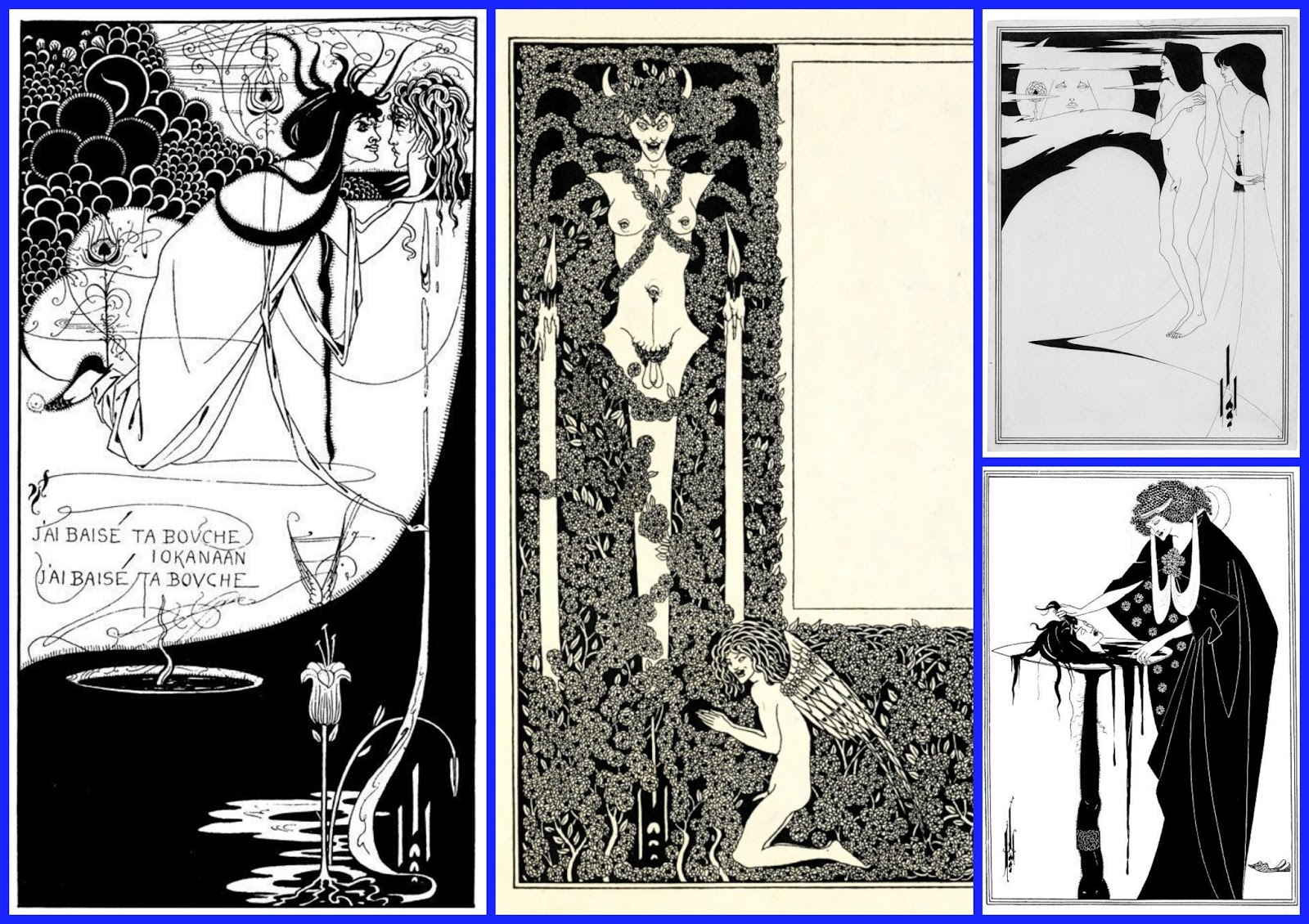
On 11th February 1896, at the Comédie-Parisienne in Paris, Oscar Wilde’s play of the Biblical story of Salomé received its premiere. Rehearsals for an earlier production had begun in 1892 starring the famous celebrity actress, Sarah Bernhardt, but the London production was banned, supposedly because the Lord Chamberlain (the censor of the day) decided that it was blasphemous to portray Biblical characters on the stage. By the time the play was staged in Paris, Wilde had been imprisoned as a result of a series of tragic miscalculations and the fervid homophobia of late Victorian Establishment.
Aubrey Beardsley's original illustrations include Wilde in the moon (top right)

What the Bible says (Mark Ch 6: 14 – 28)
John the Baptist has been raised from the dead, and that is why miraculous powers are at work in him.”
15 Others said, “He is Elijah.” And still others claimed, “He is a prophet, like one of the prophets of long ago.”
16 But when Herod heard this, he said, “John, whom I beheaded, has been raised from the dead!”
17 For Herod himself had given orders to have John arrested, and he had him bound and put in prison. He did this because of Herodias, his brother Philip’s wife, whom he had married.
18 For John had been saying to Herod, “It is not lawful for you to have your brother’s wife.”
19 So Herodias nursed a grudge against John and wanted to kill him. But she was not able to,
20 because Herod feared John and protected him, knowing him to be a righteous and holy man. When Herod heard John, he was greatly puzzled; yet he liked to listen to him.
21 Finally the opportune time came. On his birthday Herod gave a banquet for his high officials and military commanders and the leading men of Galilee.
22 When the daughter of Herodias came in and danced, she pleased Herod and his dinner guests. The king said to the girl, “Ask me for anything you want, and I’ll give it to you.”
23 And he promised her with an oath, “Whatever you ask I will give you, up to half my kingdom.”
24 She went out and said to her mother, “What shall I ask for?” “The head of John the Baptist,” she answered.
25 At once the girl hurried in to the king with the request: “I want you to give me right now the head of John the Baptist on a platter.”
26 The king was greatly distressed, but because of his oaths and his dinner guests, he did not want to refuse her. 27 So he immediately sent an executioner with orders to bring John’s head. The man went, beheaded John in the prison,
28 and brought back his head on a platter. He presented it to the girl, and she gave it to her mother.
Images copyright RSC taken by Isaac James. Actors: Matthew Tennyson, Ilan Evans, Jon Tranchard, Christopher Middleton, Simon Yadoo, Bally Gill, Johnson Willis, Assad Saman, Andro Cowperthwaite, Ben Hall

Influences and imaginative transformation
In crafting the play, Wilde:
  • takes the text (above) from the Gospel of Mark and the shorter version in Matthew’s Gospel;
  • considers the many classical paintings of the scene by da Vinci, Moreau, Rubens and Titian among others (rejecting some and admiring others);
  • and, like Shakespeare, steals phrases and rhythms from a number of other writings (Scheffauer, J C Heywood, Flaubert, Huysmans, Maeterlinck) and even
  • his own brother, Wiliam Wilde, who wrote a poem about Salomé in Trinity College magazine, in 1878.
What he does, though, is transform the story into something strange and ritualistic. The language is fluid and poetic, hypnotic and surprising. Salomé, in Wilde’s play, isn’t persuaded by her mother to demand the head of Iokanaan (John the Baptist), (as occurs in the Bible) but makes her own decision to do so and is explicit in Wilde’s play that she hasn’t consulted her mother. Thus Wilde’s Salomé is breaking free, growing up, upsetting authority, dancing on her own terms….
Isaac James photographs. Actors: Assad Zaman, Matthew Tennyson, Gavin Fowler, Suzanne Burden and Company
Owen Horsley’s production
It at first glance seems perverse to give a female role to a male actor in a 2017 Roman plays season at the RSC, given the few numbers of (textually) female roles available in Antony and Cleopatra, Coriolanus, Julius Caesar and Titus Andronicus. But the decision absolutely works in the context of the rest of the production’s design and, in my opinion, gave Wilde’s play a frisson of repressed/unrequited/ambiguous/burgeoning love and sexuality that was wonderfully apt in this year of the 50th anniversary of the partial decriminalisation of gay (male) sex. Matthew Tennyson played Salomé with delicately eye-popping rage; he alternated between naïve expressions of desire, determined ferocity and intricate vulnerability. Standing up to his dementedly incestuous stepfather, Herod, played with lascivious cowardly torment by Matthew Pidgeon, Salomé was a heroic and tragic figure who struggled to know how to express her/his love. Circling them both was the accusatory Herodias played by Suzanne Burden with flamboyant gusto (often appealing to the audience directly and inviting us to judge what we were seeing.)
Isaac James photographs. Actors: Ilan Evans, Matthew Tennyson, Gavin Fowler, Matthew Pidgeon, Ben Hall, Bally Gill, Jon Trenchard, Christopher Middleton, Miles Mitchell, Andro Cowperthwaite, Robert Ginty, Byron Mondahl, Johnson Willis, Simon Yadoo

Total theatre
The moon hung over this beautifully-lit and evocatively-costumed production, literally and imaginatively as the Roman soldiers, the Jewish and non-Jewish revellers and the Roman ambassador were all mystified about how to respond to both the dancing princess and the muscular prophet, Iokanaan (John the Baptist played by Gavin Fowler), emerging from his cistern beneath the stage smeared in dirt and booming out his intense warnings. The executioner, played by Ilan Evans, got to belt out the songs of Perfume Genius, an artist I didn’t know before this production but whose anthemic, heavily-percussive music seemed to fit the awesome, longing, desperate, romantic atmosphere of this theatrical presentation of the pangs of transgressive love.
Variations of the play: film, opera, Berkoff's adaptation

Saturday, 4 February 2017

Walling in and walling out

Walls: walling in or walling out or falling down or being pulled down?
Walls, walls, walls
Walls protect, yes, but walls are also forbidding barriers, and they can form a prison, and they can be a symbol of loneliness or isolation. Blank walls staring out have been used over centuries to depict intractability as well as inertia. Shirley Valentine talked to the kitchen wall in her domestic solitude, Pink Floyd sang about Another Brick In The Wall, Achilles chased Hector three times around the walls of Troy, Joshua marched around the walls of Jericho and then brought them a-tumbling down with shouts and rams’ horns. As Robert Frost wrote:
Before I built a wall I’d ask to know
What I was walling in or walling out,
And to whom I was like to give offense.
Pink Floyd, Jericho walls, walls of Troy, Shirley Valentine
Gentles, perchance you wonder at this show….
Quince: This man with lime and rough-cast doth present
Wall, that vile Wall which did these lovers sunder;
And through Wall’s chink, poor souls, they are content
To whisper….
Tom Snout plays Wall in Shakespeare's A Midsummer Night's Dream
Sinister cranny
Wall: In this same interlude it doth befall
That I, one Snout by name, present a Wall;
And such a Wall, as I would have you think,
That had in it a crannied hole or chink,
Through which the lovers, Pyramus and Thisbe,
Did whisper often, very secretly.
This loam, this rough-cast and this stone doth show
That I am that same Wall; the truth is so:
And this the cranny is, right and sinister,
Through which the fearful lovers are to whisper….
Cursed be thy stones
Pyramus: O grim-look'd night! O night with hue so black!
O night, which ever art when day is not!
O night, O night! alack, alack, alack,
I fear my Thisbe’s promise is forgot!
And thou, O Wall, O sweet, O lovely Wall,
That stand'st between her father's ground and mine!
Thou Wall, O Wall, O sweet and lovely Wall,
Show me thy chink, to blink through with mine eye!
Thanks, courteous Wall: Jove shield thee well for this!
But what see I? No Thisbe do I see.
O wicked Wall, through whom I see no bliss!
Cursed be thy stones for thus deceiving me….
Human Rights March in Leeds in response to President Trump's policies - proud of Sally, Harriet, Maggie and Christine and all the rest who attended
This vile Wall
Thisbe: O Wall, full often hast thou heard my moans,
For parting my fair Pyramus and me!
My cherry lips have often kiss'd thy stones*,
Thy stones with lime and hair knit up in thee…. 
Pyramus: O kiss me through the hole of this vile Wall!
Thisbe: I kiss the wall's hole, not your lips at all.
*Stones, of course, are Elizabethan slang for balls/knackers/testicles and – hole – well, the precise hole being kissed depends on which chink the actor playing Snout offers up…. 

Many American landscapes are awe-inspiring; countless aspects of American culture are having a positive influence on the world; and I know and love people in America:

  • Inspiring world figures like Mohammed Ali, Neil Armstrong, Walt Disney, Thomas Edison, Albert Einstein, Henry Ford, Dr Martin Luther King Jr, Rosa Parks;
  • Novelists like Harper Lee, Kerry Madden, John Steinbeck, Anne Tyler;
  • Playwrights like Edward Albee, Lillian Hellman, Tony Kushner, Arthur Miller, Eugene O’Neill, Sam Shepherd, Tennessee Williams;
  • Poets like Maya Angelou, Elizabeth Bishop, ee cummings, Emily Dickinson, TS Eliot, Sylvia Plath, Ezra Pound; 
these are, dare I say it, tremendous people, without thinking too hard about who to include, not to even begin mentioning singers and actors…. Tom Hanks, Katherine Hepburn, Elvis Presley and Aretha Franklin, for heavens’ sake, to name but four…! Is this a country that needs a Wall? A country whose current manifestation and wealth has been created from immigration? When birds fly around the globe, do they see borders?

Mending Wall

Genius satirical banners in the UK courtesy of The Poke
Robert Frost’s celebrated (American) poem Mending Wall was first published in 1914, right on the brink of the First World War. I haven’t seen it printed yet in the context of President Trump’s policies so here it is. “Good fences make good neighbours” is what the neighbour in the poem repeats (twice) but the poem has a tension that pulls away from that cliché and more potent are other lines that are repeated: “Something there is that doesn’t love a wall.”
Thanks to The Poke
Brief personal thoughts on Mending Wall
In Spring, two neigbours walk the wall between their properties to make repairs – is there a reason for this wall to be built at all? There are no cows, just apple trees and pine trees. Should you summon “spells” to counteract “elves,” a whimsical idea that suggests wall-building is an ancient, outdated ritual, not suited to modern thinking. Maybe the act of building a wall is a chance to talk about boundaries, to talk about customs on either side of the wall, to negotiate why the wall is there. Could a wall be built as a sign of goodwill, mutual trust and cooperation? Or is the wall an act of aggression, a hostile barrier to community? If you place a boulder (a stone, a “loaf,” a ball) into the wall, one day it will fall down. Walls fall down. Sometimes they are pulled down. Has any wall ever “stood the test of time?” How jubilant the world was when the Berlin wall was brought a-tumbling down! We build walls, even when they are not needed. Some people break walls, even when they shouldn’t. The world carries on building walls regardless of whether or not they are effective. Like all great poems, all these ideas are wrapped up in the distilled metaphor of Frost’s Mending Wall.
Mending Wall by Robert Frost
Something there is that doesn’t love a wall,
That sends the frozen-ground-swell under it
And spills the upper boulders in the sun,
And makes gaps even two can pass abreast.
The work of hunters is another thing:
I have come after them and made repair
Where they have left not one stone on a stone,
But they would have the rabbit out of hiding,
To please the yelping dogs. The gaps I mean,
No one has seen them made or heard them made,
But at spring mending-time we find them there.
I let my neighbor know beyond the hill;
And on a day we meet to walk the line
And set the wall between us once again.
We keep the wall between us as we go.
To each the boulders that have fallen to each.
And some are loaves and some so nearly balls
We have to use a spell to make them balance:
“Stay where you are until our backs are turned!”
We wear our fingers rough with handling them.
Oh, just another kind of outdoor game,
One on a side. It comes to little more:
There where it is we do not need the wall:
He is all pine and I am apple orchard.
My apple trees will never get across
And eat the cones under his pines, I tell him.
He only says, “Good fences make good neighbors.”
Spring is the mischief in me, and I wonder
If I could put a notion in his head:
“Why do they make good neighbors? Isn’t it
Where there are cows? But here there are no cows.
Before I built a wall I’d ask to know
What I was walling in or walling out,
And to whom I was like to give offense.
Something there is that doesn’t love a wall,
That wants it down.” I could say “Elves” to him,
But it’s not elves exactly, and I’d rather
He said it for himself. I see him there,
Bringing a stone grasped firmly by the top
In each hand, like an old-stone savage armed.
He moves in darkness as it seems to me,
Not of woods only and the shade of trees.
He will not go behind his father’s saying,
And he likes having thought of it so well
He says again, “Good fences make good neighbors.”
Like an old-stone savage armed/He moves in darkness
Good fences make good neighbours! Do they? Do they REALLY, though? Something there is that doesn’t love a wall.

Saturday, 10 December 2016

FOOM (Friends Of Ol' Marvel)

The Marvel Comics' Universe and the current film line-up of The Avengers
Oh, Mum, what did you do?
We all have childhood memories that we think leave a long-lasting effect. My brother and I were distraught when we came home from school one day to find my Mum had had a clear-out and decided to get rid of a huge pile of original Marvel comics…. Now, of course, they would probably be worth a fortune. So I credit that event with two things:
  • my loyalty to the Marvel brand and
  • my reluctance to throw anything away.
The genius of Marvel Comics’s Stan Lee was that he drew on the 1960s developing pop-psychology to present to teenagers a compelling escapist fantasy of legendary wish fulfilment. The comics spoke directly and emotionally to fans who felt marginalised, like Peter Parker in Spiderman. Stan Lee even addressed the reader from within the stories, asides just like in Shakespearean comedy. Stan Lee seemed like a childhood friend, so it’s a great joy to see him pop up in Marvel film cameos. I remember the first “club" I belonged to – Friends of Ol’ Marvel or FOOM – I wonder how many people, like me, kept hold of the club magazine….?
Arrested development?
How come I’m hooked on Shakespeare but I also love the X-Men, Spiderman, Thor, the Fantastic Four, the Silver Surfer and The Avengers? Is my development so arrested that I can’t distinguish between Quicksilver (in the X-Men) and Hamlet (in Hamlet)? Both Quicksilver and Hamlet have father issues…. And the underlying theme of the X-Men is the same as one of the strands in Hamlet – the outsider trying to:
  • fight for personal and political justice
  • work out his own destiny and
  • control the impulse to revenge….
Searching for father
Eclectic Tastes: The Bible, Shakespeare, Marvel….
Definition of Eclectic: not following one set of principles, ideas or systems but using many parts of different ones.

An eclectic person is someone with catholic, broad-ranging and all-inclusive tastes; someone who sees no difference between “high” culture and “popular” culture, “elegant” style and “vulgar” style. I think that’s me. I think I have eclectic tastes. Yes, I love Shakespeare, but I also love the Marvel Universe and will happily watch a superhero film the same day as reading Measure for Measure. As evidenced in the images below I think of Shakespeare as an action hero and I see nothing incongruous about Sacha Goldberger's outfits for a few of the Marvel characters. 

Reading is Reading is Reading
My appreciation of Marvel characters preceded my Mum’s notorious clearout of old comics. You see, no-one, throughout my childhood, ever told me what to read or watch. Nothing was ever censored. Picking up an encyclopedia or The Bible or The Complete Works of Shakespeare or Butler's Lives of Saints (the books on the shelf next to my Dad's chair) - they all felt the same, to me, as picking up the latest edition of Fantastic or Terrific or The Mighty World of Marvel (the UK versions of Marvel comics.) (Click the links on the titles for a trip down memory lane if you remember these comics.) I’m glad I have eclectic tastes. There are so many more things to enjoy…. Excelsior!
 

Saturday, 20 August 2016

To every thing there is a season

The author choosing between champagne and water and dreaming of the new and the old in his imaginary landscape.
Two years into Retirement
It’s coming up to two years since I retired from teaching and since April I’ve been increasingly getting into writing as my prime retirement hobby. I’ve written dialogue and many shorter prose exercises, some for competitions and some for my eyes only, and I’ve also kept this public blog going for two years as a way of disciplining myself to meet deadlines (I now try to publish blog entries five times a month!) Since August 1st 2016, though, one particular writing project has been dominant such that my “domestic Tuesdays” (see Wasted time….) are becoming writing Tuesdays, as are all other working days. Sally is becoming Domestic Goddess to give me the luxury of trying to commit an idea I’ve had to paper. The germs of the idea were planted a long long time ago. But it’ll be a long journey before any of it is seen outside the immediate family….
Skipton Castle: inspiration for one of the locations in my magnum opus
Cul de sacs, red herrings and acres of detritus
I think it was Thomas Edison who first coined the notion that worthwhile inventions come from 1% inspiration and 99% perspiration. I’m beginning to understand that at first hand now. The experience of writing is a turbulent glide over a meadow where you suddenly slip in mud, feel like you’ve twisted your brain’s sense-muscles but set off again, determined and eager before getting knocked over by cannonballs of embarrassment, picking yourself up and immediately becoming the Gold-Medal-Winning Olympic Champion of the Sport of Writing before falling down a pothole made of marshmallow and liquid treacle toffee. Wings on your heels and a stink bomb up your nose. And woe betide you stop and read what you’ve written with anything like objectivity. Painful. But then the main idea, the spark – the flash – the concept that got you started niggles at you, pleads with you, begs you and you return to the whole mystifying shebang with cockeyed optimism. Fun. Weird fun. Keeps me from causing mischief in the streets.
Life Advice

From The Bible’s Ecclesiastes Chapter Three
To every thing there is a season
and a time for every activity under the heavens:
a time to be born and a time to die,
a time to plant and a time to uproot,
a time to kill and a time to heal,
a time to tear down and a time to build up,
a time to weep and a time to laugh,
a time to mourn and a time to dance,
a time to scatter stones and a time to gather them,
a time to embrace and a time to refrain from embracing,
a time to search and a time to lose,
a time to keep and a time to cast away,
a time to tear and a time to mend,
a time to be silent and a time to speak,
a time to love and a time to hate,
a time for war and a time for peace.
Time to get on
with telling the story of Raydan’s Rhenium Tales which has plot(s), characters, themes, settings (maps), and needs a coherent style. Question: where will that come from I wonder? Answer: more perspiration…. 

Saturday, 26 December 2015

Year of the Flood

Natural disasters in the UK
There have been pandemic diseases that killed over a million people throughout the UK (the Black Death in the 14th Century, for example); over 225,000 people died of Spanish Flu in the UK alone in 1918/19; there was a Hurricane in Southern England in 1703 that killed around 15,000 people and what was probably a Tsunami in the Bristol Channel in 1607 that killed around 2,000 people. The UK has also experienced minor earthquakes, tornadoes, avalanches, landslips, famines, heatwaves and droughts. On our group of islands, though, we feel, on the whole, pretty happy with our climate.
Flooding
Floods are shocking, disturbing and disorientating, not to mention a bit disgusting in terms of the muddy debris and detritus that wraps around everything in the flood path. The biggest loss of life, so far, was in 1864 in the Great Sheffield Flood when 270 were killed. Two floods in the early 1950s (one in Lynmouth, Cornwall in August 1952 and one on Canvey Island in the Thames in January 1953) killed scores of people. But the frequency of floods in the UK since the Year 2000 has been increasing with the South West, Wales, Yorkshire and Cumbria being the worst affected in terms of damage and the need for extensive clean-up operations.
Sally and Harriet feeding the ducks in Roberts Park, Saltaire
Shipley in December 2015
Houses and businesses in Shipley where I live have been hit hard with one of my favourite pubs, the Boathouse suffering (not for the first time in its history) and houses in Baildon having to have rooftop rescues. Roberts Park was properly underwater for the first time in my memory as the River Aire burst its banks.
The Boathouse in Saltaire
Metaphorical floods
In addition to the historical reality of floods, many cultures and religions use flood-myths as part of their narratives: God wipes out the human race to start again – or nature rises up to cleanse the land. We talk about:
  • floods of tears
  • floods of complaints
  • flooding the room with light
  • floods of tourists
  • old fears and old memories come flooding back
  • flooded with emotions
Victoria Mills, Saltaire
Margaret Atwood named the middle part of her dystopian trilogy Year of the Flood.  The prequel is the heartbreaking Oryx and Crake and the final part is the mind-bending Maddaddam. I can’t praise these novels highly enough – hard to pinpoint why – maybe it just brought together so many of the things that have floated my flood-boat in the past – gender, sex, religion, politics, dreaming, storytelling, metaphorical gardening, bio-engineering, science-fiction, myths and legends – and Atwood wraps the story in mischievous language. Disaster is always round the corner – but so is love. Floods devastate, but also bring out the best in people.
Saltaire and Roberts Park during recent floods
What am I living for and what am I dying for are the same question.
….we must be a beacon of hope, because if you tell people there’s nothing they can do, they will do worse than nothing.
Happy New Year!
(from me and Margaret Atwood's Year of the Flood)
Most photographs by Harriet

Saturday, 12 September 2015

Provoking the Desire

Plenty of Henrys

Like Shakespeare’s Falstaff, another vivid image of an English drinker is Henry VIII. He was clearly a man of enormous appetites. He loved wine and ale, not to mention food, sport, music and women. There have been plenty of fictional Henry VIIIs apart from Shakespeare’s version in All Is True. Hilary Mantel created a vivid Henry in Wolf Hall and Bring Up The Bodies, as did Philippa Gregory in The Other Boleyn Girl. I also vividly remember Keith Michell in 1970 in the BBC’s The Six Wives of Henry VIII, Richard Burton in 1969 in Anne of the Thousand Days and Robert Shaw dueling with Paul Scofield as Thomas More in A Man for All Seasons in 1966.  Jonathan Rhys-Meyers in The Tudors, Sid James in Carry on Henry and Charles Laughton in The Private Life of Henry VIII have all made their mark in popular culture.
Richard Burton, Robert Shaw, Charles Laughton, Richard Griffiths, Nat Parker, Keith Michell, Damien Lewis


A few other vivid drinkers in Literature

Michael Henchard in Hardy’s The Mayor of Casterbridge starts the novel sozzled in Furmity (milk and raisins mixed with rum) – and then promptly sells his wife to a sailor, a startling beginning to a novel. Dick Diver in F Scott Fitzgerald’s Tender is the Night – starts as a successful playboy and ends in a drunken stupor. On stage Maggie and Brick in Tennessee Williams’s Cat on a Hot Tin Roof are earlier incarnations in their drinking battles of Martha and George from Albee’s Who’s Afraid of Virginia Woolf; both are memorable and sympathetic couples, in spite of their intoxication. Dickens created the unforgettable image in A Tale of Two Cities of the Parisians desperately lapping up spilled wine in the streets and even squeezing wine-soaked handkerchiefs into the mouths of infants, prefiguring the later puddles of guillotine blood. He also gave us the tragic Mrs Blackpool’s alcoholism in Hard Times and the comic Mrs Gamp’s gin-swilling in Martin Chuzzlewit.
Mrs Blackpool and Mrs Gamp

Days of dirty water

Where does the British love of alcohol come from? In medieval times alcohol was indispensible because safe drinking water was a rare commodity. If you lived near a source of fresh spring water you were lucky but most medieval folk (rich and poor alike) relied on:
  • home or locally-brewed concoctions of weak or strong wine 
  • mead (using honey or fruits)
  • cider (using different fruits) and
  • different kinds of ale or beer. Beer had many variations by the time of the guzzling Tudors and nicknames inevitably sprouted, for example: 
  • mad dog beer
  • dagger ale
  • tooth rot brew
  • dragon’s milk
  • double double beer (double double beer was eventually banned by Elizabeth I as it caused such riotous behaviour by all accounts; an early example of prohibition)

    Wine, women and song

Heavy drinking and drunken revelry is not a modern phenomenon: there are references to bacchanalian orgies of drinking in classical Greece and Rome; we know that the Chinese developed rice wines in ancient dynasties; the Vikings enjoyed pouring horns of plenty into their gullets; and even Noah in the Bible inspired artistic depictions of his fall from grace after too much celebration following the appearance of the rainbow.

The First Hangover (Genesis 18 – 24)

Noah’s sons Shem, Ham, and Japeth came out of the ark…. and from them the whole earth was populated. Noah, a farmer, made a new start and planted a vineyard. He drank too much of the wine, became drunk, took off his clothes and lay down in the middle of his tent. Ham, Canaan’s father, walked into the tent and saw his father’s genitals and told his two brothers who were outside. Shem and Japeth took a large robe, threw it over their shoulders, walked backward, and covered their naked father without looking at him because they turned away. When Noah sobered up from his wine, he discovered what his youngest son had seen...
The Drunkenness of Noah by Bernardo Cavalino

“It provokes the desire but takes away the performance….”

So spake the Porter in Macbeth.
“Drink, sir, is a great provoker of three things . . . nose-painting, sleep, and urine. Lechery, sir, it provokes, and unprovokes; it provokes the desire, but it takes away the performance.”
Times past and times present are not that different in terms of alcohol. It can lead to disaster, violence and death in some cases. It can also lead to happy times of great joy. On the one hand it’s a toxic, calorific, liver-destroying, addictive, hangover-provoking, sleep-disrupting activity that affects your judgement, perception and performance. On the other hand it can reduce stress, reveal truths, dilate blood vessels, promote socializing, improve the taste and digestion of meals, enhance friendship and lead to a more contented state of mind. I suppose you need to choose your drinking companions and moderate your intake. Then all will be well with the world. Cheers.


Saturday, 13 June 2015

Virgins and Whores, Feminist Men and the Dangers of Custard

Am I a feminist?

I started life as a son to a mother, a nephew to nine aunties and a grandson to a grandma. Soon I became a brother to a sister, an uncle to eight nieces and a friend to many female friends. In adult life I line-managed professional women and looked up myself to a great number of female bosses. Before long I became a husband to a wife and a father to daughters. You betcha I’m a feminist.

Masculinist

How could I not be? I’m a “masculinist” too, or whatever the word might be, and I’ll write about that in future. But equal opportunities starts with the greatest divide on the planet – the gender divide. In my retired dotage I can’t help but reflect that religion bears a massively significant responsibility for fostering unhealthy attitudes to women.

The Two Mary Syndrome

I grew up with the saintly image of a blue-clad Virgin Mary (the apotheosis of other scriptural heroines like Esther, Ruth, Abigail and Hannah) and a second image of a biblical not-so-virginal temptress (Jezebel, Delilah, Potiphar’s Wife, Bathsheba and Herodias – “bad girls” all – that reached their culmination in the New Testament’s Mary Magdalene.)
Abigail, Hannah, Mary, Mary M, Esther, Ruth, Jezebel, Potiphar's Wife and Delilah
During my feverish adolescent hormonal years, I therefore bounced between competing notions of Catholic femininity:
  • the ideal woman who was soft-focus, virginal, motherly and nurturing (Virgin Mary, Perfect “Mother”)  
  • the temptress woman who was alluring, sexy, mysterious and dangerous (Mary Magdalene, Forbidden Fruit)

Even as a child I knew it wasn’t so straightforward.  After all, bad-ass Virgin Mary squished snakes with her pretty feet on those otherwise demure statues – not an action I imagined I could do even now.  And Mary Magdalene got a starring role in the key event of the Resurrection – so she must have been exceptional for God to pick her to be the first witness to the Risen Christ.

Real Women

But the Two Mary Syndrome persisted in the way the media portrayed women: good girl or bad girl, virgin or whore – these ideas were planted long before I even knew what “virgin” or “whore” meant. Yet my own mother fulfilled neither stereotype and my younger sister seemed to be as complicated as the girls at school: brainy, ambitious, dynamic, sporty, courageous, funny, adaptable, independent, quirky, persistent, philosophical, witty, determined, tough, rational, emotional, modest, brash – I could keep going with the adjectives. In real life women and girls seemed to be more multi-faceted than the archetypes offered by the Two Mary Syndrome.

Eve

Wrestling with Original Sin has really messed up the Church’s ethos – not bad for a creation myth. How can we blame Eve for losing Paradise? Shouldn’t Adam’s spinelessness be equally condemned? And what about the initial blame being attached to sneaky Satan for offering the fruit in the first place? And God is hardly blameless for setting such a stupid test on the Seventh Day…. Why does Eve get the bad reputation when there were four protagonists in Eden – and three of them were ostensibly men?

Stupid boys, stupid girls

As a teacher I am proud I never let sexist comments from pupils go by. My usual line was to ask a teenage boy spouting offensive language to imagine how they would feel if someone was saying what they were saying about their own mother, sister or daughter. Girls of course can be equally culpable of attaching negative name-calling to other girls who transgress a conservative view of what a girl is allowed to say or do.

The Media

The Media (more than ever it seems to me) sells a very judgmental and discriminatory view of women: physical appearance, clothes and fashion accessories, wealth and style, education and opinion – all are used to mock, abuse and belittle women regularly in print, online, in the music industry, in advertising and marketing, on TV and in Film. Comparisons are often invidious (“before/after” shots, arrows pointing at cellulite and even Woman’s Own (OWN?) screaming on 11th May “Vanessa 2 STONE BIGGER Friends fear she’s drinking CUSTARD again.”)

Erotic Dancer, Supermum, Rescue Victim or Bestial Killer

The pressure can be horribly subtle: features by women aimed at women to “help” improve the quality of life tend to focus on how to look better, do better, be better – all geared up to produce hybrid Two Mary clones – the qualities of a saint but the attractiveness of a (classy?) sex worker. Sexualised dance routines in pop videos, capable Supermums in food advertising, movie characters that fall over and need rescuing. Why were Rudy Guede and Raffaele Sollecito allowed to “keep” their names in news coverage of the Meredith Kercher murder, but the female suspect had to be nicknamed “Foxy Knoxy”?

Where next for Feminism?

Being a feminist in the 1970s and 1980s was a badge of honour among young people but there seems to be an incomprehensible backlash against the word today. Luckily there are high-profile advocates reminding us of what is important. I thoroughly recommend clicking on this link to see Emma Watson’s full speech at the United Nations. As she says: “It is time that we all see gender as a spectrum instead of two sets of opposing ideals.” There are not “Two Marys” – there are millions of Marys, just as there are millions of “Marks.”