Showing posts with label Jesus. Show all posts

Saturday, 12 December 2020

Advent 2020

Countdown to Christmas
So muddy walks with family, jigsaw puzzles and posh takeaways continue to distract from Tier Three Restrictions. As do creative ways to meet up with longtime friends to catch up and Only Connect. It was easier this year to follow my instinct that Christmas fol-de-rol can only manifest on December 1st because lockdown meant that most shops were out of bounds and I’ve fine-tuned my ability to block out Christmas music in October and November…. Over the years, certain “traditions” mean that the Christmas countdown can begin: the Blue Peter Advent Crown (tinsel and wire coat hangers, anyone?), the decision about what day to choose (and who will decorate) a Christmas tree, the flutter of (fewer and fewer) Christmas cards through the letterbox (who will be first off the mark?), the slowing down of Autumn as Winter approaches and the military-style lists of “Things To Do” get gradually crossed off and, naturally, some form of Advent Calendar. Last Christmas Sue (in collage above) gifted us Advent Stockings and this year Sally secretly filled the Evens and I’m (naturally) Odd.
Out with the Old, In with the New
As Advent began, global miracles were occurring – yes, there’s the familiar….
  • the rising Star of Bethlehem/Comet
  • the approaching of the Three Wise Men/Kings/Astronomers
  • the glimpse of Shepherds counting their socks and heralding Angels
  • the longed-for arrival of a beloved baby in a Manger
But in the present-day, Advent 2020 heralds the start of a new world order with a few concrete miracles, in ascending order of importance….
  • a new Christmas special episode of Call The Midwife
  • the departure of some toxic staff from 10 Downing Street
  • the very-nearly-complete dismissal of the TanToxic TwitterChundering US President
  • the beginning of humanity’s vaccination FightBack against the Coronavirus – a triumph of international scientific collaboration 
– a sign of what the world can do with Wit, Wisdom, Will and Wherewithall....


Tuesday, 29 August 2017

Dance for me

The art world responds to the story of the dancing princess
Playwright in prison
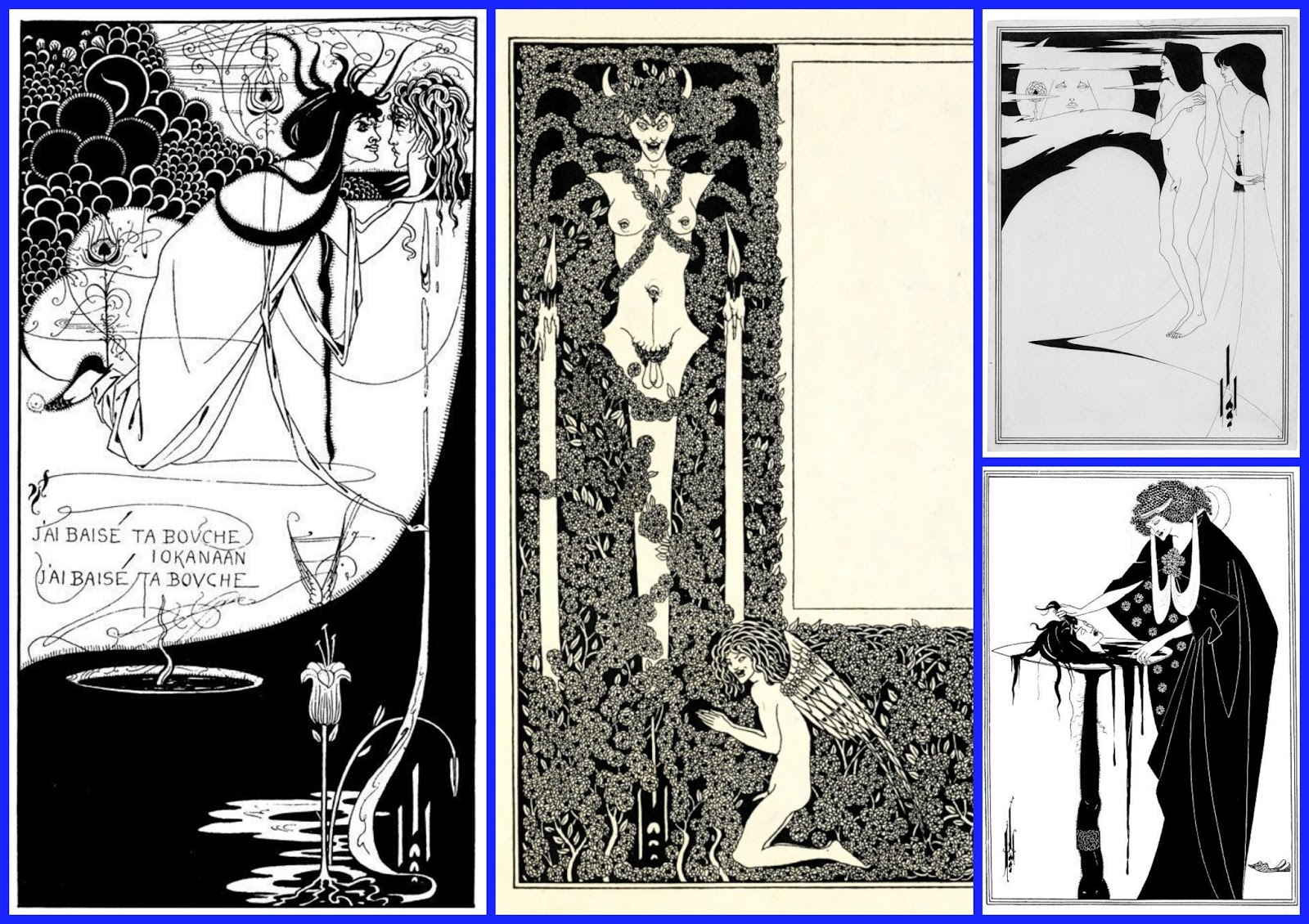
On 11th February 1896, at the Comédie-Parisienne in Paris, Oscar Wilde’s play of the Biblical story of Salomé received its premiere. Rehearsals for an earlier production had begun in 1892 starring the famous celebrity actress, Sarah Bernhardt, but the London production was banned, supposedly because the Lord Chamberlain (the censor of the day) decided that it was blasphemous to portray Biblical characters on the stage. By the time the play was staged in Paris, Wilde had been imprisoned as a result of a series of tragic miscalculations and the fervid homophobia of late Victorian Establishment.
Aubrey Beardsley's original illustrations include Wilde in the moon (top right)

What the Bible says (Mark Ch 6: 14 – 28)
John the Baptist has been raised from the dead, and that is why miraculous powers are at work in him.”
15 Others said, “He is Elijah.” And still others claimed, “He is a prophet, like one of the prophets of long ago.”
16 But when Herod heard this, he said, “John, whom I beheaded, has been raised from the dead!”
17 For Herod himself had given orders to have John arrested, and he had him bound and put in prison. He did this because of Herodias, his brother Philip’s wife, whom he had married.
18 For John had been saying to Herod, “It is not lawful for you to have your brother’s wife.”
19 So Herodias nursed a grudge against John and wanted to kill him. But she was not able to,
20 because Herod feared John and protected him, knowing him to be a righteous and holy man. When Herod heard John, he was greatly puzzled; yet he liked to listen to him.
21 Finally the opportune time came. On his birthday Herod gave a banquet for his high officials and military commanders and the leading men of Galilee.
22 When the daughter of Herodias came in and danced, she pleased Herod and his dinner guests. The king said to the girl, “Ask me for anything you want, and I’ll give it to you.”
23 And he promised her with an oath, “Whatever you ask I will give you, up to half my kingdom.”
24 She went out and said to her mother, “What shall I ask for?” “The head of John the Baptist,” she answered.
25 At once the girl hurried in to the king with the request: “I want you to give me right now the head of John the Baptist on a platter.”
26 The king was greatly distressed, but because of his oaths and his dinner guests, he did not want to refuse her. 27 So he immediately sent an executioner with orders to bring John’s head. The man went, beheaded John in the prison,
28 and brought back his head on a platter. He presented it to the girl, and she gave it to her mother.
Images copyright RSC taken by Isaac James. Actors: Matthew Tennyson, Ilan Evans, Jon Tranchard, Christopher Middleton, Simon Yadoo, Bally Gill, Johnson Willis, Assad Saman, Andro Cowperthwaite, Ben Hall

Influences and imaginative transformation
In crafting the play, Wilde:
  • takes the text (above) from the Gospel of Mark and the shorter version in Matthew’s Gospel;
  • considers the many classical paintings of the scene by da Vinci, Moreau, Rubens and Titian among others (rejecting some and admiring others);
  • and, like Shakespeare, steals phrases and rhythms from a number of other writings (Scheffauer, J C Heywood, Flaubert, Huysmans, Maeterlinck) and even
  • his own brother, Wiliam Wilde, who wrote a poem about Salomé in Trinity College magazine, in 1878.
What he does, though, is transform the story into something strange and ritualistic. The language is fluid and poetic, hypnotic and surprising. Salomé, in Wilde’s play, isn’t persuaded by her mother to demand the head of Iokanaan (John the Baptist), (as occurs in the Bible) but makes her own decision to do so and is explicit in Wilde’s play that she hasn’t consulted her mother. Thus Wilde’s Salomé is breaking free, growing up, upsetting authority, dancing on her own terms….
Isaac James photographs. Actors: Assad Zaman, Matthew Tennyson, Gavin Fowler, Suzanne Burden and Company
Owen Horsley’s production
It at first glance seems perverse to give a female role to a male actor in a 2017 Roman plays season at the RSC, given the few numbers of (textually) female roles available in Antony and Cleopatra, Coriolanus, Julius Caesar and Titus Andronicus. But the decision absolutely works in the context of the rest of the production’s design and, in my opinion, gave Wilde’s play a frisson of repressed/unrequited/ambiguous/burgeoning love and sexuality that was wonderfully apt in this year of the 50th anniversary of the partial decriminalisation of gay (male) sex. Matthew Tennyson played Salomé with delicately eye-popping rage; he alternated between naïve expressions of desire, determined ferocity and intricate vulnerability. Standing up to his dementedly incestuous stepfather, Herod, played with lascivious cowardly torment by Matthew Pidgeon, Salomé was a heroic and tragic figure who struggled to know how to express her/his love. Circling them both was the accusatory Herodias played by Suzanne Burden with flamboyant gusto (often appealing to the audience directly and inviting us to judge what we were seeing.)
Isaac James photographs. Actors: Ilan Evans, Matthew Tennyson, Gavin Fowler, Matthew Pidgeon, Ben Hall, Bally Gill, Jon Trenchard, Christopher Middleton, Miles Mitchell, Andro Cowperthwaite, Robert Ginty, Byron Mondahl, Johnson Willis, Simon Yadoo

Total theatre
The moon hung over this beautifully-lit and evocatively-costumed production, literally and imaginatively as the Roman soldiers, the Jewish and non-Jewish revellers and the Roman ambassador were all mystified about how to respond to both the dancing princess and the muscular prophet, Iokanaan (John the Baptist played by Gavin Fowler), emerging from his cistern beneath the stage smeared in dirt and booming out his intense warnings. The executioner, played by Ilan Evans, got to belt out the songs of Perfume Genius, an artist I didn’t know before this production but whose anthemic, heavily-percussive music seemed to fit the awesome, longing, desperate, romantic atmosphere of this theatrical presentation of the pangs of transgressive love.
Variations of the play: film, opera, Berkoff's adaptation

Saturday, 20 May 2017

Legend of the Sword

All things Camelot
I have blogged about King Arthur before (links at the bottom): not as many times as Shakespeare, but looking at the Label tally opposite, more often than Jesus. All things Camelot caught my imagination at a formative age and I am a sucker for lapping up Arthurian projects – not uncritically, I have to say. I was the perfect target audience for a recent book about Arthur as “dragon of the north” – yes, King Arthur from Yorkshire, count me in – but I found it unconvincing and tenuous. So, with a professional interest and a critical eye, I went to the cinema on my own to see King Arthur: Legend of the Sword, just in case it made me weep like a colicky baby. I wasn’t alone on Friday afternoon – one woman (who fell asleep in the middle) was there with a Charlie Hunnam lookalike (might have been him, I suppose); and the rest of the audience were individual men like me, looking like they spent too much time indoors reading….
Swords and Serpents….
My favourite thing in the film was Excalibur. Not just the prop, which was beautifully made, but the way Charlie Hunnam handled it, the way Guy Ritchie filmed it, its place in the story, its journey from the stone to battle to mud to water to more battles to various supernatural nuclear-Moana-goddess–Mordor-fire-Sauron-type explosions and ripples. It was a very busy sword. The script made me laugh – out loud twice. It looked excellent, as far as CGI films can. The spin on the legend was intriguing, though I would have liked more agency from Annabelle Wallis’s Maggie, a potentially beguiling character, Poppy Delevingne’s Igraine and Nicola Wren’s Lucy. The one female character who wasn’t doomed, a Mage played by Àstrid Bergès-Frisbey, certainly made her presence felt as an acolyte of (the unseen) Merlin. From my understanding of Arthurian Romance, Guy Ritchie was tapping into Welsh interpretations of Arthur as a hero who battled demons and giant serpents, although in this film, Arthur has his own serpent thing going on.
More please
I believe Guy Ritchie was hoping to use this film to launch a series of Arthurian films and, after seeing this one, I’d sign up for another in the hope that he’ll build in more scenes in the future for his daughters to enjoy. I loved the design angle that Ye Olde Londinium still had plenty of Roman ruins in evidence. And Daniel Pemberton’s score was a rumpy-pumpy blast.
  • Charlie Hunnam is a convincing reluctant hero, pulled up by his boot straps from his childhood as brothel orphan 
  • Djimon Hounsou is magnificently charismatic and noble as Sir Bedivere 
  • Aiden Gillen is always wry value as crack archer, Goosefat Bill (Bill?) 
  • Jude Law eats the scenery and swivels his eyes in demented villain mode 
  • Geoff Bell always gives great geezer, this time as someone called (I think) John 
  • Eric Bana is memorable as the ghost of old Hamlet (not quite, but if you see it you’ll know what I mean).
  • The small parts were sketched quickly and boldly: Kingsley Ben-Adir as Wet Stick, Tom Wu as George, Neil Maskell as Blue’s dad, Black Lack, David Beckham as (did they say Trigger?)
Overall it felt like a version of King Arthur that some mates down the pub might act out. (If they had a multi-million pound budget.) But it passed a rainy afternoon for this Arthurian geek quite nicely, thank you. PS, there was a very smart performance by young actor Bleu Landau as Blue.

Past blogs about King Arthur
Reading Arthurian Romance:
The Sword in the Stone
The Once and Future King
One Brief Shining Moment

Road trip with Emily to Arthurian sites:
Road to Avalon
Road to Glastonbury
Road to Stonehenge and Winchester 
Thanks, Mr Ritchie, for adding to the Arthurian canon

Saturday, 11 June 2016

The sea hath cast me on the rocks

What would Shakespeare do?

Some people use WWJD (What Would Jesus Do?) as a guide to life’s difficult questions. It is no surprise to my family and friends that my internal guru question is WWSD…. What would Shakespeare do? Would he vote to Remain in Europe or Brexit pursued by a bear?

What I have been I have forgot to know

Shakespeare’s writing always seems to empathise with castaways. A previous blog highlighted Thomas More’s appeal to the mob to embrace the migrant (click here to read.) Characters washing ashore in other lands feature throughout the plays: the Antipholus twins, their parents and the Dromio twins in The Comedy of Errors, Viola and Sebastian in Twelfth Night, Pericles and Thaisa in Pericles, Perdita in The Winter’s Tale, Prospero and Miranda in The Tempest. Shakespeare’s work is riddled with characters recovering from being adrift and cast out. Pericles, washing up on the shores of Pentapolis expresses how many migrants must feel:
Alas, the sea hath cast me on the rocks,
Wash’d me from shore to shore, and left me breath
Nothing to think on but ensuing death….
A man whom both the waters and the wind,
In that vast tennis-court, have made the ball
For them to play upon, entreats you pity him….
What I have been I have forgot to know

 European locations and European sources

Apart from setting his plays all around the Mediterranean (see map at the end of this blog – click here) Shakespeare also went to European writers to source his plays: Leo Africanus (Spanish Moroccan), Appian, Homer and Plutarch (Greek), Ariosto, Bandello, Boccaccio, Castiglione and Cinthio (Italian), Belleforest and Froissart (French), Montemayor (Spanish), Ovid, Plautus, Pliny the Elder and Seneca (Roman Italian.) Most of these were most likely in translations but it was clear the influence of Europe animated Shakespeare's writings. My head and heart tell me that if My Boy Bill could vote in the forthcoming EU referendum he would vote Remain.


Saturday, 19 March 2016

Road to Glastonbury

Glastonbury Tor
Climbing Glastonbury Tor felt to me like a pilgrimage. On the one hand there is a belief that King Arthur and his knights are buried beneath the hill (admittedly, only one of several locations throughout the UK.) On the other hand I was walking with my eldest daughter and I was reminded of Mat Johnson’s words in the novel Loving Day:
“A man's daughter is his heart. Just with feet, walking out in the world.”
The 360° view from the tower of St Michael’s was wonderful and the sky was dramatically blue and cloudy. The hill has an ancient history and has been agricultural, military and religious, as well as Celtic, Saxon and Christian. It could be a giant sacred labyrinth. It could be the gateway to the underworld kingdom of the Lord of the Wild Hunt, Gwynn ap Nud, who haunts the hills around Glastonbury. Whatever it has ever been, it is a rewarding hill to climb.
Lord of the Wild Hunt, Gwynn ap Nud
The Celtic name of the Tor was Ynys Wydryn or “The Isle of Glass” and later Britons called it Yns Yr Afalon or “The Isle of Avalon.” Although it might seem fanciful to imagine the hill as an island, myths are often founded on historical fact and archaeology has revealed that the Tor was at one time a peninsula surrounded by the large River Brue. In Neolithic times, it was almost completely surrounded by water because of the river’s course. Even now, the low-lying damp ground often produces a mist which floods the plain beneath the Tor, so that the Tor rises from the white smoke, eerily, like a spooky island. This mirage is called Fata Morgana named after King Arthur’s half-sister, the sorceress Morgan le Fey.
Glastonbury, whilst we were there, was hosting the 2015 Goddess Conference and passers-by were often dressed in robes, cloaks, tunics and ethereal fabrics. Even our lunch was hosted in a “slow food” café; the lunch was deliciously tasty but cooked and served by otherworldly beings in a Rivendell atmosphere. Visiting the Chalice Well was essential. Did Joseph of Aramathea wash the blood from the Holy Grail in the flowing waters there? Is the well head the source of the life force of Mother Earth? Is the Blood Spring only coloured the way it is because it travels through iron deposits in the hills above Glastonbury? Was there ever a more peaceful spot for contemplation?
Abbey Habit
And so to an afternoon at Glastonbury Abbey where monks apparently found the graves of Arthur and Guenevere in the Middle Ages. It was probably a tourist scam to increase the footfall (and hence the abbey coffers) but it was an atmospheric place to visit, not least because of the presence of the so-called Glastonbury Thorn – or a tree growing from a cutting from the original Thorn – that sprouted from where Joseph of Arimethea plunged his staff when visiting Glastonbury with the Holy Grail.
From the swirl of myths, legends and tourist artefacts in Glastonbury (an evocative place to visit, that’s for sure) the road trip continued by leaving Somerset and heading to Wiltshire for what turned out to be the place that (for me) had the most impact on our trip…. Stonehenge!


Saturday, 12 December 2015

Secret Santa

Alex in Wonderland....
Christmas and New Year
I think I might have broken free of the academic year cycle. Approaching this year’s season of good will, I have a definite sense that I am approaching the end of the year, a chance to reflect, look back and look forward. I spent the best part of 50 years thinking of September as the beginning of the year and August as the end of the year. From 1985 when I started teaching in secondary schools, the beginning of the year switched to A Level results day – usually the third Thursday in August – from that point on a new school/teaching/working year began…. But no longer. January is (for me now) the beginning of the New Year. I feel glad about that.
Christmas Dinner Number One: Joyce, Janet, Michael, Emily, Harriet, Sally
Secret Santa
Last weekend I had my first Christmas dinner courtesy of our friends in Badby. A log fire, great company, a trip to the Royal Shakespeare Company for Wendy and Peter Pan and Secret Santa presents (now half way through Srsly Hamlet and playing regularly, perhaps more than I should, with my wind-up toy of Shakespeare.)

My Secret Santa presents!
Origins of December 25th becoming Christmas Day
I’ve been reading quite a bit of Bernard Cornwell recently – borrowed from the library.  His Stonehenge and the trilogy about King Arthur, The Winter King, Enemy of God and Excalibur have been fascinating about the way early Christianity compromised with paganism in order to increase followers. Choosing December 25th as the Nativity of Jesus was a canny move on the part of the early church to get pagans on board. It happened to be the birthday of Mithras, the Indo-Persian-Roman Sun God (belief in whom stretched back to 1500BC and who had a virgin birth, recruited 12 disciples, was born in a manger, was wrapped in swaddling clothes and visited by shepherds, became a travelling preacher doing miracles, promoted baptism, had Sunday as a sacred day, was described as the “Way, the Truth and the Light of the World,” who ascended to heaven and who died to save the world.) December 25th was also near the winter solstice which had long been a time for Celts and Vikings to bring greenery into the house, to wander through fields and orchards singing songs (carols) to ward away evil spirits and guarantee a good harvest and burn (Old Norse) Yule logs on the fire to gather families and friends together. The date was also near Saturnalia, the Roman feast of gift-giving, candle-lighting, mistletoe-hanging (to promote fertility) and feasting. Even further back December 25th was also the birthdate of the Ancient Egyptian god, Horus.

Pretty pagan but no less wonderful for that.  Joyce off to Canons Ashby
So when was the historical Jesus born?
Historians use a number of factors to seek an accurate birth date for the historical preacher who became known as Jesus of Nazareth:
  • non-Christian historical evidence from Tacitus, Pliny the Younger, Josephus, the Babylonian Talmud, the Greek satirist Lucian 
  • the gospel accounts of the Nativity in Matthew and Luke
  • the reign of Emperor Augustus
  • the reign (and known death date) of Herod the Great
  • the census of Syrian governor Quirinius
  • the conception of John the Baptist (since there are records of his father Zacharias who was a temple priest
  • the likelihood of shepherds being on the hills watching their flocks on December 25th (nil likelihood)
  • the possibility that the star followed by the Magi was in fact an astronomical phenomenon. 
Dates suggested range from 12BC to 1AD, usually narrowed down to 6BC to 3BC and the months have been (most convincingly) suggested as May, June or September.  But I can’t see the Christian world ever changing the date of Christmas day any day soon…. But then again, I imagine the medieval world would never imagine a King of England would one day create a breakaway church because he wanted to get divorced. One teacher at my (Roman Catholic) primary school called the Church of England – “The Henry the Eighth Club” like it was a hobby rather than a religion….
Old Norse tradition or Victorian Germanic import? - it smells good!
Deck the halls with boughs of holly
Whatever the origins, I find it impossible not to enjoy the Christmas season, as long as I can avoid thinking about it before December 1st and as long as, at least once, I can watch White Christmas and, like Bing Crosby, count my blessings.


Saturday, 28 November 2015

Hey, Boo

Geoffrey Brindle, "Bradford Jesus" - photo and portrait by Gary Beck
I just like walking
Earlier this year, Geoffrey Brindle died. Not a famous man outside West Yorkshire, but he was a very distinctive man who invariably smiled, often waved, and when asked “Why do you live the way you do?” (ie walking the streets of Bradford in a cassock), he replied “I just like walking.” Geoffrey died in hospital in August 2015, having fallen at home. He was probably 88 years old. He has been called various names over the years – Bradford Jesus, the Jesus Man, the Mad Monk, the Bradford Monk, the Airedale Monk, the Bradford Hermit, Holy Joe, Moses, Happy Harry – but all the tributes to him in the local newspaper when he died were positive and came from around the world. And came from people of all faiths and from people of no faith.
Remember it’s a sin to kill a mockingbird….
Like Boo Radley in Harper Lee’s wonderful novel, Geoffrey Brindle shied away from the limelight. He was known to run away from journalists seeking interviews. He would never answer questions about himself directly. Rumours remained rumours: rumours about his extended family, rumours that he was escaping from a childhood trauma, or a rumour that shoe companies wanted to sponsor him, or rumours that he had magical healing powers or was a wizard! He remained mysterious because the only encounters anyone had with him involved him smiling warmly, being encouraging, giving time and attention….
Rumour doth double, like the voice and echo….*
(from Shakespeare’s Henry IV Part Two)
Did he meditate in a cave near Settle for 12 days in the 1960s having left his job in a factory? Did he have a wife and children? Was he born in Derbyshire? What were his motivations? There are many testaments to his willingness to talk to people, especially anyone who was upset or in trouble. Social workers in Bradford mention how helpful he was with families in distress. He would sit, drink tea, listen…. Why did he live the way he did?
Rumour is a pipe
Blown by surmises, jealousies, conjectures
And of so easy and so plain a stop
That the blunt monster with uncounted heads,
The still-discordant wavering multitude,
Can play upon it.

Small acts of kindness
My last blog celebrated unhistoric acts – and Geoffrey Brindle seemed to be one of those people. There is talk of naming a new street “Brindle Walk” – a fitting tribute to someone who was forever putting one foot in front of another come rain, come shine, come snow, come fog…. Why did he live a life so unencumbered by material goods? Why was he so generous with his smiles and waves? For at least 50 years in and around Bradford? Why Bradford? Somehow his life gives me hope. Persuades me that life-affirming people will endure. Reminds me that staying alive, living your life and walking the walk is what matters. RIP, Geoffrey. Smile and wave.

Saturday, 27 June 2015

Jesus the Feminist

Women in the Catholic Church

Ordaining women priests would be a way for the Catholic church to tackle the crisis of recruitment to the priesthood.  Women are often strong advocates of the values of church life; women are active agents in the organisation of church community events; women often lead the way in the Catholic education system (especially mothers in supporting school events) and what do the gospels show about the women in the early church?

Women were THERE

Women were present in key events throughout Jesus’s life, including being selected to be the first witnesses to the Resurrection. Given historical, community or spiritual perspectives, there are surely no sensible reasons for the Catholic authorities to put restrictions on what women are capable of.

It has happened and it happens anyway

In extremis, women have had priestly powers in the past: during times of plague, women were allowed to baptise, give the last rites and bury people (especially when the male priests were too afraid to enter a village.) “Emergency baptisms” by midwives were encouraged by the medieval church when a priest could not get to a dying baby in time. The Anglican church in the present time has fully embraced female vicars. Many other religions throughout human history have given women prominent roles in sacred rites: from Ancient Egyptian priestesses to modern day female rabbis.

Jesus was a feminist

Jesus’s treatment of women was radical: 

  • He ignored ritual impurity laws about menstruation (Mark Chapter 5 Verse 25)
  • He stated men and women should be treated equally in divorce (Mark Chapter 10 Verse 11)
  • He expressed compassionate concern for widows (Luke has six positive references to widows)
  • parables often have parallel male/female stories (see the stories starting at Luke 2:25, Luke 4:25, Luke 4:31, Luke 7:36, Luke 17:34)
  • He interacts with “sinful women” (Luke Chapter 7 Verse 37)
  • He accepted women in His inner circle (Luke Chapter 8, Verse 1)
  • He taught women contrary to the restrictions on female education (Luke Chapter 10 Verse 38)
  • He used equalizing language like “daughters of Abraham” (Luke Chapter 13 Verse 16)
  • He talked to foreign women (John Chapter 4 Verse 7)
  • and, to cap it all, the key event of Christianity shows the men running away from the Crucifixion (apart from John) or disbelieving the Resurrection but
  • the women are fully present at the death of Jesus and given the first sightings of the Risen Christ.


Paul at his worst

Much of what we have inherited of restrictive Christianity comes from the letters of Paul or the Old Testament. The words of Jesus are far more subversive and simple. And therefore challenging with their focus on love, forgiveness and mercy, traditionally feminine qualities. In Colm Tóibín’s Testament of Mary, Tóibín presents an authentic woman insisting on the truth, even though the gospel writers caring for her have “outstayed their welcome.” Mary confides that “Words matter” and she resists the attempts of her carers (interrogators? jailors?) to remember events in Jesus’s life that suit their own narrative. One of her minders, she complains, “is ready to scowl impatiently when the story I tell him does not stretch to whatever limits he has ordained.” Mary wants to tell the real story, “or else everything that happened will become a sweet story that will grow poisonous as bright berries that hang low on trees.” Paul, rabidly egotistical after his conversion on the Road to Damascus, I think, has been the seed-source of the poisonous berries in terms of the Catholic Church’s attitudes to women. Paul’s misogyny is so yesterday….
Hans Speckaert's Conversion of St Paul on the Road to Damascus

Paul at his best – 1 Corinthians Chapter 13

If I speak in the tongues of mortals and of angels, but do not have love, I am a noisy gong or a clanging cymbal. And if I have prophetic powers, and understand all mysteries and all knowledge, and if I have all faith, so as to remove mountains, but do not have love, I am nothing. If I give away all my possessions, and if I hand over my body so that I may boast, but do not have love, I gain nothing.

Love is patient; love is kind; love is not envious or boastful or arrogant or rude. It does not insist on its own way; it is not irritable or resentful; love does not rejoice in wrongdoing, but rejoices in the truth. Love bears all things, believes all things, hopes all things, endures all things.

Love never ends. But as for prophecies, they will come to an end; as for tongues, they will cease; as for knowledge, it will come to an end. For we know only in part, and we prophesy only in part; but when that which is perfect comes, the partial will come to an end.

When I was a child, I spoke like a child, I thought like a child, I reasoned like a child; but when I became an adult, I put away childish things. For now we see through a glass darkly, but we will then see face to face. Now I know only in part; then I will know fully, even as I have been fully known.

And now abideth faith, hope, and love, these three; and the greatest of these is love.


Saturday, 13 June 2015

Virgins and Whores, Feminist Men and the Dangers of Custard

Am I a feminist?

I started life as a son to a mother, a nephew to nine aunties and a grandson to a grandma. Soon I became a brother to a sister, an uncle to eight nieces and a friend to many female friends. In adult life I line-managed professional women and looked up myself to a great number of female bosses. Before long I became a husband to a wife and a father to daughters. You betcha I’m a feminist.

Masculinist

How could I not be? I’m a “masculinist” too, or whatever the word might be, and I’ll write about that in future. But equal opportunities starts with the greatest divide on the planet – the gender divide. In my retired dotage I can’t help but reflect that religion bears a massively significant responsibility for fostering unhealthy attitudes to women.

The Two Mary Syndrome

I grew up with the saintly image of a blue-clad Virgin Mary (the apotheosis of other scriptural heroines like Esther, Ruth, Abigail and Hannah) and a second image of a biblical not-so-virginal temptress (Jezebel, Delilah, Potiphar’s Wife, Bathsheba and Herodias – “bad girls” all – that reached their culmination in the New Testament’s Mary Magdalene.)
Abigail, Hannah, Mary, Mary M, Esther, Ruth, Jezebel, Potiphar's Wife and Delilah
During my feverish adolescent hormonal years, I therefore bounced between competing notions of Catholic femininity:
  • the ideal woman who was soft-focus, virginal, motherly and nurturing (Virgin Mary, Perfect “Mother”)  
  • the temptress woman who was alluring, sexy, mysterious and dangerous (Mary Magdalene, Forbidden Fruit)

Even as a child I knew it wasn’t so straightforward.  After all, bad-ass Virgin Mary squished snakes with her pretty feet on those otherwise demure statues – not an action I imagined I could do even now.  And Mary Magdalene got a starring role in the key event of the Resurrection – so she must have been exceptional for God to pick her to be the first witness to the Risen Christ.

Real Women

But the Two Mary Syndrome persisted in the way the media portrayed women: good girl or bad girl, virgin or whore – these ideas were planted long before I even knew what “virgin” or “whore” meant. Yet my own mother fulfilled neither stereotype and my younger sister seemed to be as complicated as the girls at school: brainy, ambitious, dynamic, sporty, courageous, funny, adaptable, independent, quirky, persistent, philosophical, witty, determined, tough, rational, emotional, modest, brash – I could keep going with the adjectives. In real life women and girls seemed to be more multi-faceted than the archetypes offered by the Two Mary Syndrome.

Eve

Wrestling with Original Sin has really messed up the Church’s ethos – not bad for a creation myth. How can we blame Eve for losing Paradise? Shouldn’t Adam’s spinelessness be equally condemned? And what about the initial blame being attached to sneaky Satan for offering the fruit in the first place? And God is hardly blameless for setting such a stupid test on the Seventh Day…. Why does Eve get the bad reputation when there were four protagonists in Eden – and three of them were ostensibly men?

Stupid boys, stupid girls

As a teacher I am proud I never let sexist comments from pupils go by. My usual line was to ask a teenage boy spouting offensive language to imagine how they would feel if someone was saying what they were saying about their own mother, sister or daughter. Girls of course can be equally culpable of attaching negative name-calling to other girls who transgress a conservative view of what a girl is allowed to say or do.

The Media

The Media (more than ever it seems to me) sells a very judgmental and discriminatory view of women: physical appearance, clothes and fashion accessories, wealth and style, education and opinion – all are used to mock, abuse and belittle women regularly in print, online, in the music industry, in advertising and marketing, on TV and in Film. Comparisons are often invidious (“before/after” shots, arrows pointing at cellulite and even Woman’s Own (OWN?) screaming on 11th May “Vanessa 2 STONE BIGGER Friends fear she’s drinking CUSTARD again.”)

Erotic Dancer, Supermum, Rescue Victim or Bestial Killer

The pressure can be horribly subtle: features by women aimed at women to “help” improve the quality of life tend to focus on how to look better, do better, be better – all geared up to produce hybrid Two Mary clones – the qualities of a saint but the attractiveness of a (classy?) sex worker. Sexualised dance routines in pop videos, capable Supermums in food advertising, movie characters that fall over and need rescuing. Why were Rudy Guede and Raffaele Sollecito allowed to “keep” their names in news coverage of the Meredith Kercher murder, but the female suspect had to be nicknamed “Foxy Knoxy”?

Where next for Feminism?

Being a feminist in the 1970s and 1980s was a badge of honour among young people but there seems to be an incomprehensible backlash against the word today. Luckily there are high-profile advocates reminding us of what is important. I thoroughly recommend clicking on this link to see Emma Watson’s full speech at the United Nations. As she says: “It is time that we all see gender as a spectrum instead of two sets of opposing ideals.” There are not “Two Marys” – there are millions of Marys, just as there are millions of “Marks.”