Showing posts with label Henry VI. Show all posts

Saturday, 27 February 2021

Talking Shakespeare Neljä (Four)

Dense, Juicy, Layered
David Oyelowo, speaking from Los Angeles, remembered a dusty (and intimidating) copy of Shakespeare’s plays in his family’s Islington council flat. He was later surprised to discover Kenneth Branagh’s film of Henry V was also written by Shakespeare, having watched it as a movie, not caring about the language. The real breakthrough for David, though, was seeing a live production at the National Theatre – the visceral production of Robert Lapage’s mudbath Midsummer Night’s Dream with Timothy Spall as Bottom. David started acting accidentally when he tried to impress a girl by joining a youth theatre and then standing in when another young actor couldn’t attend because of a tube strike. His Theatre Studies teacher, Jill Foster, encouraged him to consider acting as a profession and helped David audition (successfully) for LAMDA. His father fully expected him to “get it out of his system” when he was given small roles (seven lines in Antony and Cleopatra) at the Royal Shakespeare Company. But the bug had bitten and seeing someone like Mark Rylance in his fourth incarnation of Hamlet at The Globe deliver the language with “dexterity, musculariy and elasticity” further reinforced David’s conviction that Shakespeare is the “Everest of Acting… so dense, so juicy, so layered.” 
Greg Doran of the Royal Shakespeare Talking Shakespeare with David Oyelowo, Helen Mirren and Ian McKellen
Vulnerability and Frailty
He gave a very funny account of getting the role of Henry VI and loved “the journey” of his time on Michael Boyd’s production but became weary of the “pioneer” emphasis placed on him by the media wanting to interview him about being the first black actor at the RSC to play an English king. He detected a similarity between Dr Martin Luther King in the movie Selma and Henry VI where the abiding motivation for both characters, as he played them, was religious faith, leading to vulnerability and frailty. David felt that both MLK and Henry VI fully expected everyone around them to be imbued with the same values and were both destabilised when the. His other major Shakespeare role was playing Othello with Daniel Craig and Rachel Brosnahan (as Iago and Desdemona) in an intimate production in New York in 2015. Like Greg Doran, I hope he can be tempted away from Hollywood for more UK stage work in the future.
Selection of David Oyelowo roles: as Henry VI, Othello, Orlando in As You Like It and the movie Selma
Queen Helen
Helen Mirren is a multiple award winner: she has carried home an Oscar, a Tony and an Emmy and has famously played a line of queens: Queen Margaret in the Henry VI trilogy; and on TV and film: Catherine the Great, Elizabeth I and Elizabeth II. She also has the distinction of playing Cleopatra three times, first at the National Youth Theatre in 1963 and then later playing opposite Michael Gambon (1982) and Alan Rickman (1998) as her Antonys. I was lucky to see the 1982 Adrian Noble production (in The Other Place in Stratford-upon-Avon) and for me it became a benchmark production of how epic plays can be staged in small spaces. Helen’s early memories of working at the RSC include watching the generous Ian Richardson from the wings in Coriolanus.  She reminisced about working (warily) with the mercurial Nicol Williamson (on both stage and in the film Excalibur) and played Lady Anne, Julia in Two Gentlemen of Verona and Ophelia to Alan Howard’s Hamlet. She also vividly recounted the touring production of Troilus and Cressida which many argued brought the play back into favour in modern times and she described working with Peter Brook in the legendary project Conference of the Birds which toured the Saharan regions of Africa in 1979.
Helen Mirren as Cleopatra (three times), Cressida, Prospera in The Tempest and Rosalind in As You Like It
Sir Ian ("You shall not pass....")
Ian McKellen has had recent experience of remembering his distinguished acting career as part of his touring one-man show which raised considerable funds for small venues throughout the UK. (Tolkien, Shakespeare, Others and You.) With Greg Doran he shared early memories of seeing and loving theatre and getting involved in amateur and school productions. He always thought Shakespeare seemed fun and enjoyed travelling down from Bolton for school Shakespeare camps in Stratford-upon-Avon. He saw Laurence Olivier, Peggy Ashcroft and Charles Laughton in their prime (but also confessed to sleeping through Olivier’s Corialanus – it was a school trip, after all.) At Cambridge he joined the Marlowe Society and came under the influence of George Rylands who has mentored many of today’s great theatre directors as well as John Barton who persuaded young McKellen he could play the ancient Justice Shallow in Henry IV Part Two. He gave a moving account of working at Nottingham Playhouse with Tyrone Guthrie who gave McKellen confidence about becoming an actor and credits Maggie Smith with recommending him to Olivier to join the Old Vic. He was waspish about Franco Zefirelli and had insights into the impact of Olivier and of touring Shakespeare in the provinces and abroad with Prospect Theatre. I’ve seen many of his stage performances and been lucky to meet him both backstage after Waiting for Godot and at a UK showing of the film Gods and Monsters at Bradford’s Pictureville Cinema. Always gracious and always energetic, with a significant place in popular film history with his portrayals of Magneto and Gandalf, Sir Ian continues to be an astonishing creative force for good in the UK.
Ian McKellen as Romeo, Macbeth, Toby Belch in Twelfth Night (which I saw in Doncaster!), Coriolanus, Richard III, King Lear (twice) and Prospero in The Tempest at Leeds Playhouse


Saturday, 9 January 2021

Three Resolutions

The weasel in the garden
And 2021 has begun. I resolve to Keep Walking and Keep Creatively Visualising images like the one above and the one at the end of this post. And I Resolve to only check on the news once a day. Walk. Love. Limit the News. Walk. Love. Limit the News. Winter sun. Flurries of snow. Wintery frost. Lockdown Three Point Zero. Rising Covid cases, hospital admissions and deaths. As Reignier says in Henry VI Part One
Defer no time, delays have dangerous ends.
This is a Shakespearian line that should be tattooed onto the UK government’s eyeballs. For the best part of the last year, life-saving decisions have been slow, many have been contradictory and, from the week of Cummings-gate, have been interpreted to suit everyone’s own circumstances because that was the lesson learned from BoJo’s support of the weasel in the Rose Garden. Hopefully the newest campaign to take Covid seriously will make an impact and bring down cases. Time will tell.
The coward on the hill
The President of America, in the dying days of his reign of misinformation, vulgar speechifying and inconsistently perverse decision-making, has incited a crowd of his supporters to invade and riot in the Capitol building leaving (to date) 5 dead bodies, broken glass, stolen goods, vandalised furtniture, and a (future) string of court appearances and prison sentences Although Trump shouted “We’re going to walk down Pennsylvania Avenue…. I know everyone here will soon be marching over to the Capitol building…” he only meant a “royal we” and “everyone” didn’t include his own bloated orange self, so he sent his supporters into notoriety and infamy as he returned, I imagine, to put his feet up on a padded cushion in the White House and eat a cheeseburger and pretend he was innocent.
Cartoon by John Shakespeare for The Age
The rebel without a plan
As ever, something in Shakespeare nagged at me and I realised it was Jack Cade in Henry VI Part Two inveterately boasting and inciting a mob. Even though his promises to the angry and starving peasants are impossible, the promises are still effective at rabble-rousing the mob to march and, of course, many are killed.
Valiant I am…. I fear neither sword nor fire…. When I am king, as king I shall be…. I thank you good people…. I will make myself a knight…. Burn all the records of the realm…. My mouth shall be the parliament…. I must sweep the court clean of such filth as thou art…. Thou hast men about thee that usually talk of a noun and a verb…. Away with him – he speaks Latin!.... Take him away and behead him…. I’ll defy them all…. (Jack Cade in Henry VI Part Two)
Jack Cade's rebellion
The gardener with a pruning sword 
But Jack Cade’s life becomes (like Trump’s is likely to be), not a bang but a sad whimper away from the crowds. The witness to Cade’s death (indeed his unwitting executioner) realises who Jack Cade is as he dies and calls him “monstrous traitor” and ends the scene with a grim final action:
Hence I will drag thee headlong by the heels
Unto a dunghill which shall be thy grave….
Leaving thy trunk for crows to feed upon.
The identity of Jack Cade’s nemesis is – future High Sheriff of Kent in history, working class gardener in Shakespeare’s play – Alexander Iden – an English spelling of Eden…. Let’s hope 2021 becomes more of an Eden than 2020. Walk. Love. Limit the News. Walk. Love. Limit the News.
An Edenic Future Visualisation using snapshots of the past

Saturday, 19 December 2020

Talking Shakespeare Kaksi (Two)

Like a potter’s wheel (Coasters, Stockings and Nativities)

My thoughts are whirled like a potter’s wheel:
I know not where I am, nor what I do.

The valiant Talbot’s words in Henry VI Part One are a potent reflection of what my mind has felt like during 2020. At times, the effects of the pandemic (on me) have produced clarity, joy and hope but more often confusion, frustration and despair (the negative emotions mostly caused by the UK government, I have to say.) Time has seemed elastic so pre-Covid times feels like two months ago and also two years ago. 

  • Local walks continue on most days,
  • jigsaws keep the left brain/right brain synapses twanging,
  • freshly-baked mulled wine and mince pies have now been sampled and
  • posh takeaways from La Rue restaurant provide a once-a-week luxury oasis, providing a time to scrub down, dress up and light candles.
Whatever it takes to cope in this strangest of times…. In the collage below there is evidence that our Advent Stockings (from Sue) have continued to yield treasures at morning coffee time. You can also see the creative endeavours of our Badby friend, Alex Thompson, honorary daughter and sister to the Allard-Johnsons, who has used some of her time at least to design beautiful coasters. These are all evidence of “clarity, joy and hope” – as is the glimpse of an ambitious Nativity scene (see collage above) constructed in a neighbour’s garden, along with child-friendly story sheets telling of those days in May or September (likely) between 4 and 6 BC (probably) when a stable in Bethlehem became the centre of the universe. The centre of my imaginative universe at the moment is re-reading, re-listening to and re-watching Shakespeare plays – it stops my thoughts whirling and helps me avoid becoming frustrated by the news bulletins. I introduced the RSC Talking Shakespeare series in an earlier post (here). PS Kaksi is Finnish for Two so the information below is my record of the second “batch” I enjoyed.
Paterson Joseph and Sir Simon Russell Beale
  • Paterson Joseph almost became a chef before turning to acting. All of the interviewees were asked about their earliest introductions to the national poet and Paterson Joseph delivered a classic line that chimed with my own experience: “I didn’t come to Shakespeare – Shakespeare came to me.” I first “noticed” Joseph in 1990 as Oswald in King Lear, and suddenly realised – because of his performance – what a brilliant and significant role Oswald is. I was also lucky to see his shattering Othello (with the evillest Iago I’ve seen in Andy Serkis) at the Royal Exchange in Manchester. I loved Joseph’s Patroclus in Troilus and Cressida and, most jaw-droppingly, his tormented Brutus (pitted against Ray Fearon’s Mark Antony) in Julius Caesar. He didn’t talk about his many non-Shakespearean roles (including the recent Kamal Hadley in the BBC’s Noughts and Crosses and one of my favourites, his role in Survivors; plus on stage his compelling Atahualpa in Shaffer’s Royal Hunt of the Sun at the National Theatre) but then the point of the series is to talk about Shakespeare and I’ll never forget the Channel 4 documentary in which he directed a group of disaffected teenagers in London in a moving production of Romeo and Juliet.
  • Simon Russell Beale first exploded into my theatrical knowledge in a series of Restoration plays at the Royal Shakespeare Company playing gut-wrenching comic grotesques with painful vulnerabilities. He has spoken to the RSC Summer School a couple of times and it became obvious that comedy was not his only skill. Seeing him in Ghosts and The Seagull made it clear that he was “one of the greats.” He extracted every moment of impact from his appearances as Edgar in King Lear and his Thersites in Troilus and Cressida was truly disgusting. Then as a toad-like Richard III, an extremely strange Ariel in The Tempest and (at the Donmar) a heart-breakingly buttoned-up, pinched and pained Malvolio from Twelfth Night it became clear he could tackle anything Shakespeare wrote with clarity, intelligence and heart. He triumphed at the National with Benedick in Much Ado About Nothing and Hamlet and surprised (inevitably) with his Cassius in Julius Caesar and Macbeth at the Almeida. I thought he was tremendous as Leontes in The Winter’s Tale at the Old Vic but it was his Timon in Timon of Athens at the National (and broadcast to cinemas) that blew me away, reinventing the play anew as a Play for Today in these no-such-thing-as-society Thatcherite times. Of course he’s done Falstaff on TV (a more vicious one than usual) and (brilliantly) King Lear himself at the National. But his Prospero, on his return to the RSC, in a multimedia Tempest was a revelation – here was a guilty Prospero, as tormented as Ariel and Caliban, struggling to forgive himself never mind anyone else and finally breaking the audience’s hearts as he parted from the island.
Paterson Joseph in Julius Caesar, Othello, Noughts and Crosses, Royal Hunt of the Sun, Simon Russell Beale in The Tempest (as both Ariel and Prospero), The Winter's Tale, Twelfth Night, Hamlet, Troilus and Cressida (with Paterson Joseph), Juliet Stevenson in Measure for Measure, As You Like It, Truly Madly Deeply, Troilus and Cressida, Antony Sher in King Lear (as both The Fool and King Lear), Falstaff and Richard III
Juliet Stevenson and Sir Antony Sher
  • Juliet Stevenson confided that she peed on stage during a spear-carrier scene (alongside Ruby Wax) in her first appearance at the RSC in a production of The Tempest. She paid tribute to early mentors in her acting career (well known like Peter Brook and less well known like David Perry) – sometimes by saying or doing things that she reacted against. Her insights into language and space were marvellous to hear as she discussed in detail her approach to Isabella in Measure for Measure, Cressida in Troilus and Cressida and Rosalind in As You Like It. The season in which she played the latter two roles was a significant one for me as I was living in Stratford-upon-Avon during that year teaching English as a Foreign Language to groups of adults who I would accompany to the theatre so I saw those two productions a great number of times, each time spotting more and more depth and detail, especially in Stevenson’s performances. Of course in later years I got to know her screen work such as Truly, Madly, Deeply and Life Story in which she played Rosalind Franklin, the scientist who contributed to the discovery of the structure of DNA.
  • (Sir) Antony Sher, one of the most powerful presences I’ve seen on stage in plays like Tartuffe and Tamburlaine the Great, had a plethora of breakthrough roles to discuss, not to mention aspects of his own biography (growing up a Lithuanian-Jew in South Africa, being gay and working at the Liverpool Playhouse.) His famous Richard III (on crutches with a prosthetic back), Shylock (in Merchant of Venice), Titus Andronicus (in a production which started in South Africa where audiences were unsurprised by the anarchic violence in the play which was given a contemporary political context), Leontes in The Winter’s Tale (where he researched and brilliantly portrayed the psychological condition of morbid jealousy), and the warrior-like Macbeth, in a Swan production that he and Harriet Walter infused with a palpable and terrifying sense of panic - all these performances were memorable and mesmerising. In recent years he famously portrayed Falstaff with equal doses of bonhomie and arrogant cruelty in the History sequence of Henry IV and a monumental King Lear arriving on an elevated wheely-throne.
Greg Doran Talking Shakespeare with Paterson Joseph, Simon Russell Beale, Antony Sher and Juliet Stevenson


Saturday, 2 June 2018

Here at the palace I will rest awhile

Afternoon tea and a shock for George III
En route to Salisbury Cathedral (see previous blog) and before the ecstasy of Stonehenge (following blog) we rested for afternoon tea at Blenheim Palace. As you do. Apart from the glory of the treat, we had a guided tour round the State Rooms, a virtual tour round a weird “Untold Story” with ghostly projections giving a flavour of Blenheim’s history (and in fact on the return journey we stopped again to peer into the Duke’s rooms.) At times like these, I usually feel like Heathcliff must have felt staring into the windows of Thrushcross Grange, expecting at any moment to be thrashed and sent back to Wuthering Heights. At Blenheim the guides were in fact very welcoming, impressively knowledgeable and were able to motormouth through the chequered history of battles, wars, loveless marriages, tragic events, bitter legal disputes and architect tiffs that went into the creating of the only building in England called a Palace that’s neither royal nor connected to the church. Although the construction began during Queen Anne’s time, it was George III who cemented Blenheim’s reputation as being too big for its non-royal boots by gasping “We have nothing to equal this!”
"Be thine own palace, or the world’s thy jail"
In John Donne’s poem of witty poetical advice To Sir Henry Wotton he remarks that “Life is a voyage,” “Cities are sepulchres,” “Courts are theatres” and “The country is a desert” unless you can look within and “Be then thine own home.” No amount of luxury or power will satisfy your soul if you fail “to thine own self be true” as Shakespeare had Polonius say in Hamlet. Donne admires the snail who carries “his own house still, still is at home” and the fish who glide by “leaving no print where they pass.” Seeking fame or fortune means nothing without loved ones. I’m sometimes puzzled by my own politics of liking big houses and estates (and supporting the Monarchy as an institution 100%) – when I’m instinctively liberal and hate entitlement and the unfair distribution/hoarding of wealth by the few. Could it be that my “view within” (as E M Forster put it in A Room With A View) recognises that the “gorgeous palaces” can be seen as prisons, trapping those inside whose souls can never truly be free?

Sunday, 5 November 2017

Catherine and Guy


Catherine Wheel
It was a shock to learn at some point when I was a child that the whizzing firework of a Catherine Wheel was named after a saint who was imprisoned, tortured and finally martyred by being beheaded. At first the (male) authorities tried to “break” Catherine of Alexandria on a “breaking wheel” but, according to history/legend, the wheel shattered and pieces flew everywhere, hence the design of the firework in later years.
Margaret Clitherow
Saint Catherine was one of many characters parading through my brain at Primary School. Her strength of purpose was an inspiration, as was the pregnant St Margaret Clitherow who was stripped, laid on a large sharp rock and covered with the door of her own house. The door was then piled with an immense load of rocks until the sharp rock beneath broke her back…. can anybody really believe the past was the “good old days”?…. and I’m sorry to report that Margaret met her fate in one of my favourite cities, York.
Saints Margaret Clitherow, Joan of Arc, Teresa Benedicta of the Cross, Bernadette, Hilda of Whitby, Peter, Christopher, Anthony of Padua, Joseph, Sebastian, Francis of Assisi and books from my childhood: Butler's Lives of Saints

Saints on the brain
I’m prepared to admit that, as a young boy, I thought the sensational lives of the saints were fascinatingly gripping. In some cases the manner of their deaths lit an imaginative fire (fuelled by some statues and paintings in school and on church walls that at times revelled in the martyrdoms.) In other cases the humanitarian efforts of the saints, often in extreme poverty and violent opposition, left me awe-struck by their bravery and compassion. So, without too much agony, here are my top dozen saints, six women and six men who have become symbolic of particular ideas and impulses.
  • St Catherine of Alexandria (the Catherine wheel inspirer)
  • St Margaret Clitherow, the Yorkshire lass whose stubbornness killed her (would I have caved in? yes I would)
  • St Joan (of Arc) who features (as a villainess) in Shakespeare’s Henry VI Part One but is sensationally sympathetic in GB Shaw’s play Saint Joan and who received visions from both squashed Saint Margaret and firework-famous Saint Catherine. Joan inspired the French to raise the siege of Orleans and gain successes in the Hundred Years War against England but she was ultimately burned to death at the stake (with the agreement of both France and England as an act of political expediency)
  • St Teresa Benedicta of the Cross who faced her end in the gas chambers at Auschwitz
  • St Bernadette who faced bullying and disbelief in her home town of Lourdes when her chats with Mary the mother of Jesus were doubted, despite her ability to summon up rushing holy water springs that would help the town become a major tourist attraction
  • St Hilda (of Whitby) is admirable in my book because she was a phenomenally powerful figure in 7th Century Northumberland having started her life in France. Anyone who can run abbeys in Hartlepool and on the cliffs of Whitby has my respect
  • St Peter, the tragic cock-crowing denier, fated to be the first Pope but who paid a high price by being horrifically crucified upside down
  • St Christopher, the “Christ-bearer”, braved raging rivers to help travellers to safety
  • St Anthony of Padua, patron saint of lost items and lost people (and sometimes fish and fishermen) died peacefully but after a long period of hardship and poverty. He makes my list because I was named after him (without an ‘h’)
  • St Joseph, Jesus’s daddy, an excellent carpenter according to tradition and I always rooted for him because his son and the mother of his son (wife?) got far more attention than he did
  • St Sebastian, favourite of classical artists, riddled with arrows after disobeying his superiors in his role as captain of the Praetorian Guard (sadly the truth is that he was probably clubbed to death and dumped in the Roman sewers rather than shot with arrows but artists chose the latter image)
  • St Francis of Assisi, wolf-tamer, beloved of conservationists and the first true hippy
One person's terrorist is another's freedom fighter
Penny for the Guy
Bonfire Night was a time of private conflict for my childhood brain. Although I loved everything about the fire, the food, the fireworks, I felt uneasy about putting a “Guy” on top of the bonfire. My primary school taught me that Guy Fawkes wasn’t necessarily a gunpowder-toting terrorist. He could be seen as a freedom fighter, trying to restore the rights of Roman Catholics in England during the period of The Henry VIII Club. I don’t know which teacher taught me to call the Church of England The Henry VIII Club but it stuck with me, as did the political complications of an event like the Gunpowder Plot. What should people do if they think the world isn’t listening to them? Blow up parliament? Vote for Brexit? Elect Trump? Become a suicide bomber? Die a martyr? Like the saints? Was Guy Fawkes, in his way, following his beliefs to their logical conclusion, like St Catherine of Alexandria? I’ll think about both Saint Catherine and Guy Fawkes at tonight’s Bolton Abbey bonfire.

Saturday, 12 August 2017

The Great Garden at New Place

A place in inspiration, a place of rest
New Place (previous blog) is, for me, an emotional place to be. On the whole I think the development there has been an imaginative success. To me is seems to be a place of inspiration with its quirky nooks and the roofline of the Guild Chapel, with its ancient wall paintings, looming over it. It is also a place of rest, somewhere I imagine Shakespeare would have appreciated given the death of his only son, Hamnet, one year before Shakespeare bought New Place. The house would’ve, I imagine, signalled a new beginning, a new leaf, a new page, a new act.

William, Fulke and Hercules
The family who sold New Place to Shakespeare have a shady history. William Underhill who did the original sale to Shakespeare in 1597 died two months after the sale. History tells us Underhill Senior was poisoned by his son and heir, Fulke (why does no-one name their son Fulke any more?) History is less sure whether Fulke died of natural causes or was hanged for the murder, but it was Fulke’s younger brother, the flamboyantly named Hercules who confirmed all the paperwork to Shakespeare including the orchards behind the property which became known as The Great Garden.

The Great Garden at New Place
In my own “olden days” (1980s and 1990s) The Great Garden was my favourite place to sit in Stratford-upon-Avon. It used to have open access to the public and was a green oasis in the midst of the tourist bustle. Now you enter the garden as part of your (paid) entry to New Place but, in my opinion, it remains a lush and evocative oasis. It is still populated with the offspring of a mulberry tree from Shakespeare’s day and with the ashes of Peggy Ashcroft and with benches to sit and dream. But it now also has a marvellous tactile bronze sculpture trail by American Gregg Wyatt.

Family weddings
Both Shakespeare’s daughters lived with Anne and William in New Place until they were married:
  • Susanna, aged 24, to Dr John Hall on June 5th 1607
  • Judith, aged 31, to (“bad boy”) Thomas Quiney on February 10th 1616

And one man in his time plays many parts
Shakespeare is known in 2017 primarily as
a PLAYWRIGHT and ACTOR
In his own time he gained most cultural prestige as a writer of narrative poems and sonnets
a POET
But he had the most influence on his immediate contemporary world as
a SHAREHOLDER and THEATRE OWNER
a LANDLORD and LANDOWNER
a BUSINESSMAN and GENTLEMAN
(having bought a family coat of arms in 1596)
But visiting Stratford-upon-Avon as I do a few times each year and delving into the depths of the Shakespeare Birthplace Trust properties, the Shakespeare Institute and the work of the Royal Shakespeare Company, I never cease to learn something new about Shakespeare as
a SON and GRANDSON
a BROTHER
a SCHOOLBOY and TEENAGER
a LOVER and HUSBAND
a FATHER and GRANDFATHER
a RETIRED GENT

living and loving (and dreaming and writing) in New Place and its Great Garden until the day he died.

Saturday, 3 December 2016

The grand old Duke of York

City walls of York
The walls of York began as an earthen and wooden stockade surrounding Eboracum (the Roman name for York.) Stone sections were added during the Roman occupation of Britain and a few of these remnants are still visible. During the centuries of Anglo-Saxon and Viking York (Eoferwic and Jorvik) it is likely that the walls were patched up in places but generally left to the weather’s ravages as the city focused on Christianity and Trading. During medieval times, though, when York became the York we know today, the walls were enlarged and reinforced and it is mostly these walls that have been renovated enough to walk on when you visit the city in 2016.

Barley Hall

York has a formidable distinction of being a thriving contemporary city (with its forward-thinking EU Remain-voting populace.) It is also a place that exploits its past for the tourist pound, but in a mostly respectful (and academic) fashion. Barley Hall is a prime example of the potential for forging new economic possibilities from a building that was about to be demolished – until the archaeologists realised how much of the original medieval structure was still intact under the layers of additions and alterations. In a recent visit I enjoyed a vivid display of the costumes from the BBC’s adaptation of Hilary Mantell’s Wolf Hall. Even without the headline-displays Barley Hall is evocative of a distant past that, in some ways, reveals itself to be unnervingly similar to today, even though swans and peacocks rarely feature on 21st century dining tables.

O tiger’s heart wrapped in a woman’s hide!

I’ve always loved York since learning at a young age that the castle nearest my childhood home in Wakefield, Sandal Castle, was the site of the nursery rhyme
Oh, the grand old Duke of York!
He had 10,000 men.
He marched them up to the top of the hill
And he marched them down again….
Tragically, of course, the grand old Duke of York also had the blood of his son, Edmund, smeared over his face by Margaret of Anjou, the wife of Henry VI and effectively the commander of the Lancastrian army at Sandal Castle during the Wars of the Roses. To add further humiliation Margaret placed a mock paper crown on the Duke of York’s head before slaughtering him and removing his head to be hoisted on a pike above Micklegate Bar in the city of York. Is all that true? It’s not in the nursery rhyme, that’s for sure, but Shakespeare has it covered in Henry VI Part Three. Ah, the good old days….
Margaret of Anjou kills the Duke of York (in Shakespeare's version) at Sandal Castle, Wakefield

Saturday, 1 October 2016

Scotland's Game of Thrones

Soap opera, history lesson and universal themes
Twice this year, in Manchester and Newcastle, I enjoyed the National Theatre of Scotland’s epic trilogy of Rona Munro’s The James Plays. I love seeing a group of actors in a series of plays when individuals appear in small parts in one play and then emerge in a major part in another. This is one of the joys of seeing an acting ensemble perform Shakespeare’s History Cycle. The eight consecutive history plays of Shakespeare are a revelatory miracle when encountered in one fell swoop, but The James Plays are up there with the best “Shakesperean” experiences I’ve ever had.
A bit of everything
Like the greatest soap opera sagas, this “history lesson” contained it all: family love, family feuds, husbands and wives, parents and children, friendships, men, women, betrayal, loyalty, secrets, power, sex, government, nationalism, tribalism and a healthy dose of comedy.
James I: The Key Will Keep The Lock
It’s interesting that all the events depicted in The James Plays were happening during England’s War of the Roses. We met the future James I (a soulful and vulnerably funny Steven Miller) as a helpless prisoner of the English King Henry V. James II’s “homecoming” as King of the Scots proves dark and dangerous when the regents who have been “minding the throne” for him prove to be an ultra-violent bunch whose matriarch, Isabella (played attractively and frighteningly by Blythe Duff), is a she-wolf in the mould of Shakespeare’s Margaret of Anjou. Only the crafty Mudac (the charismatic John Stahl) manages to prevent all-out massacres; the Scottish clans were not impressed by James II’s ideas about collecting taxes for the royal household so political manouvering had to be devious as well as, eventually, brutal. The play also benefits from some joyous female perspectives between spirited Queen Joan (a funny and touching Rosemary Boyle) and her blunt companion Meg (Sally Reid.) Shakespeare’s histories suffer from the convention of all-male acting companies but Rona Munro in these plays gives the voices of women a significant presence.
James I - The Key Will Keep The Lock
James II – Day Of The Innocents
Recurring nightmares prove to haunt the days and nights of Andrew Rothney’s vulnerable James II with his vermilion facial birthmark and lonely existence, often hiding in a trunk. His main consolation comes from William Douglas (a complex portrayal by Andrew Still), a best friend who has father issues of his own; the growing friendship between James and William is the core of the second play and how it strains (fatally) when James marries a confident Dutch princess and William becomes Earl of Douglas following his bullying father’s on-stage death. The play was the darkest of the three but was brilliantly acted by Rothney and Still showing two damaged boys developing a bromance that breaks under the responsibilities of adulthood.
James II - The Day Of The Innocents
James III – The True Mirror
The final play includes joyous kilt-swishing whole-cast songs and dances; wouldja believe Lady Gaga’s Born This Way, Lorde’s Royals, Pharrell Williams’s Happy and Human League’s Don’t You Want Me Baby? The elegant and dignified Danish Queen Margaret (a beguiling Malin Crépin) copes with and manipulates her bisexual and unpredictably stubborn husband, James III (Matthew Pidgeon), steering the country through crisis after crisis. This was the funniest play and, in some ways, the most disturbing by showing the dangers of monarchy if the monarch is anything other than a cipher. James III lounged on cushions, spent money recklessly on rare wines and flattering choirs and avoided all kingly issues. The son of Margaret and James (Daniel Cahill in a performance of volcanic energy) emerged from the wrangling mess, wrapping his own naked flesh in barbed-wire chains, remembering his mother’s advice that what we wear against our skin should reflect the person we are. James (IV) thereby ends the triilogy determined (masochistically) to make Scotland a brutally realist kingdom, steering its own course in the future. Coming in the wake of the campaign for Scottish Independence, I found myself wishing for an Independent Scotland, partly because (having also travelled there recently) I do feel they do things differently there. The air is different. The history was certainly different.
James III - The True Mirror

Congratulations to:

  • the National Theatre of Scotland
  • Laurie Sansom who directed (with pace and inventiveness) nine hours of sterling theatre
  • Jon Bausor who designed the arena-style setting with its emblematic objects and levels of indoors, outdoors, scaffold, beach, bedchamber, battlefield, dance floor, playground, dreamscape….
  • the cast who entertained, provoked, educated, thrilled, moved….
  • and, finally, to Rona Munro who has written a trilogy that I hope will be staged again by other companies with its fruity, lyrical, rhythmic, realistic, dramatic and surprising language
Jon Bausor's setting with the onstage "jury"

Tuesday, 10 May 2016

What country should give you harbour?

Romans in Britain, A Doll's House, Richard II, Behzti (Honour)
A play may be dangerous
Thomas Middleton’s words (in the sub-heading above) were true in Elizabethan and Jacobean times just as they can be true now: a play may be dangerous. Drama has always had the capacity to be contentious and provocative, although the Internet is the forum today where controversies are most easily stirred up. Shakespeare’s Richard II was banned in its day (because of the scene where the king is forced to abdicate on stage); Ibsen’s A Doll’s House was credited with women walking out on their husbands at the end of the 19th Century; the director of Howard Brenton’s The Romans in Britain was prosecuted under the Sexual Offences Act; and as recently as 2004 British-born playwright Gurpreet Kaur Bhatti was forced into hiding following death threats after her play Behtzi (Honour) had to close after two days of violent demonstrations outside Birmingham Rep.
Turbulent times
An Act of Parliament in 1543, while Henry VIII was establishing the Reformation in England, forbade plays that explicitly explored religious issues. 100 years later in 1642 the parliament (who seven years later would execute King Charles I) banned stage plays altogether.
Between 1543 and 1642 current affairs were in a dangerous state:
  • Who would succeed Henry VIII?
  1. Would it be the young Edward VI, who was keen on his cousin Lady Jane Grey succeeding him?
  2. The pro-Catholic (Bloody) Mary I?
  3. The daughter of beheaded Anne Boleyn, Elizabeth I? 
  4. (In the event they all did, including Jane, albeit Jane for only nine days!)
  • Could the old Catholic forces and new Protestant Church of England find a non-violent accord?
  • Could the country manage the effects of the colonisation of the Americas (the New World)?
  • Would the economic boom and bust caused by new trade routes ever stabilise?
  • How would the population of England deal with the influx of migrants from the new trading partners abroad?
  • Could the racial and sectarian conflicts, especially in London, be quelled by the authorities?
  • Would the increasing social mobility give the lower and middle classes an inflated sense of their rights and influence?
  • Would Spain invade?
  • Would the pockets of civil disobedience spread out of control?
  • Would the plague destroy the whole of society?
Turbulent times indeed.
Turbulent times in Elizabethan and Jacobean England

Ian McKellen in Stratford-upon-Avon
I enjoyed (most of) the BBC2 broadcast of the Shakespeare Live! presentation from the stage of the Royal Shakespeare Company on the 400th anniversary of Shakespeare’s death – April 23rd 1616. One “act” that struck me as blindingly contemporary was Ian McKellen’s impassioned extract from Sir Thomas More. It’s astonishing that the speech McKellen delivered is the only known example of William Shakespeare’s own handwriting.
Shakespeare's own handwriting
When I saw Sir Thomas More in Stratford-upon-Avon in 2005 it was clear that a central section was indeed by Shakespeare – it had echoes of Coriolanus, King Lear and the Henry VI trilogy and vocabulary that was recognisably Shakespearean. Scholars agree the original work was by Anthony Munday and Henry Chettle but that at least three other playwrights contributed revisions or additional scenes: Shakespeare, Thomas Dekker and Thomas Heywood.
Judi Dench as Elizabeth I and Simon Callow as Sir Edmund Tilney in Shakespeare in Love


What country should give you harbour?

The Master of the Revels, Edmund Tilney (played by Simon Callow in the movie Shakespeare in Love) is known to have banned the play unless major revisions were made – “Leave out the (riot) wholly” he demanded – a clear sign of political censorship. Within Shakespeare’s scenes is the climax of the May Day riot of 1517 when the character of Thomas More persuades the crowd to calm down by imagining the plight of the refugees and asylum-seekers:
Imagine that you see the wretched strangers,
Their babies at their backs, and their poor luggage,
Plodding to the ports and coasts for transportation,
And that you sit as kings in your desires....
....What country, by the nature of your error,
Should give you harbour?....
....would you be pleased
To find a nation of such barbarous temper
That, breaking out in hideous violence,
Would not afford you an abode on earth?
The text is timeless; Ian McKellen delivered the speech as if it were about 2016 not 1517; the sentiments and questions are as powerful now as they were in Shakespeare’s time. If you were an asylum-seeker or a migrant in another country, how would you hope to be treated? The crowd replies to Sir Thomas More:
Faith, he says true: let’s do as we may be done to.
Images of Thomas More (Paul Schofield, Anton Lesser, Nigel Cooke and "wretched strangers"


Saturday, 5 March 2016

Road to Fatherhood

Emily and Harriet
Road to Fatherhood
I have no doubt that Being A Father is the summit of my achievements. Helping create two new human beings and marvelling at their interactions with the universe are astonishing aspects of my existence. They are both part-Me; they are both part-Sally; they are both Entirely Themselves. They are The Same and they are Entirely Different. How could two people brought up by the same parents in the same environment have such wonderful variations? And yet also display some of the same senses of humour, some of the same interests and some of the same dreams? And so proud am I that they are both intelligent, creative, responsible, compassionate, empathetic, generous, intuitive, honest, courageous, wholehearted and spirited.
“Your father’s image is so hit in you….”(Leontes in The Winter's Tale)
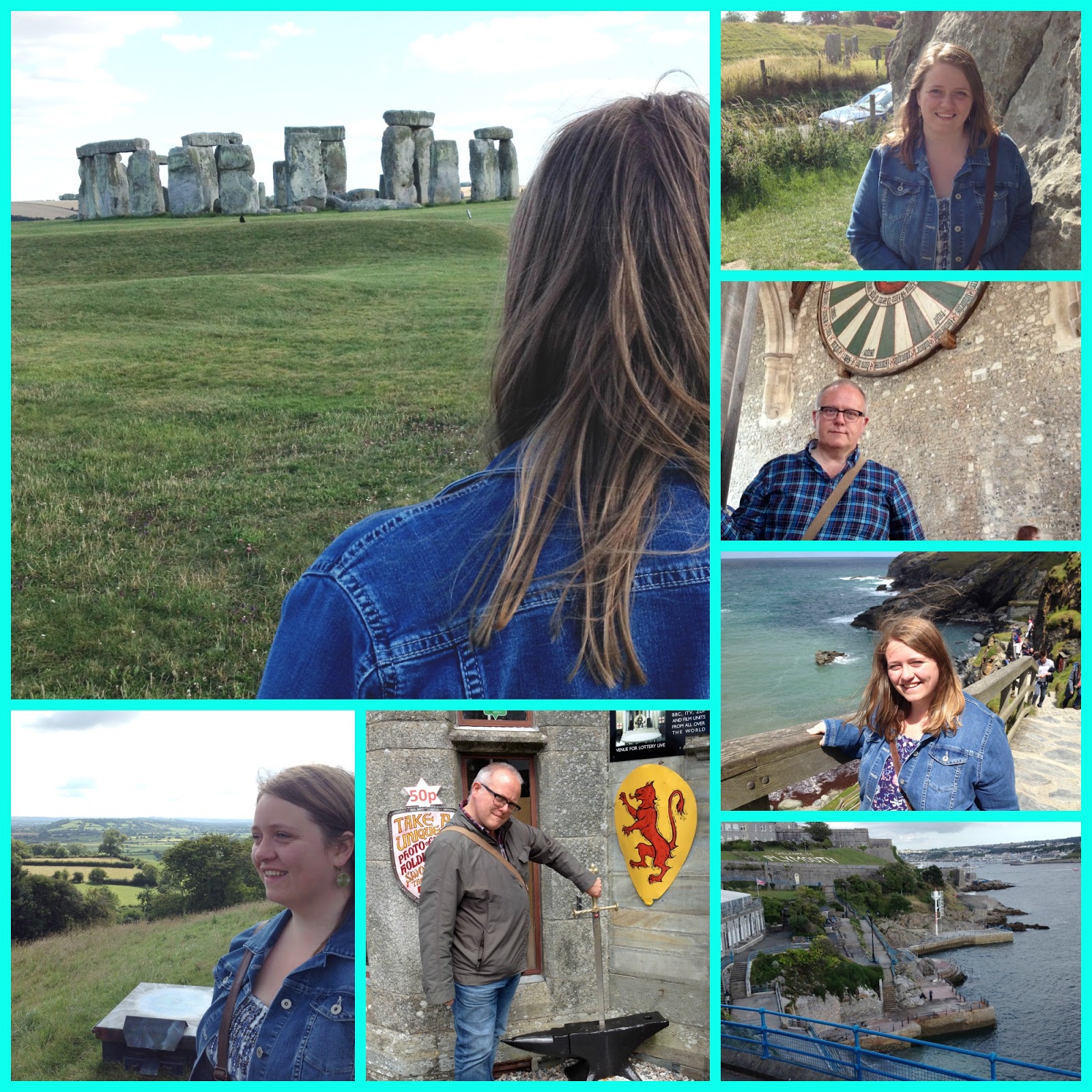
Whereas Harriet has absorbed some of my sense of the absurd and delight in the oddities of the English Language, Emily has inherited my love of history, fantasy, myths and legends. So it was that father and eldest daughter embarked on an Arthurian road trip last summer. I pretended it was a birthday present for Emily but really it was a personal pilgrimage to places I had longed to visit myself. And Emily humoured me. (And the sun shone, the plans worked out and we had a wonderful trip - full of sights and sounds that still linger in my imagination.)
Welcome to Plymouth....
“And I unto the sea from whence I came….”(Montague in Henry VI Part Three)
We began in Plymouth – by the sea – where we hired a car and met up with one of Emily’s university friends at the remarkable gin distillery. I wandered over the Hoe, admired Smeaton’s Lighthouse and imagined Sir Francis Drake’s pre-Armada game of bowls. A fitting beginning for the Odyssey ahead. Next stop Tintagel.
Views of Plymouth