Showing posts with label Rome. Show all posts

Saturday, 22 July 2017

Trip to the North

Inner geeks
In honour of Emily’s birthday, here’s what we did last Easter. Sally and Harriet went off on a walking tour round the Yorkshire dales (Settle, Malham, Grassington) and Emily and I summoned our inner geeks to explore the western end of Hadrian’s Wall and other historical sites in the Border country.

Brougham Castle
After a toilet break and cheese market purchase in Kirby Lonsdale we first stopped at Brougham Castle, the seat of the formidable Lady Ann Clifford. The view from the top of the intact keep presented an uplifting view over the whole site. References to the castle’s role in the Border Wars and the Wars of the Roses gave plenty of ammunition to kick-start our imaginations.
Brougham Castle

Carlisle Castle
Carlisle Castle was a remarkable surprise, partly because of the mighty building itself, well-preserved with several floors to explore. Its reputation as the most besieged castle in England is well explained with details of its Roman origins, connections to the Wars of the Roses, Mary Queen of Scots and the Jacobite Rebellion; as well as its time as a military prison. On the day we were there wild violets grew in clumps so it looked especially beautiful.
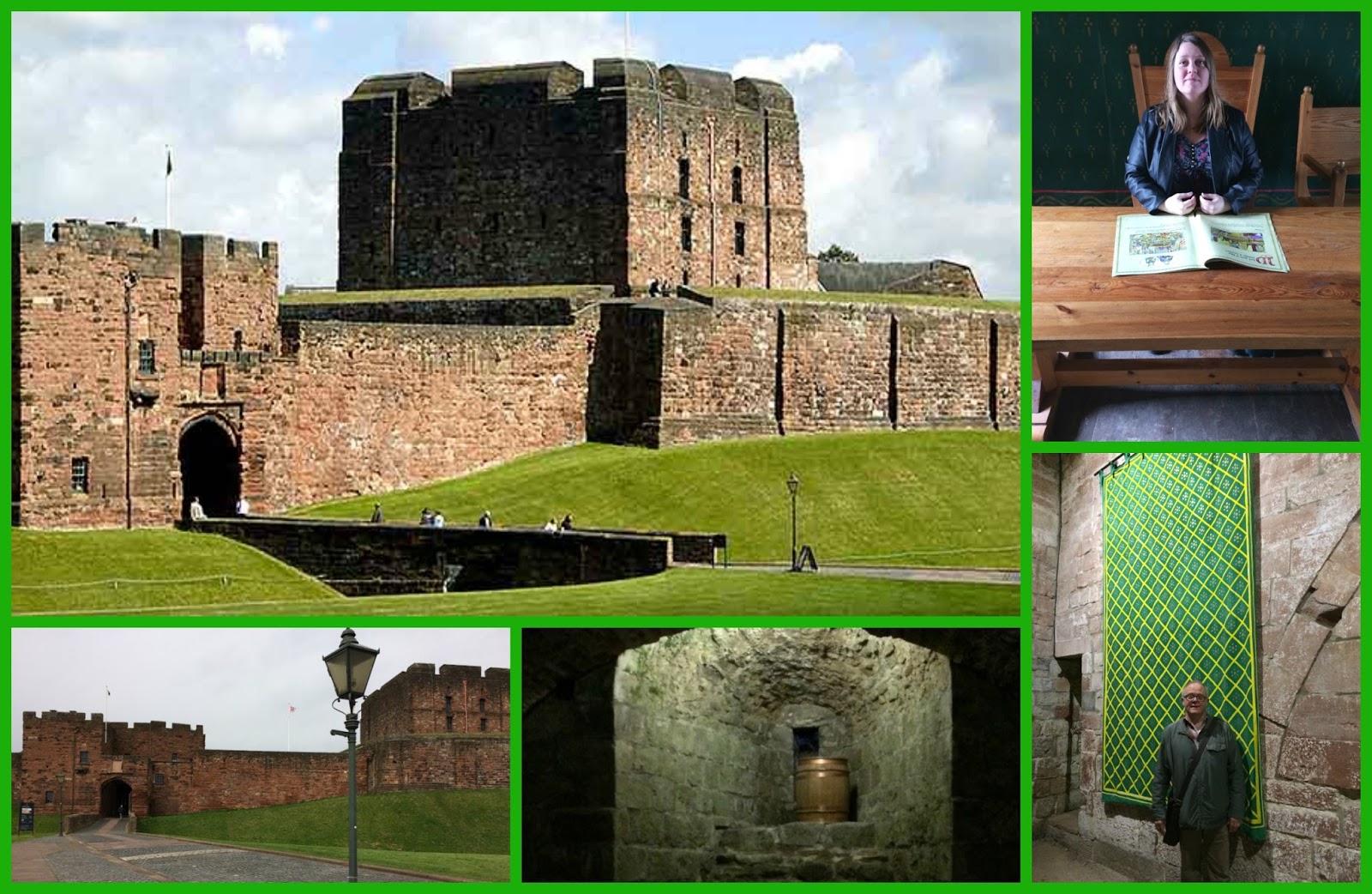
Carlisle Castle

Museum of Military Life
My biggest surprise there was how much I enjoyed the Museum of Military Life housed inside the castle. It was unexpectedly fascinating and poignant. It showed soldiering through the centuries and was packed with human-interest stories of sacrifice, ambition, courage and complexity. Military facts, figures and jargon were all there, but in every section there were personal stories, not only of the soldiers’ lives but also of the reputations of the military and how it changed in different circumstances in different periods.

Heads Nook Hall
Our home for the four nights was Heads Nook Hall, a hefty pile, beautifully-appointed with plenty of space in the rooms and bathrooms. A great armchair to sit in in my bedroom overlooking sunrises and sheep fields through to the horizon. Malcolm Murray, our informative host, welcomed us with home-made scones and tea and supplied perfect
breakfasts every morning in front of an open fire.
Heads Nook Hall. Emily was in the Blue Room with a bath. I was in the Yellow Room with a view.

Birdoswald Roman Fort
Birdoswald was our first Hadrian’s Wall stop. It boasts interesting panels and museum artefacts but the site atop a pretty valley was upstaged by an eccentric kite-flying festival with audacious designs (like a weird deep sea diver) and stroppy tantrums by stunt-kite fliers. A whirlwind of enthusiastic amateurism, extraordinary skill and eye-catching design. Only in England….?
Birdoswald Roman Fort

Corbridge Roman Town
Corbridge Roman Town was another surprise, sited just south of the Wall and clearly servicing the settlements in all the ways you might imagine a military outpost would. An excellent audio-guide brought the streets and buildings to life. I hadn’t imagined the walls would be so intact. You get a strong sense of the different bits of the town community almost 2000 years after it thrived.
Corbridge Roman Town

Aydon Castle
En route to our next Wall stop we spontaneously called at Aydon Castle. A super-enthusiastic young man at the entrance tantalized us with what was available: a higgledy-piggledy totally eccentric pile of a house occupied (spartanly) as late as the 1960s when the owners were still using outside toilets. Stairs cropped up in strange places; rooms led off rooms that made little sense. It felt like being in an Escher building where you never know what room will come next – all the result of different occupiers bashing it about, including, at one time, a group of bandits. A real gem of a house with a short but pretty outside walk – through an orchard – above a gorge dropping down to a gurgling river.
Aydon Castle

Housesteads Roman Fort
I’ve wanted to visit Housesteads Roman Fort for ages – it didn’t disappoint. It was a bitingly windy day which made the thought of the Roman/Syrian occupiers even more atmospheric. Housesteads clings to a ridge across a wide area and it’s easy to imagine how isolated the auxiliaries must have felt being stationed there. The museum was freshly informative and the randomly-placed panels around the site meant your view and perspective kept changing if you made an effort to read all the panels. A panoramic, cobweb-blowing visit.
Housesteads Roman Fort

Roman Army Museum
Our B&B host recommended we include the Roman Army Museum, a commercial set-up which wasn’t planned but it proved well worth it. Targeted at and suitable for all ages, the multi-AV museum is essential if you want to sort out your legionary from your auxiliary and delve deeper into an understanding of Roman Army life. The different set-ups are all imaginative and a 3D film includes aerial shots of The Wall as well as recreations of the life of a bored auxiliary stationed in Roman Britain. A cheesy semi-soap about a group of auxiliary friends also highlights different aspects of the whys and wherefores of being a soldier at that time. The Roman emperor timeline was enlightening, as was the section on Hadrian himself in all his complexity, including his unsuccessful marriage to Vibia Sabina and his love for Antinous.
Roman Army Museum with "Roman" loos....!

Vindolanda
I had imagined Vindolanda quite differently. I knew Vindolanda had ongoing excavations every summer (and will do for the next 200 years if all goes according to plan) but what I didn’t expect was such a massive site with such a clear visual presentation of the dynamic between the fort itself and the vicus that grew up outside the fort. It was a rainy and cold day when we visited but that played into the narrative of Pat, our excellent tour guide, who brought various parts of the site to life with a mix of funny anecdotes, dry references to quirky facts and a genuine love for the place itself. She knew her stuff! The reconstruction project of a section of stone Wall and a section of wood/turf Wall was fascinating as was the museum at the bottom of the site. The highlight for me of the museum was the remarkable discovery and presentation of writing tablets discovered quite by accident and revealing personal details of the lives of people at the time.
Vindolanda

Lanercost Priory
The austerity of the functional church at Lanercost Priory is a stark contrast with what your imagination can do with the remains of the medieval Augustinian Priory, a solid and impressive edifice. It was fun (and sad?) to find bits of Hadrian’s Wall purloined to build the Priory. It’s hard though not to obsess (in a disturbing way) about the terracotta effigy of four month old Elizabeth Howard, a Victorian tomb by Sir Edgar Boehm. Felt very conflicted about its value but it certainly made an impact.
Lanercost Priory

Richmond Castle
Richmond Castle is another substantial building with an intact keep and fantastic view over the town and into the far distance. Scolland’s Hall is a highlight inside, as is the extensive curtain wall. The cockpit garden contains some dramatic topiary and there is an informative display about the Richmond Sixteen, the conscientious objectors from the First World War.
Richmond Castle

Easby Abbey
Our final stop on the way back home was Easby Abbey. The stunning refectory with its great window and the atmospheric cloister were easy to imagine with the help of the information panels. You can just see some original faint traces of red paint on the outer archway of the gatehouse. An impressive ruin though the highlight is probably the peaceful setting.
Easby Abbey
So what now? You decide.
Dad-daughter geek fests – highly recommended! First we did Arthurian sites, then this Hadrian’s Wall trip. Where next? We got along enough to think it may well happen again – yes, there is much talk of history and what we’ve seen, but there is also talk of politics and the state of the nation and reactions to and comments about James O’Brien LBC podcasts (The best of…. and Mystery hour) and we watched the films of Avatar and The Eagle to wind down in the evenings. And, well, we could spend as long as we liked reading the information panels. And we did.

(final lines from The Eagle)
Esca: So what now?
Marcus Aquila: You decide.

Saturday, 22 April 2017

Reasons to be cheerful

Glass half full
After three blogs about reasons to be fearful and fake news, it’s time to cheer up. Most of my life I’ve been a glass half full kinda person. I admit it can be annoying but I can’t stop myself trying to look on the bright side. Maybe it’s because I’m a Libran, I can usually find another way of looking a problem. Seeing it from the alternative point of view…. On the other hand.  My two favourite mottos are carpe diem and only connect.


Carpe diem
Seize the day is a popular aphorism, attributed in its earliest form to the Roman poet Horace in his Odes (23 BC.) I used to write on the inside cover of my notebooks when a teenager: plan as if you are going to live forever, live as if you are going to die tomorrow. Seizing the day is a tough ask when annoying and frustrating bits of living get in the way. It’s hard to seize the day when you have to buy onions at the supermarket; or hoover the carpet. But I try…. My biggest weapon for seizing the day is my imagination. When on a bus or train, if I don’t have a book with me I can’t stop myself travelling back in time and imagining myself in another place in a different period of history. The Tags list on the right will reveal which eras are the ones I flutter away to….

Only connect!
Live in fragments no longer. I used to think it was my Mum who invented the motto: Every day in every way I’m getting better and better until I learned it was Émile Coué, a French psychologist from the early part of the Twentieth Century. Deep down I think if I haven’t read something new or experienced something new every day I’m not exercising my brain or heart and I think that’s what E M Forster’s quotation from Howard’s End is all about. Focusing on brain and heart without thinking about how my body might benefit from exercise has, of course, been a significant weakness of mine. Who would guess that I was a rugby player between the ages of 11 and 18 and between 16 and 18 I played both union and league? If only I’d made the connection then with being physically fit and living a longer life…. but then again, the connections I’ve made with my brain have given me plenty to enjoy in life. We just have to connect the beast and the monk, the prose and the passion, the body with the brain and heart – see the interlinks between us all and everything else. Live in fragments no longer.
Only connect! That was the whole of her sermon. Only connect the prose and the passion, and both will be exalted, and human love will be seen at its height. Live in fragments no longer. Only connect, and the beast and the monk, robbed of the isolation that is life to either, will die.
Merchant Ivory's film of E M Forster's Howard's End, the source of "Only Connect!" 
Anthony Hopkins as Henry Wilcox, Vanessa Redgrave as Ruth Wilcox, Emma Thompson as Margaret Schlegel, Helena Bonham Carter as Helen Schlegel, Samuel West as Leonard Bast, Nicola Duffett as Jacky Bast, James Wilby as Charles Wilcox and Adrian Ross Magenty as Tibby Schlegel

Tuesday, 14 February 2017

Saint Valentine

Instead of chocolates or flowers, why not smear your Valentine with the skinned hide of a goat?
As well as lovers, Saint Valentine is patron saint of bee-keeping, epilepsy, fainting, plague, teenagers and distant travels. We tend not to focus on these other items on February 14th (Valentine’s Day since the Fifth Century AD), but why not?  February is named after a Roman festival of purification. Strips of grisly goat skin were called februa. The verb “to purify” was februare. Grisly goat skin? Valentine’s Day? Where’s Cupid in all this?
Cupid in various guises....
Lupercalia
Imagine gathering at a sacred cave where you believe the baby boy twins Romulus and Remus were reared and suckled by wolves (wolves in Latin = lupi.) Imagine sacrificing a goat for fertility and a dog for purification. Imagine two naked youths taking bloody strips of the goat’s skin and wetly slapping the crops to make them grow. Imagine those nude teenagers then turning to local women and swatting them with the same bits of gory flesh hoping that the sacrifical blood would make the women fertile. Imagine at the end of the day all the young women placing their names in a big urn and the city’s bachelors coming along to choose a name; these matched pairs then staying together for a year – either resulting in marriage or the parting of the ways and another turn next year. (A bit like getting a partner through a raffle or tombola.) This was the beginning of Valentine's Day. This festival of Lupercalia was banned at the end of the Fifth Century by Pope Gelasius (great name, not a flavour of ice cream!) who declared February 14th would now be known as Saint Valentine’s Day and naked yoofs slapping crops and women with bloody goat hide would be banned
The joys of Lupercalia
Blind Cupid
So, for Valentine’s Day in the 20th century, we send cheesy cards, boxes of chocolates and flowers today. No more sacrificing goats and dogs…. All the main Christian festivals are attached to pagan days, a consequence of the Church “Christianising” popular days but I think most people who send flowers on February 14th will never give a thought to bloody goats strips or purification. Most people imagine they are following the tradition of bringing sweets and flowers to Venus's altar, Venus being a female deity associated with love and her son Cupid being the god of love.
What's Saint Valentine got to do with it, if anything?
The historical Saint Valentine
As far as we can tell, Valentine was beheaded and buried around CE 270. Emperor Claudius II had executed him for performing marriages outside the rule of the clergy. Apparently whilst in prison Valentine fell in love with the jailer’s daughter (who may or may not have been blind) and his final letter to her before his death was signed “Your Valentine.” There are, as ever, several other variations of the Saint Valentine origin story. Chaucer himself may have invested the name of Valentine with courtly love through his satirical Parliament of Foules, written around 1382. Shakespeare certainly imprinted it forever with his portrayal of the faithful Valentine in Two Gentlement of Verona, a contrast to the more macho and devious Proteus, two best friends who fall for the same woman in one of literature’s archetypal triangles.
Proteus and Valentine, Shakespeare's Two Gentlemen of Verona

Saturday, 3 December 2016

The grand old Duke of York

City walls of York
The walls of York began as an earthen and wooden stockade surrounding Eboracum (the Roman name for York.) Stone sections were added during the Roman occupation of Britain and a few of these remnants are still visible. During the centuries of Anglo-Saxon and Viking York (Eoferwic and Jorvik) it is likely that the walls were patched up in places but generally left to the weather’s ravages as the city focused on Christianity and Trading. During medieval times, though, when York became the York we know today, the walls were enlarged and reinforced and it is mostly these walls that have been renovated enough to walk on when you visit the city in 2016.

Barley Hall

York has a formidable distinction of being a thriving contemporary city (with its forward-thinking EU Remain-voting populace.) It is also a place that exploits its past for the tourist pound, but in a mostly respectful (and academic) fashion. Barley Hall is a prime example of the potential for forging new economic possibilities from a building that was about to be demolished – until the archaeologists realised how much of the original medieval structure was still intact under the layers of additions and alterations. In a recent visit I enjoyed a vivid display of the costumes from the BBC’s adaptation of Hilary Mantell’s Wolf Hall. Even without the headline-displays Barley Hall is evocative of a distant past that, in some ways, reveals itself to be unnervingly similar to today, even though swans and peacocks rarely feature on 21st century dining tables.

O tiger’s heart wrapped in a woman’s hide!

I’ve always loved York since learning at a young age that the castle nearest my childhood home in Wakefield, Sandal Castle, was the site of the nursery rhyme
Oh, the grand old Duke of York!
He had 10,000 men.
He marched them up to the top of the hill
And he marched them down again….
Tragically, of course, the grand old Duke of York also had the blood of his son, Edmund, smeared over his face by Margaret of Anjou, the wife of Henry VI and effectively the commander of the Lancastrian army at Sandal Castle during the Wars of the Roses. To add further humiliation Margaret placed a mock paper crown on the Duke of York’s head before slaughtering him and removing his head to be hoisted on a pike above Micklegate Bar in the city of York. Is all that true? It’s not in the nursery rhyme, that’s for sure, but Shakespeare has it covered in Henry VI Part Three. Ah, the good old days….
Margaret of Anjou kills the Duke of York (in Shakespeare's version) at Sandal Castle, Wakefield

Saturday, 8 October 2016

Barcelona


Wonderful friends, wonderful time

Barcelona is full of wonders. On a recent trip I went with Sally, Nick and Graeme. I was lucky enough to visit about ten years ago one New Year’s Eve when Spaniards smashed many a bottle around us on La Rambla as we stuffed grapes in our mouths (all in traditional celebration of course) and drank Sangria (we meaning Sally, Emily, Harriet, Sue, Brian and me.) On that occasion Sue and Brian (moored in the docks there) wanted to show us the Magic Fountains but they were turned off for the night so on our return visit last month, the fountains were on the to-do list.


Magic Fountains of Montjuïc

Retirement joys

I don’t think I will ever underestimate travelling during school term time. It is a privilege and feels a bit illegal and I can’t be the only retired teacher to feel so. Our holiday base overlooked the hill of Tibidabo with its retro fairground and the spires of Temple Expiatori del Sagrat Cor. Sally, Graeme, Nick and I stayed in a stylish AirBnB apartment with a terrace for continental breakfast and evening beer. Thank you, gracious hostess, Anna.

Blowing the cobwebs away

I probably over-use the phrase “blowing the cobwebs away” but it’s an image that works for me. Disrupting routine and walking somewhere surprising is a great way to look back, be in the present and look forward.
Docks of Barcelona

Tourist times

On the first afternoon we did an orientating bus tour round the eastern part of the city and admired the sea front, the gothic quarter, the bold architecture and the brash, youthful city centre. Plenty of people-watching even though my pics are all of buildings and scenery (discretion, you know.)

Tapas

Eating and drinking was on the itinerary, of course, and tapas was the order of the day most days, though there were some fish dishes that were as tasty as any I’ve known.

Gaudí

Antoni Gaudí i Cornet’s work dominates the visual side of the city, although there are plenty of other bold and successful architectural statements. Gaudí’s work is so very distinctive. I love his references to the natural world, his use of colour, ceramics, stained glass, ironwork and swirling, pouring materials.


La Sagrada Família

If I’m alive in 10 to 20 years time it would be great to come back and visit the (hopefully by then) finished basilica of the Holy Family. It’s hard to take it all in – the soaring vaults, the fluted columns, the remarkable colours, the mix of straight lines with spheres, fruit, foliage and animals, the sense that the whole building is dripping upwards.

Miracle of design, engineering and building

Visiting a cathedral in the final years of its building is a mind-bending experience. I found myself thinking about the visitors who saw the laying of the foundation stone in 1882; and the visitors 500 years in the future who will wonder how long it took to build.

The Quarry

Equally impressive was La Pedrera (The Quarry) or, officially, Casa Milà, named because of the couple who commissioned it: Pere Milà i Camps and his wife Roser Segimon i Artells. The astonishing outside and inside contains algae-coloured designs, curves, waves, balconies from fairy tales, ergonomic door knobs, fancy lintels, suggestions of bone and an attic space that feels like the skeleton of a snake.

The garden of warriors

The undulating roof with its primitive steps, warrior chimneys, skylights, tiles and embedded broken champagne bottles is a magical space and it was hard to leave the aeriel wonderland.

MACBA

The Barcelona Museum of Contemporary Art is an austere white temple to performance and abstract art. There was a fascinating exhibition of 100 candid photographs by Hans-Peter Feldmann showing black and white portraits of different individuals (twins in one case) at each age, from 8 weeks to 100 years old. Some looked to have secrets; all had stories to tell. One exhibit involved putting two ice cubes (one sweet, one salty) in your mouth and walking into a gigantic wooden cylindrical tunnel whilst a fan blows you from the other end…. Very contemporary….

Nudity beneath the snowstorm

The Cathedral of the Holy Cross and Saint Eulalia (aka Barcelona’s Gothic Cathedral) was a total surprise. The remains of St Eulalia are grandly presented in an ostentatious crypt, the least the Catholic church could do for someone who the Romans stripped in public but then, were so angry when a miraculous snowfall obscured her naked body, that they pushed her into a barrel, stuck knives through it and rolled it down the street now known as Baixada de Santa Eulàlia. Just to be sure she was fully violated poor St Eulalia was then decapitated, but, to the Romans’ surprise, a white dove flew out of her gushing neck! If all that truly happened then she deserves the magnificent cathedral that has now been raised in memory of her martyrdom. I’m not sure I entirely understood why geese were occupying the cloisters, but the Roman Catholic church is full of surprises....

Two pieces of music

Like Paris or Rome, I hope to revisit Barcelona one day. Two pieces of music have been playing in a loop round my brain since returning: one is Ismael Lô’s Tajabone from the score of Pedro Almodóvar’s film All About My Mother (a transition point in the film when the story moves to Barcelona) and the other is the theme from the Barcelona Olympics sung by Freddie Mercury and Montserrat Caballé. You can hear the first one HERE and the second one HERE.
Lyrics for Barcelona (by Freddie Mercury and Mike Moran)

Barcelona – Viva (Barcelona – Live!)

I had this perfect dream
    Un sueño me envolvió (A dream enveloped me)
This dream was me and you
    Tal vez estás aquí (Perhaps you are here)
I want all the world to see
    Un instinto me guiaba (An instinct guided me)
A miracle sensation
My guide and inspiration
Now my dream is slowly coming true

The wind is a gentle breeze
    Él me habló de ti (He told me about you)
The bells are ringing out
    El canto vuela (The song flies forth)
They're calling us together
Guiding us forever
Wish my dream would never go away

Barcelona - It was the first time that we met
Barcelona - How can I forget
The moment that you stepped into the room you took my breath away
Barcelona - La musica vibró (The music vibrated)
Barcelona - Y ella nos unió (And she joined us)
And if God willing we will meet again, someday

Let the songs begin
    Déjalo nacer (Let it be born)
Let the music play
Make the voices sing
    Nace un gran amor (Born a great love)
Start the celebration
    Ven a mi (Come to me)
And cry
    Grita (Cry out)
Come alive
    Vive (Come alive)
And shake the foundations from the skies
Shaking all our lives

Barcelona - Such a beautiful horizon
Barcelona - Like a jewel in the sun
    Por ti seré gaviota de tu bella mar (For you I will be your beautiful sea gull)
Barcelona - Suenan las campanas (Bells ring)
Barcelona - Abre tus puertas al mundo (Open your doors to the world)
If God is willing
If God is willing
If God is willing
Friends until the end
Viva Barcelona (Live Barcelona)

Saturday, 24 September 2016

Kynren

Glen Coe

Glen Coe

An epic drive back from Drimnin was broken by a geocache stop at beautifully grim Glen Coe. Apart from the brutal massacre of Glen Coe in 1692 (in fact three simultaneous slaughters in different locations along the Glen), the site it also familiar to film location hounds: (Harry Potter and the Prisoner of Azkeban, Skyfall and Monty Python and the Holy Grail.)
Skyfall, The Massacre at Glen Coe by James Hamilton, Harry Potter and the Prisoner of Azkeban and Monty Python and the Holy Grail locations

Inveruglas and Hermitage Castle

Pretty Inveruglas where we later stretched our legs and had a cuppa had a view across Loch Lomond with an imposing hydro-electric station as a backdrop. Hermitage Castle was a further stop just before the Scottish-English border where ghostly memories of Mary Queen of Scots haunted the massive monolithic castle and chapel.
Inveruglas and Hermitage Castle


Bishop Auckland, near Durham – The Eleven Arches Company and Kynren

Our final stop before heading for home was an extraordinary event in the shadow of Auckland Castle. Around 1000 volunteers on a 7.5-acre site took part in a £30m specatacular pageant of the history of England. We were in an audience of 8000! Jonathan Ruffer, a city hedge fund manager, philanthropist and art collector grew up in the north and was inspired to spend some of his fortune buying the castle and some important art works and then investing in restorations and in this theatrical enterprise. The script focused on the history of the North East and the style of the show is influenced by the Cinéscénie at Puy du Fou in France. Jonathan Ruffer has managed to create an astonishing infrastructure of parking, food and drink stalls, toilet facilities and dazzling flower-strewn walks down to a state-of-the-art 8000-seater performance arena (the Tribune) with hydraulics, pyrotechnics, hundreds of costumes, props, sets and those unbelievably well-drilled, well-choreographed volunteers.


Kynren, the flower meadows walking down to the arena and, in the centre, philanthropist and creator of Kynren, Jonathan Ruffer with the Chief Executive of Eleven Arches, Anne-Isabelle Daulon

How was the Kynren experience?

The nearest thing I’ve experienced to Kynren is watching a big Disney show in America, but in Kynren’s case there were more people on stage – and they were all local amateurs! There was a true sense of Kynren (a word that means generation or community or kindred or family.) A cavalcade of English history paraded in front of our eyes:
  • Romans
  • Vikings
  • King Arthur and the Knights of the Round Table
  • St Cuthbert and the Lindisfarne Gospels
  • the Normans at the Battle of Stamford Bridge
  • a medieval festival
  • the Battle of Neville’s Cross against the Scots
  • Henry VIII and the Field of the Cloth of Gold
  • Elizabeth I and Shakespeare
  • Charles I’s beheading
  • the Georgian Renaissance
  • the Industrial Revolution (especially an astonishing steam train and a moving account of the Trimdon Grange mine disaster)
  • Queen Victoria’s diamond jubilee
  • the Christmas Truce in World War One
  • the Roaring Twenties contrasted with a Miner’s Gala
  • World War Two’s “Finest Hour.”
A young Geordie boy Arthur was whisked through time by Bishop Hensley Henson; water fountains suddenly revealed a ghostly projection of Durham cathedral’s arches; thundering horses with knights charged across the backdrop; cows, horses, sheep, goats, ducks and geese joined in the action; the Glastonbury Holy Thorn emerged out of the water like Excalibur. The script was sometimes a bit hard to follow, partly because the ever-changing spectacle meant it was hard to “keep up.” Filmic music by Nathan Stornetta and jaw-dropping lighting effects gave the whole event a rousing and emotional core which was impossible to resist. The plan is to revive the event every couple of years and I for one have signed up on the website for future updates and ticket sales.

Saturday, 11 June 2016

The sea hath cast me on the rocks

What would Shakespeare do?

Some people use WWJD (What Would Jesus Do?) as a guide to life’s difficult questions. It is no surprise to my family and friends that my internal guru question is WWSD…. What would Shakespeare do? Would he vote to Remain in Europe or Brexit pursued by a bear?

What I have been I have forgot to know

Shakespeare’s writing always seems to empathise with castaways. A previous blog highlighted Thomas More’s appeal to the mob to embrace the migrant (click here to read.) Characters washing ashore in other lands feature throughout the plays: the Antipholus twins, their parents and the Dromio twins in The Comedy of Errors, Viola and Sebastian in Twelfth Night, Pericles and Thaisa in Pericles, Perdita in The Winter’s Tale, Prospero and Miranda in The Tempest. Shakespeare’s work is riddled with characters recovering from being adrift and cast out. Pericles, washing up on the shores of Pentapolis expresses how many migrants must feel:
Alas, the sea hath cast me on the rocks,
Wash’d me from shore to shore, and left me breath
Nothing to think on but ensuing death….
A man whom both the waters and the wind,
In that vast tennis-court, have made the ball
For them to play upon, entreats you pity him….
What I have been I have forgot to know

 European locations and European sources

Apart from setting his plays all around the Mediterranean (see map at the end of this blog – click here) Shakespeare also went to European writers to source his plays: Leo Africanus (Spanish Moroccan), Appian, Homer and Plutarch (Greek), Ariosto, Bandello, Boccaccio, Castiglione and Cinthio (Italian), Belleforest and Froissart (French), Montemayor (Spanish), Ovid, Plautus, Pliny the Elder and Seneca (Roman Italian.) Most of these were most likely in translations but it was clear the influence of Europe animated Shakespeare's writings. My head and heart tell me that if My Boy Bill could vote in the forthcoming EU referendum he would vote Remain.