Showing posts with label Fountains Abbey. Show all posts

Saturday, 6 February 2021

Then welcome, Winter

Hunkering down with Call My Agent and It's A Sin
Winter's costs and benefits
Although this year’s Winter has not included usual highlights like sitting by roaring fires in stately homes, getting a beer at a Christmas market, singing carols in the cloisters at Fountains Abbey or solving Murder Mysteries on New Year’s Eve, snow has still fallen appropriately, woolly clothes have been wrapped around, mulled wine has been glugged and boots have crunched on icy meadows. And I thank the Winter stars for the universe’s permission to savour stodgy pudding and custard at this time of year. I manage to stem the flow of inner tears when our weekly posh takeaway from La Rue restaurant in Saltaire doesn’t include a sponge pud as a dessert choice on their menu. But then I’m only human. Winter has costs but benefits too – hunkering down with movies and box sets, curtains shut, anticipating that Spring will come. Carpe diem.
Winter's Beauty
by W H Davies

Is it not fine to walk in Spring,
When leaves are born, and hear birds sing?
And when they lose their singing powers,
In Summer, watch the bees at flowers?
Is it not fine, when Summer's past,
To have the leaves, no longer fast,
Biting my heel where'er I go,
Or dancing lightly on my toe?
Now Winter's here and rivers freeze;
As I walk out I see the trees,
Wherein the pretty squirrels sleep,
All standing in the snow so deep:
And every twig, however small,
Is blossomed white and beautiful.
Then welcome, Winter, with thy power
To make this tree a big white flower;
To make this tree a lovely sight,
With fifty brown arms draped in white,
While thousands of small fingers show
In soft white gloves of purest snow.
One tree, Four Seasons.... (plus the real Frankie Valli and the movie-acting Four Seasons from Jersey Boys)


Saturday, 26 January 2019

Fountains Abbey by Floodlight

Enterprising Evenings for Ancient Sites
The National Trust has been creative in its use of evening events at ruined places (probably following the success of enterprising places like the Bolton Abbey estate with their Bonfire and Firework nights.) 
Fountains by Floodlight
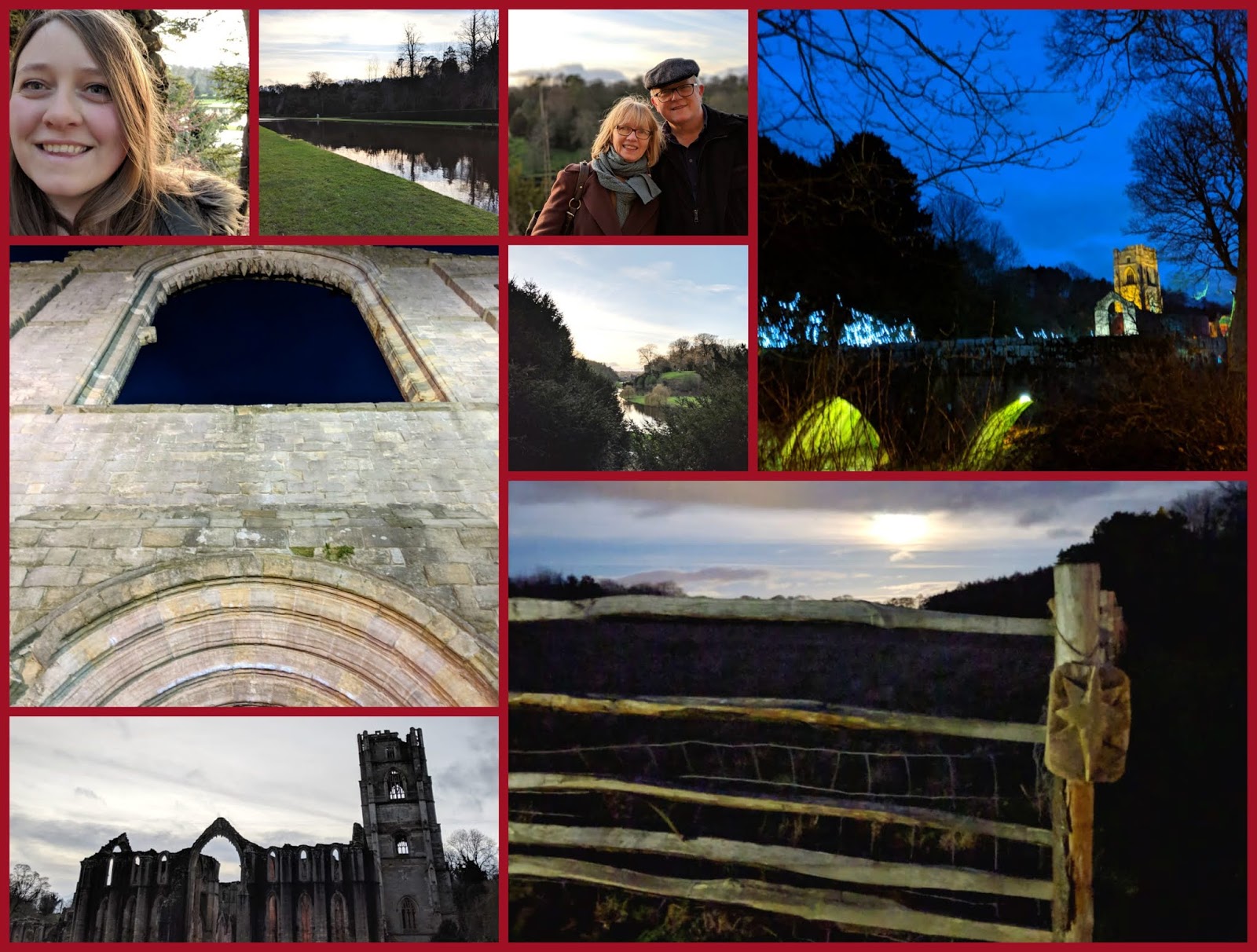
Fountains Abbey (and Studley Royal and the high walks and low walks round the estate) is fantastic to visit at any time. On selected evenings in the winter, as the sun set over Fountains Abbey, coloured floods and spots reveal the architecture, literally and metaphorically, in a quite different light.
Make we joy now in this fest
Clutching our heated glasses of mulled wine, we listened to the live choir singing carols ancient and new in the cellarium.
Colours of the past
We know from places like CathĂ©drale Notre-Dame d’Amiens (Amiens Cathedral) and the traces of paint found there that ancient monuments, in their early pomp, would likely have been brightly painted. It is impossible to say whether or not the colours would have been as lurid and varied as the Fountains by Floodlight experience, but it makes the past seem less monochrome and brightens up the chill of winter.


Saturday, 19 September 2015

Constant as the northern star....

Saltaire Festival

Saltaire Festival

A few times a year Saltaire, where I live, holds a street and park festival with beer tents, food stalls, craft and vintage stalls, live music and street performers. Some years there are arts trails, open garden trails and in recent years in the build-up to Christmas there has been a Window Advent Calendar hunt. All these events bring out the creative best in local people and the atmosphere is generally fantastic although the Festival now is a huge and crowded event and seems to get bigger every year. I am as proud of my adopted home, Saltaire, as I am of my birth city of Wakefield.


Proud of Wakefield

Wakefield Cathedral

Growing up, I loved Wakefield. I loved the open fields near Eastmoor Estate, the sense of history with Sandal Castle and the chantry chapel, the cathedral, the parks, the opportunities for both sports and the arts; as a teenager I played rugby and acted in a local amateur dramatic society – an odd combo looking back. One of the constants about Yorkshire through my life has been how quickly you can get to places of interest and beauty.


Harewood House

Harewood House near Leeds

A place like Harewood House, for example, has so many quirky aspects: the beauty of the house and grounds; the Bird Garden (complete with penguins); the terrace art gallery and cafĂ©; the display about Britain’s history of slavery; and the painting of the “Scandalous” Lady Worsley, recently portrayed in a BBC TV drama by Natalie Dormer.


East Riddlesden Hall

East Riddlesden Hall between Bingley and Keighley

Along the road from my house is the National Trust-run East Riddlesden Hall complete with a huge ancient barn, legends of hauntings, at least three stages of building and a riverside walk.


Jervaulx Abbey

Jervaulx Abbey, North Yorkshire

Further afield is the tranquility of one of the great ruined abbeys of the north. You can take your pick in Yorkshire from Bolton, Byfield, Coverham, Easby, Fountains, Jervaulx, Kirkham, Monk Bretton, Mount Grace, Rievaulx, Roche, Whitby and York St Mary’s. The pictures above are from Jervaulx but they all are atmospheric and peaceful  places to visit.


Middleham Castle

Middleham Castle, North Yorkshire

And not far from Jervaulx is my favourite Yorkshire castle, childhood home of Richard III, Middleham, maintained by English Heritage. I visited Leicester cathedral recently to see the new burial site of Richard but it is Middleham where his heart seems to have been and where his positive reputation remains intact.

Linda Thompson's statue of Richard III at Middleham Castle
I have posted the poem below in a previous blog, but I think it’s a superbly crafted piece of writing:


Richard by Carol Ann Duffy
My bones, scripted in light, upon cold soil,
a human braille. My skull, scarred by a crown,
emptied of history. Describe my soul
as incense, votive, vanishing; you own
the same. Grant me the carving of my name.
These relics, bless. Imagine you re-tie
a broken string and on it thread a cross,
the symbol severed from me when I died.
The end of time – an unknown, unfelt loss –
unless the Resurrection of the Dead …
or I once dreamed of this, your future breath
in prayer for me, lost long, forever found;
or sensed you from the backstage of my death,
as kings glimpse shadows on a battleground.


Saturday, 1 November 2014

Chubbing as a nipper

Childhood freedom
As a child growing up in the 1960s on the Eastmoor Estate in Wakefield, my playground consisted of fields, dens, paths, bushes, trees, woods, a canal, a river, bridges, haunted ruins, marshes, bonfires…. On days out, my eldest brother would take me, my mum and sister to places like Brimham Rocks in North Yorkshire, a weird and atmospheric collection of rocks on the moors near Pateley Bridge. Another day might be spent exploring the ruins of the great northern abbeys – Byland, Fountains, Jervaulx, Kirkstall, Riveaulx and Roche. In winter laking out* might mean involving two gangs playing Kick Out Can in the smog-riddled ginnels** and gardens of the estate.
*laking out = playing out from the Old Norse laik – “to play”
**ginnels = snickets, alleyways
Bonfire night
TV for children was limited, computers were non-existent and so running free seemed to be the only way to live – but back for tea or for bed! Friendships, loyalties, enemies and rivalries were passionate, none more so than around bonfire night when rival gangs went chubbing*** and then jealously guarded their huge bonfires. It was a great honour to be on guard duty, especially if you were a nipper**** and you were paired up with one of the older lads. 
***chubbing = scrounging for stuff to burn on the street bonfire
****nipper = small kid
Chubbing in the 1960s. Photo property of Bill Bullock.
The giant stack – ElfNSafety nightmare
Modern health and safety regulations wouldn’t tolerate the sorts of bonfire night I remember from childhood.  The centre pole was usually an abandoned telegraph pole with discarded railway sleepers stacked around it.  Linton Road householders would shove in broken cupboards, old sofas and discarded toys so the stack looked like an immense wigwam jumble sale.  Whether the urban myth was true – that one year, one boy was burned to death because he fell asleep when on guard – I never found out.  But the nearest Saturday to November 5th always saw the conflagration go up with a roar.
A local bonfire stack that wouldn't be allowed these days
Tasty treats
Pork pies, mushy peas, baked potatoes, parkin and “bonfire toffee” appeared with paper cups of pop from the Corona van – dandelion and burdock, cola, lemonade, orangeade, cream soda, limeade, cherryade. Some “taties” were cooked on sticks in the fire itself. Did the mums all have a planning meeting to coordinate all the food and drink?
Are the memories true?
Every year someone was burned with a banger and every year someone had to stay up through the night until the embers were safe to leave. Was it really as wild and pagan as my memory conjures? Or have the phantom dangers of childhood conjured a more feral existence than really happened?

Saturday, 13 September 2014

Imaginative History

RHS Harlow Carr Gardens - with its great bookshop 
Trip out
Unpacking boxes, bags and months of living in the South finally gave way to a trip to North Yorkshire, via Harlow Carr Gardens bookshop near Harrogate. Where else more appropriate for a visit than Fountains Abbey?

Buried in a secluded valley not far from Ripon, the word “magnificent” is not too strong to describe the experience of visiting Fountains Abbey.  Pretty quickly it is obvious why the place is a World Heritage Site – from the romantic abbey ruins, to the landscaped lakes and gardens of Studley Royal, the “High Ride” walk with intriguing follies, the deer park, St Mary’s Church, Fountains Hall, the herb garden, the display rooms….
Views from the "High Ride" walk at Fountains Abbey and Studley Royal
Time travel
If only time travel were possible…. To glimpse the place when the first 13 rebel Benedictine monks arrived in the valley in 1132, and then to see a time lapse movie of the growth of the buildings over several centuries into the richest Cistercian monastery in England, and then to despair as the site turned into the largest abbey ruins in the UK…. If only I believed that King Henry VIII and Thomas Cromwell had pure religion in mind when they began their dissolution scam.… (£!£!£!£!)
Vices and virtues
Fountains Abbey speaks of time, decay, conviction, faith, vanity, glory and power. The stones, without doubt, hide stories of anger, greed, sloth, pride, lust, envy and gluttony. Of course I am sure there were many monks who demonstrated virtues of chastity, temperance, charity, diligence, patience, kindness and humility. One of my favourite pastimes is to let my imagination roam on the sites run by the National Trust or English Heritage. Ken Follett’s Pillars of the Earth is partly responsible for cementing my imaginative take on the blood, sweat and turmoil that went into the construction of church buildings in the medieval period.
Whose history is it anyway?
Seamus Heaney famously thought that history “is about as instructive as an abattoir” and Henry Ford wrote that "history is more or less bunk” but I suspect they were referring to the official version of history, the one written by the military winners. History to me has always been about the untold stories, the domestic details, the women and children, the teachers and builders, the doctors and bakers. Shakespeare’s history plays are as real, to me, as Holinshed or Plutarch in evoking the passions of the past; sure, they are biased, but so are the text books. The billions of words of conjecture written about the Tudors cannot all be correct. Give me Sharon Penman’s The Sunne in Splendour over David Baldwin’s biography of Richard III (though I have to say Baldwin’s is the best I know….) Both approaches are equally popular but I have yet to be convinced that a literary view of history is any less valid than a “historical” approach to history.
Either our history shall with full mouthSpeak freely of our acts, or else our grave,Like Turkish mute, shall have a tongueless mouth,Not worshipp'd with a waxen epitaph.

That was then, this is now
Wandering round Fountains Abbey can be an experience which involves the politics of the rise and fall of monasteries and the factual history of the architectural decisions, or it can be about imagining Brother Dominic and what brought him there, how he fared in the different seasons, what jobs he enjoyed doing the most, what were the greatest hardships, when did he experience his finest moments of faith and what caused his strongest moments of doubt? What kind of an abbot was Henry MurdacWandering round on a crisp September day in 2014, Fountains Abbey is an ideal place for contemplation of who we’ve been, who we are and who we’re going to be.