Showing posts with label Julius Caesar. Show all posts

Tuesday, 29 August 2017

Dance for me

The art world responds to the story of the dancing princess
Playwright in prison
On 11th February 1896, at the Comédie-Parisienne in Paris, Oscar Wilde’s play of the Biblical story of Salomé received its premiere. Rehearsals for an earlier production had begun in 1892 starring the famous celebrity actress, Sarah Bernhardt, but the London production was banned, supposedly because the Lord Chamberlain (the censor of the day) decided that it was blasphemous to portray Biblical characters on the stage. By the time the play was staged in Paris, Wilde had been imprisoned as a result of a series of tragic miscalculations and the fervid homophobia of late Victorian Establishment.
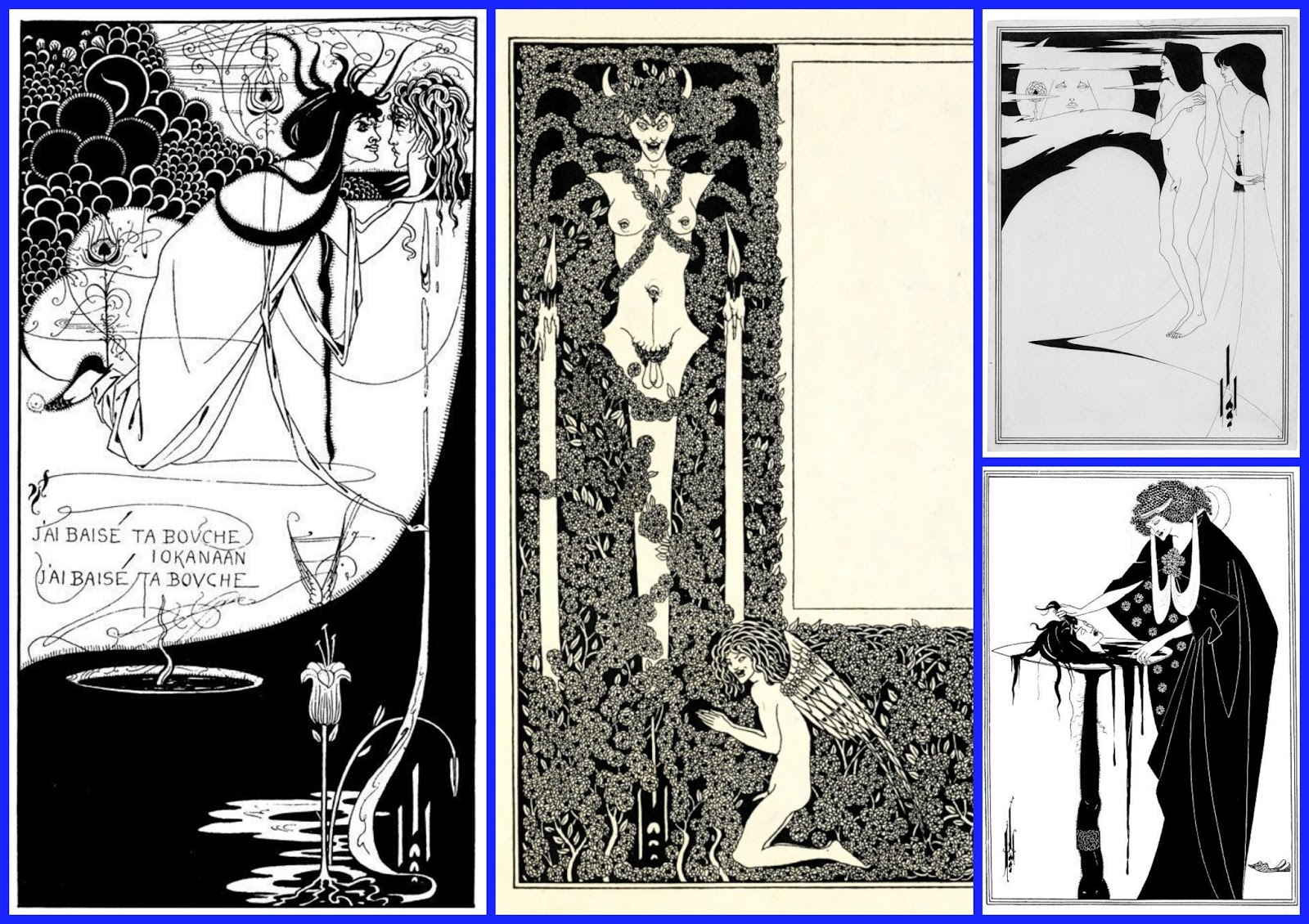
Aubrey Beardsley's original illustrations include Wilde in the moon (top right)

What the Bible says (Mark Ch 6: 14 – 28)
John the Baptist has been raised from the dead, and that is why miraculous powers are at work in him.”
15 Others said, “He is Elijah.” And still others claimed, “He is a prophet, like one of the prophets of long ago.”
16 But when Herod heard this, he said, “John, whom I beheaded, has been raised from the dead!”
17 For Herod himself had given orders to have John arrested, and he had him bound and put in prison. He did this because of Herodias, his brother Philip’s wife, whom he had married.
18 For John had been saying to Herod, “It is not lawful for you to have your brother’s wife.”
19 So Herodias nursed a grudge against John and wanted to kill him. But she was not able to,
20 because Herod feared John and protected him, knowing him to be a righteous and holy man. When Herod heard John, he was greatly puzzled; yet he liked to listen to him.
21 Finally the opportune time came. On his birthday Herod gave a banquet for his high officials and military commanders and the leading men of Galilee.
22 When the daughter of Herodias came in and danced, she pleased Herod and his dinner guests. The king said to the girl, “Ask me for anything you want, and I’ll give it to you.”
23 And he promised her with an oath, “Whatever you ask I will give you, up to half my kingdom.”
24 She went out and said to her mother, “What shall I ask for?” “The head of John the Baptist,” she answered.
25 At once the girl hurried in to the king with the request: “I want you to give me right now the head of John the Baptist on a platter.”
26 The king was greatly distressed, but because of his oaths and his dinner guests, he did not want to refuse her. 27 So he immediately sent an executioner with orders to bring John’s head. The man went, beheaded John in the prison,
28 and brought back his head on a platter. He presented it to the girl, and she gave it to her mother.
Images copyright RSC taken by Isaac James. Actors: Matthew Tennyson, Ilan Evans, Jon Tranchard, Christopher Middleton, Simon Yadoo, Bally Gill, Johnson Willis, Assad Saman, Andro Cowperthwaite, Ben Hall

Influences and imaginative transformation
In crafting the play, Wilde:
  • takes the text (above) from the Gospel of Mark and the shorter version in Matthew’s Gospel;
  • considers the many classical paintings of the scene by da Vinci, Moreau, Rubens and Titian among others (rejecting some and admiring others);
  • and, like Shakespeare, steals phrases and rhythms from a number of other writings (Scheffauer, J C Heywood, Flaubert, Huysmans, Maeterlinck) and even
  • his own brother, Wiliam Wilde, who wrote a poem about Salomé in Trinity College magazine, in 1878.
What he does, though, is transform the story into something strange and ritualistic. The language is fluid and poetic, hypnotic and surprising. Salomé, in Wilde’s play, isn’t persuaded by her mother to demand the head of Iokanaan (John the Baptist), (as occurs in the Bible) but makes her own decision to do so and is explicit in Wilde’s play that she hasn’t consulted her mother. Thus Wilde’s Salomé is breaking free, growing up, upsetting authority, dancing on her own terms….
Isaac James photographs. Actors: Assad Zaman, Matthew Tennyson, Gavin Fowler, Suzanne Burden and Company
Owen Horsley’s production
It at first glance seems perverse to give a female role to a male actor in a 2017 Roman plays season at the RSC, given the few numbers of (textually) female roles available in Antony and Cleopatra, Coriolanus, Julius Caesar and Titus Andronicus. But the decision absolutely works in the context of the rest of the production’s design and, in my opinion, gave Wilde’s play a frisson of repressed/unrequited/ambiguous/burgeoning love and sexuality that was wonderfully apt in this year of the 50th anniversary of the partial decriminalisation of gay (male) sex. Matthew Tennyson played Salomé with delicately eye-popping rage; he alternated between naïve expressions of desire, determined ferocity and intricate vulnerability. Standing up to his dementedly incestuous stepfather, Herod, played with lascivious cowardly torment by Matthew Pidgeon, Salomé was a heroic and tragic figure who struggled to know how to express her/his love. Circling them both was the accusatory Herodias played by Suzanne Burden with flamboyant gusto (often appealing to the audience directly and inviting us to judge what we were seeing.)
Isaac James photographs. Actors: Ilan Evans, Matthew Tennyson, Gavin Fowler, Matthew Pidgeon, Ben Hall, Bally Gill, Jon Trenchard, Christopher Middleton, Miles Mitchell, Andro Cowperthwaite, Robert Ginty, Byron Mondahl, Johnson Willis, Simon Yadoo

Total theatre
The moon hung over this beautifully-lit and evocatively-costumed production, literally and imaginatively as the Roman soldiers, the Jewish and non-Jewish revellers and the Roman ambassador were all mystified about how to respond to both the dancing princess and the muscular prophet, Iokanaan (John the Baptist played by Gavin Fowler), emerging from his cistern beneath the stage smeared in dirt and booming out his intense warnings. The executioner, played by Ilan Evans, got to belt out the songs of Perfume Genius, an artist I didn’t know before this production but whose anthemic, heavily-percussive music seemed to fit the awesome, longing, desperate, romantic atmosphere of this theatrical presentation of the pangs of transgressive love.
Variations of the play: film, opera, Berkoff's adaptation

Saturday, 19 August 2017

There is a world elsewhere

Productions during the 2017 summer school
70th anniversary of the summer school
I’ve just finished attending the 70th anniversary of the Royal Shakespeare Company’s Summer School. There are some attendees who remember seeing Laurence Olivier and Vivian Leigh perform in Stratford in Titus Andronicus in 1955. Four years later delegates saw a season including Paul Robeson in Othello, Charles Laughton in A Midsummer Night’s Dream and Dame Edith Evans in both All’s Well That Ends Well and Coriolanus (the latter also with Olivier.) Imagine.
Faces of the RSC summer school 2017: Janet Suzman, Katy Stephens, Ray Fearon, Tony Byrne, Nia Gwynne, David Troughton, Erica Whyman, Chuk Iwuji, Dr Elizabeth Sandis, Miles Tandy, Penny Downie, Suzanne Burden, Michael Billington, Jacqui O'Hanlon, Dr Maria Evans, Matthew Tennyson, Prof Michael Dobson, Prof Russell Jackson, Gavin Fowler
31st anniversary for me….
My first summer school was in 1986, the year I married Sally, and the year The Swan theatre opened in Stratford-upon-Avon. I haven’t been every single year since then, but more years than not and, like with Shakespeare himself, there are surprises every year.

Roman season
This year it’s all about Ancient Rome. So all four of Shakespeare’s Roman plays are being staged: Antony and Cleopatra, Julius Caesar and Titus Andronicus at the moment and  Coriolanus later in the year. There is a spoof new play based on Plautus by Phil Porter, charmingly titled Vice Versa (or the Decline and Fall of General Braggadocio at the hands of his canny servant Dexter and Terence the Monkey) which can only be described as the love child of Carry On – Up Pompeii – Panto On Weed. Sitting between these offerings was a gay-focused version of Oscar Wilde’s Salomé with a male actor in the role of the dancing princess.

Decapitations, songs, stabbings, dances, neck-breakings, love scenes….
They say variety is the spice of life and the theatrical sights veered between grisly shocks and tender vignettes. All of the productions offered a new angle or fresh perspective on the characters or themes. Over it all soared the language of Shakespeare and Wilde (and the thumping doggerel of Phil Porter, acting like a satyr dance or bergomask to the season.) During the day lectures by people like the rigorous Dame Janet Suzman and the visionary Erica Whyman commented on the season, the plays, the RSC and the state of theatre and the world in 2017. As Coriolanus himself says, “There is a world elsewhere….” There were no overt attempts to make the plays relevant to today’s political upheavals but it was impossible to ignore the parallels and hear echoes of our current world. As Ben Jonson wrote in the First Folio,
“Soul of the Age!....
He was not of an age, but for all time!”
Shakespeare Birthplace Trust Exhibition

All time and all places
As if to underline the Shakespeare Everywhere theme, a new exhibition at The Birthplace explores active involvement in Shakespeare in a group of Asian countries. To some Shakespeare is all about the overthrow of tyrants; to some he is the epitome of justice and mercy; to others he is the key to unlocking the freedom of the imagination and creativity. He is, to me, all these things and many more – a body of work, a fascinating point in history, an explosion of language and dramatic situations.
He was a man, take him for all in all,
I shall not look upon his like again.
Shakespeare Imagery: to Bard or not to Bard....

Saturday, 8 April 2017

Our fears do make us traitors


Fear

In Shakespeare's Macbeth Macbeth himself recognizes that:
        Present fears
Are less than horrible imaginings
In Romeo and Juliet Juliet imagines waking up from her death-like sleep in a tomb with the bones of her ancestors, including the recently-murdered Tybalt. She knows the bones, smells and shrieks will be in her imagination but still exclaims:   
O, if I wake, shall I not be distraught,
Environed with all these hideous fears?
Shakespeare's famous exploration of the power of FEAR - Macbeth

Laughing off fears

Of course Caesar in Julius Caesar is tricked into disbelieving his wife’s prophetic dreams that harm that will come his way on the Ides of March:
How foolish do your fears seem now, Calpurnia!
I am ashamed I did yield to them.
And off he trots to his assassination! And, more poignantly Lady Macduff debates the actions of her husband fleeing to England to enlist the aid of Malcolm in the fight against Macbeth and she thinks being afraid is traitorous:
ROSS: You must have patience, madam.
LADY MACDUFF: He had none:
His flight was madness; when our actions do not,
Our fears do make us traitors.
By the end of the scene both she and her young children have been slaughtered.

Imaginary fear versus legitimate fear

Macbeth and Juliet are afraid of things that have not yet happened and seem unlikely. Caesar and Lady Macduff decide that being fearful is unpatriotic. All four of them die at the end of their journey in their play. Perhaps the fears in those plays were well founded. Fear is a real human emotion but Shakespeare knew that our imaginary fears are corrosive and take away our capacity for enjoying the blessings of living. Politicians and the Media portray a world that is fearful – full of fear – but we are statistically living in a period in history when fewer people than ever before die from war, disease, violence and accident. Hard to believe, I imagine, if you are one of the people who fall under the spell of the politics of fear. I myself have to work hard to remind my heart and brain that we had more real reasons to be fearful in every century before the one in which we are currently living.

Saturday, 9 January 2016

Give Me A Bowl Of Wine

Adrian Smith, family and friends
Give me a bowl of wine
Brutus’s full line to Cassius in Julius Caesar is “Give me a bowl of wine; in this I bury all unkindness.” Wine in Shakespeare is often shared between characters who are healing rifts or expressing friendship. Over the years I have enjoyed some very jolly wine-consuming occasions with friends like the Tuffnells and the Lancelots who all appreciate a hearty glug. The latest wine-tasting with online Drink Me magazine’s, Adrian Smith, took place in his stylish Leeds city centre offices towards the end of 2015. (Editor's Update Jan 2021: check out Aidy's personal website and The Three Drinkers website to see what's happened in the years since this post....)
Unpretentious quaffing
The beauty of Adrian’s “sessions” (apart from the relaxed company and excellent nibbles) is that he loves wine and encourages an enthusiastic approach to sampling, especially new wines that he has discovered on his international travels. I’ve learned how to release the aroma of wine through gadgets, decanting and swirling glasses; and I’ve learned about the body of a wine, the fruitiness or sweetness of wine, the acidity and the tannins. But more important than any of the imaginative and bizarre words to describe the taste and smell of wine is the answer to the simple question – “Do you enjoy drinking it?” Context is everything. Cheap plonk looking across the Bay of Naples can taste just as lovely as expensive wine in a local restaurant. Cheap fizz on a birthday beach picnic can be just as delicious as posh champagne.
Give me some wine and let me speak a little
The above line is the line that follows Antony’s “I am dying, Egypt, dying” just before Antony’s death in the arms of Cleopatra. Apparently alcohol is a common request on death beds, almost as frequent as calling for loved ones and praying to God. Rarely do people think of anything especially witty to say – but a glass of wine or a splash of gin brings immediate comfort and no doubt memories of convivial times with family and friends. 50 years after Shakespeare died, the Rev John Ward, vicar of Holy Trinity Church, Stratford-upon-Avon, relates that the night before he died (in 1616, 400 years ago this year) Shakespeare had a drinking session with buddies playwright Ben Jonson and poet Michael Drayton. It’s hard after all this time to be sure of whether or not this was true, but since Shakespeare's plays and poems are filled with words and images of alcoholic drinks, I have no doubt that my boy Billy enjoyed a tipple. Here’s to the next wine-tasting. Cheers!

Saturday, 31 October 2015

Think well, love well, sleep well

Curry capital
Bradford has been named curry capital of the year for the fifth year in a row and the Autumn nights and approaching winter means that going for a curry is a great way of celebrating. Zaara’s remains my favourite place to have a curry in Saltaire for two very good reasons (Edited 2020 - Zaara's has sadly now closed): I can walk there; and, more importantly, the dishes we choose are always cooked to perfection. Recent research has shown that curry may be actually good for you, easing arthritis and even affording some possible protection from Alzheimer’s. What’s not to like?
The glory of Zaara's in Saltaire
Tolkien’s wisdom
Hobbits famously had two breakfasts during their morning routines and, since I’ve blogged about the joys and dangers of drink, it feels that the time is ripe for talking about the wonders and glories of tasty food. Tolkien wrote: “If more of us valued food and cheer and song above hoarded gold, it would be a merrier world." Too true. And Virginia Woolf, a writer very different from Tolkien, concurred: "One cannot think well, love well, sleep well, if one has not dined well." 
Luxury Carriage
In an episode of 3rd Rock from the Sun Dick Solomon expressed one of my default justifications of why I enjoy eating so much: “Why should I be concerned about gaining weight? My body is just a carriage that carries my brain around. And my brain deserves a smooth luxurious ride.”  There is Shakespearean precedent too, to celebrate plump people.  In Julius Caesar, Caesar himself says:
Let me have men about me that are fat,
Sleek-headed men and such as sleep o' nights:    
Yond Cassius has a lean and hungry look;    
He thinks too much: such men are dangerous.
Joys of Food and Drink
Retirement Pleasure
Eating cheaply but well, shopping carefully and trying new recipes – these are all retirement activities that are new to me. But after all these years of over-eating, I wonder whether or not I could become healthier by losing some of my luxury carriage that is surplus to requirements. I’ve been doing some research into men’s attitude to weight loss, made notes, devised a spreadsheet and bought some cheap dumbbells. (Typical man, I think, reminiscent of Mr Toad's hobbies.) I’m hopeful I won’t become a bore about it because I am a foodie through and through – but I’ll try and keep a track of my progress – or lack of it – and let you know how it goes….
Mr Toad from The Wind in the Willows who enjoys new hobbies....

Saturday, 11 April 2015

If I should tell my history....

Mythical Histories
In honour of Shakespeare's April 23rd birthday, this post is about his sensational History plays. They feel more relevant than ever because of the popularity of Game of Thrones and George RR Martin’s acknowledgement of the influence of Shakespeare's Wars of the Roses sequence.
Power of Eleven
Shakespeare wrote eleven plays dealing with English History (King John, much of Edward III, Richard II, Henry IV Part 1, Henry IV Part 2, Henry V, Henry VI Part 1, Henry VI Part 2, Henry VI Part 3, Richard III and most of Henry VIII.) Shakespeare also wrote four historical tragedies set in Ancient Rome (Titus Andronicus, Coriolanus, Julius Caesar and Antony and Cleopatra.)
Pseudo-history
Some of the other tragedies contain historical aspects: Titus Andronicus, for example, with the wars between the Romans and Goths or Othello with the Venetian/Turkish tensions. King Lear, Macbeth and Cymbeline (a comedy?!) might fall under the banner of Shakespearean history because they are based on legendary, pseudo-historical figures; and they were included in one of Shakespeare’s key source books, Holinshed’s Chronicles, a history of Britain, although even contemporary commentators thought Holinshed was inventing much of his “history.”
There weren't no mechanical clocks in Ancient Rome, not never
But how far did Shakespeare’s exploration of history colour subsequent interpretation? Richard III and Cleopatra in popular culture certainly derive from Shakespearian characterisation. There are wild inaccuracies and anachronisms in the history plays. These howlers occur either for dramatic effect or as a result of Shakespeare’s patronage and the need to stay in favour with the aristocratic sponsors of the Elizabethan and Jacobean theatre. But no theatre fan has ever claimed the History plays are documentaries. Modern TV and film dramas play equally fast and loose with police work, legal proceedings and medical treatments.
Box office hits
With the printing press still a relatively new invention, and newspapers still an invention of the unimagined future, world events in the late sixteenth century might well vanish from memory – unless they had been turned into legends, handed down mainly through oral tradition, or presented in drama. For the majority of the illiterate English populace, plays provided a vivid introduction to the history of their grandparents, piecing together the oral anecdotes that had been passed down. The original audiences flocked to the early performances of these plays; Henslowe’s diary includes fantastic box office receipts for Shakespeare’s histories.  
Elizabethan and Jacobean propaganda
But the plays also served another purpose. Even an invigorated England could not quell the growing fear and uncertainty surrounding the last years of the reign of Queen Elizabeth I. The question on people’s minds was what would happen to England when their queen died? A series of plots to assassinate Elizabeth, combined with the knowledge that there was no obvious heir to the throne, sent nervous tremors throughout the country. Would the power struggle reignite a civil strife between a new set of contenders like Henry VI, Edward IV and Richard III or would the country unite as it did behind Henry V and Henry VII? 
Universal truth interwoven into the fictional history
Using history as a foundation, Shakespeare built characters and events that explored the rich complexity of human nature. His ability to craft stories of human emotion, motivation, bravery and vulnerability is a legacy that is astonishing in its richness and variety. Thanks, fellah! And happy birthday for April 23rd.

Saturday, 21 March 2015

Who Murdered the Princes in the Tower?

The Return of the King

I couldn’t help being glued to the saga of the discovery of the bones of Richard III.  Philippa Langley’s Looking for Richard project demonstrated a tenacity and meticulousness that leaves me in utter admiration.
Philippa Bailey, 


The king in the car park

Channel 4’s documentary about the finding of the bones of Richard in the remains of the Greyfriars Priory was a riveting account, I thought, of English doggedness and sheer fluke.  The moments of revelation were handled well and the “host” Simon Farnaby delivered his dry and charming commentary with sensitivity and flashes of grim humour – “If that isn’t Richard III, that’s one unlucky monk!”
Jacqui Binns with her funeral pall

Shakespearean spin
As a lifelong Shakespeare devotee, should I be huffing and puffing like the pantomime historian, David Starkey, and trying to denigrate the Ricardians who were all anxious to give the bones a reinterment with honour and dignity?  Would any deviation from the Tudor view of the “poisonous bunchbacked toad” undermine Shakespeare’s brilliant creation?
Ian McKellen, Antony Sher, Simon Russell Beale, Jonjo O'Neill

Sharon Penman
Since reading Sharon Penman’s evocative fictionalised account of Richard’s life and seeing the Shakespeare Histories Octology staged in all its glory (five times now) I am an avid reader of Wars of the Roses material.  Growing up nearby – and regularly visiting – Sandal Castle in Wakefield also has something to do with my obsession with the Yorkist cause, I’m sure.
One of my favourite books

History is bunk – and marvellous at the same time
I wrote in an earlier blog (here) about my feelings about History.  No way can we ever truly know about the motivations and actions of anybody, let alone a long-dead historical figure.  Every bit of evidence will be tainted with bias.  Even recent figures (wholly alive) are elusive – and will remain so.  Who can prove with absolute certainty what motivated Tony Blair’s thoughts and actions during his time as Prime Minister?  There will be as many interpretations as there are commentators and even Tony B's own memory and brain will fashion and refashion what happened and how and why.  History is a narrative construct; all evidence is interpretative.

Ricardians
I find the Sharon Penman view of Richard III the most persuasive.  (Any work that explore four brothers is bound to get me – as I discovered when I read The Queen of Air and Darkness.)  Her sympathetic Richard, loyal to the north of England, and a loving brother, husband and father, is completely at odds with Shakespeare’s character of Richard III.  But Shakespeare’s “bottled spider” is a fictional villain, a study in tyranny and a theatrical tour de force.  I don’t watch Julius Caesar or Macbeth expecting a documentary study of those rulers.  Cleopatra in history, I’m 100% sure, was nothing like the Shakespearean character in Antony and Cleopatra.

So thank you to all those who contributed to the honour and dignity of bringing Richard’s bones to a more dignified resting place.  Of course I would have favoured a reinterment in York Minster – and I would have attended myself if it had been at Middleham Castle.  Where he belongs.  But I can accept him being in Leicester for all kinds of reason – I hope Richard’s presence there gives the city a boost.  That would chime with what I believe about Richard III’s sense of justice.  He knows Yorkshire loves him….  
Middleham Castle, a Ricardian paradise
Who murdered the Princes in the Tower?
Buckingham is a likely contender but my understanding of the time – and my reading of the evidence – points to the supporters of Henry VII.  Did they act on his orders?  Did Buckingham do the dirty on behalf of Henry VII?  Did the older boy die, and the younger boy survive to become Perkin Warbeck?  We will never know.  But we will never know, either, that Richard III definitively ordered their deaths.  Anyone expressing absolute certainty is simply giving an interpretation.  J’accuse Buckingam/Henry VII!  Final words to the brilliant Carol Ann Duffy:


Richard

My bones, scripted in light, upon cold soil,
a human braille. My skull, scarred by a crown,
emptied of history. Describe my soul
as incense, votive, vanishing; you own
the same. Grant me the carving of my name.

These relics, bless. Imagine you re-tie
a broken string and on it thread a cross,
the symbol severed from me when I died.
The end of time – an unknown, unfelt loss –
unless the Resurrection of the Dead …

or I once dreamed of this, your future breath
in prayer for me, lost long, forever found;
or sensed you from the backstage of my death,
as kings glimpse shadows on a battleground.

By Carol Ann Duffy


Friday, 1 August 2014

I Will Survive


Relief, Fear, Uncertainty
A grim start to a new blog? But Relief, Fear and Uncertainty are my initial feelings now that I’m retired.
At first I was afraid
I was petrified

How can I survive without a full-time job? Particularly such a busy, all-consuming job? Teaching for the best part of 32 years…. In Manchester, in London, in Winchester, in Helsinki, in Stratford-upon-Avon, in Retford, in Sheffield, in Leek, in Keighley, in Wakefield, in Leeds, in Bingley and for the last 14 years at Bradford Grammar School, a large coeducational independent school, where I was Head of English and Drama.
The Likes Of Us, my final "big" school production
Retirement

    ….tis our fast intent
To shake all cares and business from our age
Conferring them on younger strengths, while we
Unburdened crawl towards lie-ins, reading and going to the cinema in the afternoon, writing for fun, puzzling over jigsaws, walking on canal towpaths, the Yorkshire moors and dales on weekdays, focusing on health, booking holidays in school term times…. Working at living instead of living at work.
Ripeness Is All
Was it the right time to leave?
There is a tide in the affairs of men, which,
Taken at the flood, leads on to fortune….
Was this the right time? This blog may partially answer that question. Life is in an unusual place at the moment. I’ve been commuting most weekends from Bradford to Dorking where my family is temporarily renting a flat.
The Temple on the Nower in Dorking
Life In A School
I will miss the working life in school: the buzz, the buildings, the banter – but most of all the people. Working in a collegiate atmosphere with people who, by and large, have the same values and aims - colleagues who have compassion, enjoy a sense of absurdity and teach their specialist subjects with depth and detail. Colleagues whose goal is to inspire teenagers, those infuriating, bizarre semi-adult beasts, creatures full of the future, full of unpredictable fun, full of hormonal bullshit.
Rat Trap an original musical I directed at Leek Westwood High School in my first teaching job
Life As A Teacher
Every day contained dozens - probably hundreds - of interactions; some interactions were like performances, some quick and intense, some combative and unsettling, some giddyingly silly; but all were involving and immediate. Will I Survive without timetables, schemes of work, planning, delivering, evaluating, monitoring, assessing, reviewing, planning, delivering, evaluating, monitoring, assessing, reviewing, planning…. And so it goes on, deadline after deadline, day after day, week after week, term after term…. But never the same in my subjects (English and Drama) and never the same because of the endless parade of humans…. Teachers, Support Staff, Students…. A cavalcade of teeming humanity.
Mikey Lord leading These are the days of our lives at Bradford Grammar School We Will Rock You
What Next?
So the aims of this blog are for me to reflect on retirement, practise writing skills and comment on whatever crops up in the moment of writing.  The only binding constant will be the words of William Shakespeare, which I expect to crop up frequently; the Complete Works of Shakespeare (and everything that surrounds those Works) are my hobby and have been for a very long time. Anyone who enjoys spotting quotations (the clues are in the labels below each blog), feel free to reveal which words belong to which play. I expect there will be no obvious “narrative arc” – just a diary of whatever crops up in my retired life. My dream is to live in retirement as a “writer” and my first step is to begin this blog and aim for five posts a month by August 2016 (I’m giving myself two years to get into the swing of it….) As the Marvel-lous Stan Lee often says…. Excelsior!