Showing posts with label Game of Thrones. Show all posts

Saturday, 19 September 2020

A (Yorkshire) lass unparallel'd

Boast thee, Death…. Downy windows close
In Antony and Cleopatra, Charmian closes the eyes of her asp-poisoned mistress with the following words:
So, fare thee well.
Now boast thee, Death. In thy possession lies
A lass unparallel'd. Downy windows, close;
And golden Phoebus never be beheld
Of eyes again so royal!
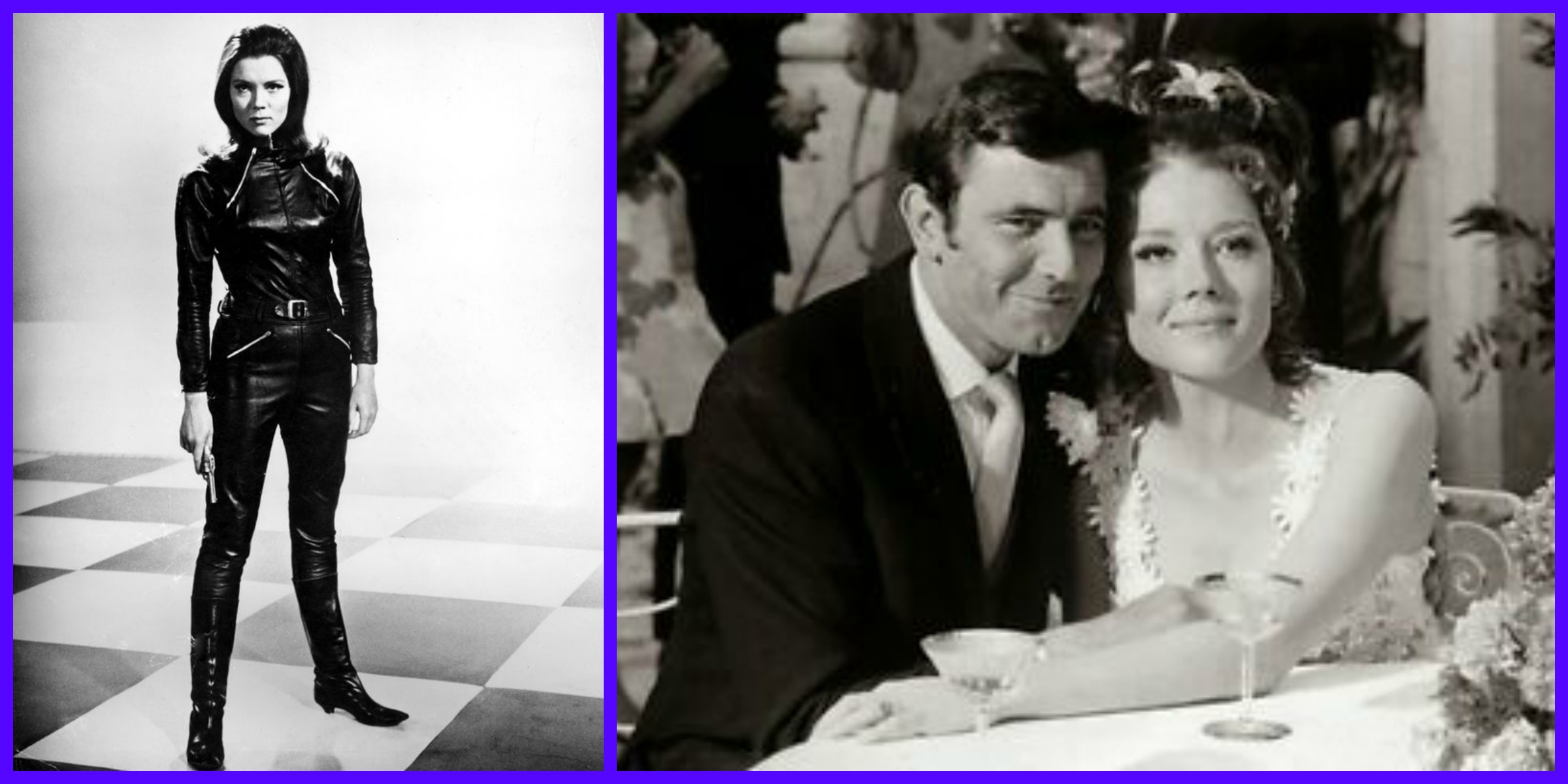
And thus spake Jenny Michelmore to Diana Rigg at the Chichester Festival Theatre in 1985. Thirty-five years later, on September 10th 2020, that same majestic Cleopatra, Dame Diana, took her last bow. Born in Doncaster, Diana Rigg always paid tribute to her Yorkshire roots. Her father was a railway engineer who was transferred to work on the railways in India where Diana learned Hindi as a second language. In later years, when an interviewer expected her to cite India when asking “where did you develop your ingrained sense of justice?”  Diana’s answer was “Yorkshire.” Although feeling she didn’t fit in when she returned to school in Leeds, Diana’s drama teacher at Fulneck, Sylvia Greenwood, instilled a love of Shakespeare and performing and Dame Diana returned to Leeds to receive an honorary degree and visit her old school.
Mistress of Theatre, TV, Cinema
At school Diana appeared as Orlando in Shakespeare’s As You Like It and Emily Brontë in The Brontës. She went on to be crowned with plaudits, winning BAFTA, Emmy, Tony and Evening Standard Awards in her time. (And striking out – successfully – for equal pay with her co-star in The Avengers at a time when it was rare for women to highlight inequality.) Highlights included:
  • In Theatre: Brecht’s Caucasian Chalk Circle and Mother Courage, Shakespeare’s King Lear, Twelfth Night, Macbeth and Antony and Cleopatra (as Cordelia, Viola, Lady M and Cleopatra), Ronald Millar’s Abelard and Helouise, Stoppard’s plays Jumpers and Night and Day, both Eliza Dolittle and Mrs Higgins (twice) in My Fair Lady, Sondheim’s Follies, Euripides’ Medea, Albee’s Who’s Afraid of Virginia Woolf, Williams’s Suddenly Last Summer and Chekhov’s The Cherry Orchard
  • On TV: Shakespeare’s King Lear (as Regan), The Morecambe and Wise Show, Clytemnestra in The Oresteia, Ibsens’s Hedda Gabler, the 1985 Bleak House, her BAFTA-winning turn in Mother Love, Moll Flanders, Mrs Danvers in 1997’s Rebecca, Oleanna Tyrell in Game of Thrones, and cameos in popular programmes like Victoria, Detectorists, Doctor Who and the forthcoming Black Narcissus. But she will always be associated with her groundbreaking performance as Emma Peel in 51 episodes of The Avengers
  • On film: Shakespeare’s Midsummer Night’s Dream and Julius Caesar (as Helena and Portia), Mrs Tracey Bond in On Her Majesty’s Secret Service, Theatre of Blood, A Little Night Music, The Great Muppet Caper, Evil Under The Sun, The Painted Veil and the forthcoming Last Night in Soho
As well as her Shakespeare roles, I was most affected by (on TV) her performances in The Avengers, Mother Love, Moll Flanders, Game of Thrones and Detectorists; on film the shock of her fate in On Her Majesty’s Secret Service; but I was lucky enough to see her grimy, cackling, pipe-smoking, funny, grotesque Mother Courage on stage at the National Theatre in 1995 – a character full of grim energy at the beginning, dragging her enormous cart around the stage, quipping, dominating, manipulating; and, by the end of the production, a zombified hollowed-out shell of a woman, emblematic of all people shattered by the effects of needless war. An extremely un-vain performance. An acting legend.


Saturday, 15 July 2017

Bradford Literature Festival 2017

Bradford Literature Festival 2017
The cover of the booklet proclaimed 400 writers, 300 events, 10 days, 1 city
I listened to 28 speakers in 10 events over 4 days
I felt insanely proud of the city where I live for hosting such an event – the fourth year now and getting stronger each time. A thousand congratulations to the driving forces: Syima Aslam, Irna Qureshi and their superb team.
Bradford Waterstones in the old Wool Exchange

Inclusive, surprising, chock-a-block with surprising juxtapositions
I’ve been to a number of literary and writing festivals during my lifetime but I haven’t experienced one with such a variety: from Harry Potter spell-making to Pakistani politics, from Jane Austen to Rebel Girls, from Star Wars to Cricket, from LGBTIQ events to J B Priestley, from Waris Shah’s epic love love poem to lessons on how to avoid writing bad sex scenes. The organisers seem to be fearless and determined to put in something for everyone. And everyone, it seemed, turned out.
Bradford: City Square, City Hall, R C Bridgestock in the Victorian courtroom (see below)

City square in the sun
I found something on both weekends to intrigue and pull me in. But my abiding memory of the festival might be sitting in City Square watching the fountains play and being astonished (and moved) by the smiling crowds going in and out of the book tent, by the individuals, friends, strangers, families, young, old, all ethnicities, all backgrounds and all types watching the pop-up entertainments. Many, I’m sure, were as equally contented as me that, after all the metaphorical earthquakes in the political world in recent years, the evidence of people congregating at the Bradford Literature Festival shows that the human race is overwhelmingly peaceful, loving, investigative and open-hearted. Culture and the arts celebrate communities, spread ideas and, yes, it’s true, they advance civilisation. Much to learn. Much to debate. Much to ponder. Much to love.
Samantha Ellis's book, the Arabian Nights event (Abdul-Rheman Malik, Robert Irwin and S F Said); the Arthurian legends (Kirsty Logan, Reluca Radulescu and Remona Aly); and Game of Thrones: Myths and History (Tom Huddleston and Carolyne Larrington)

So what did I learn, debate, ponder and love?

Book Bidding Wars

  • Inside City Hall is as jaw-dropping as the outside, inspired as it is by the Palazzo Vecchio in Florence
  • The women from the publishing industry who spoke at this event were inspiring, funny and encouraging (thank you Ailah Ahmed, Danuta Kean, Lisa Milton and Kate Nash)
  • Update on my Rhenium Tales efforts: the arc of my second book is laid out with some material already dumped there because I’ve cut it out of Book One
  • Book One, Raydan Wakes, is in the final stretch of complete first draft at 111,000 words split into 15 chunky chapters, each divided into three sections….
  • Nothing at this event made me think I should stop writing and editing, writing and editing….

The Arthurian Legend and its Enduring Appeal

  • Remona Aly (journalist and broadcaster) was an endearing and enthusiastic chair whose expressions of her fandom articulated exactly my own Arthurian obsessions (and that's what's great about the festival: where the internal worlds of a white Roman Catholic in his 50s and a young Muslim woman can meet in an unlikely space....)
  • Kirsty Logan inspired me to buy her book The Gracekeepers 
  • I wish I’d been taught at university by Professor Reluca Radulescu
  • The three women debated the crux of the Arthurian canon: the fruitful jostle between the imaginative, the scholarly, the historical, the gender-focused, the patriotic, the European and the romantic approaches
  • The Tag “King Arthur” in the list to the right will demonstrate how much I wallowed in this event

Arabian Nights: the Original Science Fiction

  • There are way more stories in the Arabian Nights collection than I knew of
  • From oral tradition to the printed collection(s) on shelves now, the journey of The Arabian Nights is fraught with cultural, political and linguistic complexities
  • There are some wild and wonderful stories I never knew containing prophetic imaginings and leaps of technology
  • The Arabian Nights is more mind-boggling and enticing than I thought before
  • I need a new translation (thank you Abdul-Rehman Malik, Robert Irwin and S F Said)

Game of Thrones: Myths & History

  • Tom Huddleston (author and film journalist) and Professor Carolyne Larrington (Oxford) made a brilliant double act with well-prepared questions (Tom) and authoritative answers (Carolyne) and conversation that was mesmerisingly entertaining (both of them, thank you)
  • Another event, like the King Arthur session, that explored how history, geography, politics, gender studies, fiction and the imagination can work together to brew sci-fi and fantasy
  • They revelled in the North-South divide of York/Lancaster and Stark/Lannister which tickled me to bits
  • They revealed some crazy medieval anecdotes and prompted me to make four pages of notes

The Books they don’t want you to read

  • Kevin Duffy helps run Bluemoose books which published STOP! Don’t read this by Leonora Rustamova and her students, a story which is worth researching if you don’t know it (click here)
  • Melvin Burgess (who wrote two of my favourite “Young Adult” books Bloodtide and Bloodsong) is much more genial than I expected
  • Tariq Mehmood is a funny guy – and sometimes scary in his emphatic challenges – but whose book You’re not proper is one I’m looking forward to reading
  • All three men wrangled around the subject of banning books and acknowledged the empty chair reserved for Juno Dawson who had withdrawn from the festival for reasons which could be seen as ironic given the topic of this event – complex times – so I hope one day I’ll be able to hear Juno talking about her work; she would, I think, have had a different perspective to the three men on the panel, all of whom were interesting....
Branwell Brontë, Juliet Barker, the Bidding Wars panel (Lisa Milton, Ailah Ahmed, Kate Nash, Danuta Kean), Samantha Ellis, Michael Stewart, Louise Doughty and Robert Edric

And on the second weekend?

The Missing Brontë

  • Juliet Barker really is the best speaker about the Brontës on the circuit
  • She showed us extraordinary images of the Haworth Parsonage and analysed the ‘gun portrait’ in a fresh way
  • She painted a picture of Branwell that was complicated and sympathetic, believable and sad
  • She made a strong case for Branwell’s role in pushing the imaginative lives of the sisters when they were children

Inspired by the Brontës

  • Samantha Ellis, author of Take Courage (about Anne Brontë) and How to be a heroine, is an absolute delight and would be a great dinner party guest
  • Louise Doughty, author of Apple Tree Yard, won a place to be at the same dinner party; both she and Samantha Ellis spoke with humour and passion about the Brontës and how their writing had influenced their work
  • I tried to ignore Robert Edric who seemed to be there under false pretences; and Michael Stewart (writer) asked some good questions and some rubbish questions; but luckily the two women had enough to say and illuminated the theme of the event
Boyd Tonkin and Germaine Greer

Gender Expectations in the Lives of the Brontës

  • Boyd Tonkin (writer, journalist, editor) commented intelligently and asked pertinent questions
  • Germaine Greer (academic, environmentalist) said a lot, often wittily, always memorably, frequently debatable
  • On signing “To Tony” inside one of her Shakespeare books for me at the end, formidable Germaine looked me in the eye and said “I have a cousin called Tony who exposed himself to my little sister.” Which meant I forgot just about everything else she’d said earlier, except I remember that she admitted she didn’t know Wuthering Heights well, even though she was happy to deliver strong opinions about it.
  • Greer’s book Shakespeare’s Wife is a brilliant account of Elizabethan/Jacobean social history so I’ll always be a Germaine fan because of it. But I’ll avoid listening to her talking about the Brontës in the future. She ain’t got nothing useful to say about them. Entertaining. Thought-provoking. Occasionally stubbornly wrong. Juliet Barker beats her hands down. Not that it’s a competition…

A Man’s Game

  • Ross Raisin (ex Bradford Grammar School, award-winning author) is a thoughtful and philosophical speaker; his first novel God’s Own Country was (imho) an absorbing and poetic read; I got a copy of his latest A Natural signed at this event
  • David Park is a Belfast-born writer whose words inspired me to buy his collection of short stories, Gods and Angels, so I’ll look forward to reading that
  • Ellis Cashmore (sociologist and cultural critic) moderated, intervened, provoked and enjoyed his own thought processes awfully much
  • Will women’s sport ever (again) receive as much media attention and financial investment as male sport?
  • I was interested to learn how in the early part of the 20th Century women’s football flourished and was then banned by the FA….
  • Is there a modern crisis of masculinity?
  • Do fiction writers have any responsibility in attempting to portray an ‘ideal’ man?
Ellis Cashmore, Ross Raisin, David Park, A Natural, Melvin Burgess and the Banned Book event (Kevin Duffy, Melvin Burgess and Tariq Mehmood)

Realism in Crime Fiction & Tour of the Bradford Police Museum

  • Who knew there was a fascinating Police Museum housed in City Hall? I know now.
  • Who knew there were Victorian police cells to visit and an astonishing Victorian courtroom, often hired by film and TV production companies? I know now.
  • R C Bridgestock (aka husband-and-wife team Bob and Carol) gave an entertaining account of their careers in the police force, their transition to writing crime fiction and their forays into consulting on series’ like Sally Wainwright’s Happy Valley 
  • Bob and Carol were generous in their enouragement and writing tips
  • Pamela Clare, make-up artist, showed astonishing skill in demonstrating gruesome facial injuries on audience members
  • Martin Baines was an informative, entertaining and thoughtful guide round the fascinating bowels of City Hall and revealing insights into the past (and present) practices of police custody
I’m already anticipating Bradford Literature Festival 2018
The founders of the BLF: Syima Aslam and Irna Quresh


Saturday, 18 February 2017

A mighty woman with a torch


The Colossus of Rhodes

In 280 BC the sculptor Chares of Lindos supervised the erection of one of the Seven Wonders of the Ancient World to commemorate the Greek island of Rhodes’s victory over Cyprus who had besieged the island 25 years before. The statue became known as the Colossus of Rhodes and apparently straddled the mouth of Rhodes harbour. Many writers and artists have attempted to imagine what it looked like from various contemporary descriptions. Illustrators of George RR Martin’s Game of Thrones have used its concept to depict the Titan standing in the harbour of the Free City of Braavos.

How the mighty are fallen

The Colossus of Rhodes stood for 54 years but broke off at the knees during a devastating Earthquake in 226 BC. For nearly a century travellers would write about the immense ruin. Pliny the Elder couldn’t reach his arms around one of the fallen thumbs. There have been many famous statues since Chares’s Colossus and recently one particular statue has been haunting my imagination. I’ve been lucky enough to see it on a holiday in New York and was very moved by the poem carved into its pedestal, a poem that references the Colossus of Rhodes. The statue celebrates the immigrant founding of modern America and its words have been quoted many times (“world-wide welcome….Give me your tired, your poor/Your huddled masses yearning to breathe free….Send these, the homeless, tempest-tost to me….”)  The words seem to have been forgotten for the moment, by far-right politicians and their supporters in America, Europe and Australia.

The New Colossus by Emma Lazarus

Not like the brazen giant of Greek fame,
With conquering limbs astride from land to land;
Here at our sea-washed, sunset gates shall stand
A mighty woman with a torch, whose flame
Is the imprisoned lightning, and her name
MOTHER OF EXILES. From her beacon-hand
Glows world-wide welcome; her mild eyes command
The air-bridged harbor that twin cities frame.

"Keep, ancient lands, your storied pomp!" cries she
With silent lips. "Give me your tired, your poor,
Your huddled masses yearning to breathe free,
The wretched refuse of your teeming shore.
Send these, the homeless, tempest-tost to me,
I lift my lamp beside the golden door!"


Look on my Works, ye Mighty, and despair!

I’ve quoted from Shelley’s Ozymandias before (here) in the context of life’s futility. It is a worthy companion poem to The New Colossus and a comforting, though tragic, idea when feeling in despair about global politics. Nothing lasts forever. The Colossus of Rhodes fell. The Statue of Liberty is currently an empty gesture. Ozymandias became a couple of legs and half a head. The mighty fall. In the musical Avenue Q the characters wisely sing that everything “Is only for now….” What will happen to us all? Time will tell.

Ozymandias by Percy Bysshe Shelley

I met a traveller from an antique land,
Who said—“Two vast and trunkless legs of stone
Stand in the desert. . . . Near them, on the sand,
Half sunk a shattered visage lies, whose frown,
And wrinkled lip, and sneer of cold command,
Tell that its sculptor well those passions read
Which yet survive, stamped on these lifeless things,
The hand that mocked them, and the heart that fed;
And on the pedestal, these words appear:
My name is Ozymandias, King of Kings;
Look on my Works, ye Mighty, and despair!
Nothing beside remains. Round the decay
Of that colossal Wreck, boundless and bare
The lone and level sands stretch far away.”

Saturday, 4 February 2017

Walling in and walling out

Walls: walling in or walling out or falling down or being pulled down?
Walls, walls, walls
Walls protect, yes, but walls are also forbidding barriers, and they can form a prison, and they can be a symbol of loneliness or isolation. Blank walls staring out have been used over centuries to depict intractability as well as inertia. Shirley Valentine talked to the kitchen wall in her domestic solitude, Pink Floyd sang about Another Brick In The Wall, Achilles chased Hector three times around the walls of Troy, Joshua marched around the walls of Jericho and then brought them a-tumbling down with shouts and rams’ horns. As Robert Frost wrote:
Before I built a wall I’d ask to know
What I was walling in or walling out,
And to whom I was like to give offense.
Pink Floyd, Jericho walls, walls of Troy, Shirley Valentine
Gentles, perchance you wonder at this show….
Quince: This man with lime and rough-cast doth present
Wall, that vile Wall which did these lovers sunder;
And through Wall’s chink, poor souls, they are content
To whisper….
Tom Snout plays Wall in Shakespeare's A Midsummer Night's Dream
Sinister cranny
Wall: In this same interlude it doth befall
That I, one Snout by name, present a Wall;
And such a Wall, as I would have you think,
That had in it a crannied hole or chink,
Through which the lovers, Pyramus and Thisbe,
Did whisper often, very secretly.
This loam, this rough-cast and this stone doth show
That I am that same Wall; the truth is so:
And this the cranny is, right and sinister,
Through which the fearful lovers are to whisper….
Cursed be thy stones
Pyramus: O grim-look'd night! O night with hue so black!
O night, which ever art when day is not!
O night, O night! alack, alack, alack,
I fear my Thisbe’s promise is forgot!
And thou, O Wall, O sweet, O lovely Wall,
That stand'st between her father's ground and mine!
Thou Wall, O Wall, O sweet and lovely Wall,
Show me thy chink, to blink through with mine eye!
Thanks, courteous Wall: Jove shield thee well for this!
But what see I? No Thisbe do I see.
O wicked Wall, through whom I see no bliss!
Cursed be thy stones for thus deceiving me….
Human Rights March in Leeds in response to President Trump's policies - proud of Sally, Harriet, Maggie and Christine and all the rest who attended
This vile Wall
Thisbe: O Wall, full often hast thou heard my moans,
For parting my fair Pyramus and me!
My cherry lips have often kiss'd thy stones*,
Thy stones with lime and hair knit up in thee…. 
Pyramus: O kiss me through the hole of this vile Wall!
Thisbe: I kiss the wall's hole, not your lips at all.
*Stones, of course, are Elizabethan slang for balls/knackers/testicles and – hole – well, the precise hole being kissed depends on which chink the actor playing Snout offers up…. 

Many American landscapes are awe-inspiring; countless aspects of American culture are having a positive influence on the world; and I know and love people in America:

  • Inspiring world figures like Mohammed Ali, Neil Armstrong, Walt Disney, Thomas Edison, Albert Einstein, Henry Ford, Dr Martin Luther King Jr, Rosa Parks;
  • Novelists like Harper Lee, Kerry Madden, John Steinbeck, Anne Tyler;
  • Playwrights like Edward Albee, Lillian Hellman, Tony Kushner, Arthur Miller, Eugene O’Neill, Sam Shepherd, Tennessee Williams;
  • Poets like Maya Angelou, Elizabeth Bishop, ee cummings, Emily Dickinson, TS Eliot, Sylvia Plath, Ezra Pound; 
these are, dare I say it, tremendous people, without thinking too hard about who to include, not to even begin mentioning singers and actors…. Tom Hanks, Katherine Hepburn, Elvis Presley and Aretha Franklin, for heavens’ sake, to name but four…! Is this a country that needs a Wall? A country whose current manifestation and wealth has been created from immigration? When birds fly around the globe, do they see borders?

Mending Wall

Genius satirical banners in the UK courtesy of The Poke
Robert Frost’s celebrated (American) poem Mending Wall was first published in 1914, right on the brink of the First World War. I haven’t seen it printed yet in the context of President Trump’s policies so here it is. “Good fences make good neighbours” is what the neighbour in the poem repeats (twice) but the poem has a tension that pulls away from that cliché and more potent are other lines that are repeated: “Something there is that doesn’t love a wall.”
Thanks to The Poke
Brief personal thoughts on Mending Wall
In Spring, two neigbours walk the wall between their properties to make repairs – is there a reason for this wall to be built at all? There are no cows, just apple trees and pine trees. Should you summon “spells” to counteract “elves,” a whimsical idea that suggests wall-building is an ancient, outdated ritual, not suited to modern thinking. Maybe the act of building a wall is a chance to talk about boundaries, to talk about customs on either side of the wall, to negotiate why the wall is there. Could a wall be built as a sign of goodwill, mutual trust and cooperation? Or is the wall an act of aggression, a hostile barrier to community? If you place a boulder (a stone, a “loaf,” a ball) into the wall, one day it will fall down. Walls fall down. Sometimes they are pulled down. Has any wall ever “stood the test of time?” How jubilant the world was when the Berlin wall was brought a-tumbling down! We build walls, even when they are not needed. Some people break walls, even when they shouldn’t. The world carries on building walls regardless of whether or not they are effective. Like all great poems, all these ideas are wrapped up in the distilled metaphor of Frost’s Mending Wall.
Mending Wall by Robert Frost
Something there is that doesn’t love a wall,
That sends the frozen-ground-swell under it
And spills the upper boulders in the sun,
And makes gaps even two can pass abreast.
The work of hunters is another thing:
I have come after them and made repair
Where they have left not one stone on a stone,
But they would have the rabbit out of hiding,
To please the yelping dogs. The gaps I mean,
No one has seen them made or heard them made,
But at spring mending-time we find them there.
I let my neighbor know beyond the hill;
And on a day we meet to walk the line
And set the wall between us once again.
We keep the wall between us as we go.
To each the boulders that have fallen to each.
And some are loaves and some so nearly balls
We have to use a spell to make them balance:
“Stay where you are until our backs are turned!”
We wear our fingers rough with handling them.
Oh, just another kind of outdoor game,
One on a side. It comes to little more:
There where it is we do not need the wall:
He is all pine and I am apple orchard.
My apple trees will never get across
And eat the cones under his pines, I tell him.
He only says, “Good fences make good neighbors.”
Spring is the mischief in me, and I wonder
If I could put a notion in his head:
“Why do they make good neighbors? Isn’t it
Where there are cows? But here there are no cows.
Before I built a wall I’d ask to know
What I was walling in or walling out,
And to whom I was like to give offense.
Something there is that doesn’t love a wall,
That wants it down.” I could say “Elves” to him,
But it’s not elves exactly, and I’d rather
He said it for himself. I see him there,
Bringing a stone grasped firmly by the top
In each hand, like an old-stone savage armed.
He moves in darkness as it seems to me,
Not of woods only and the shade of trees.
He will not go behind his father’s saying,
And he likes having thought of it so well
He says again, “Good fences make good neighbors.”
Like an old-stone savage armed/He moves in darkness
Good fences make good neighbours! Do they? Do they REALLY, though? Something there is that doesn’t love a wall.

Wednesday, 30 November 2016

If Winter comes, can Spring be far behind?

Sweet though in sadness
I’ve already recorded that I love Autumn (birthday, sense of new start with the new school year, colours of nature.) Of course I also love Winter, Spring and Summer – each season generates distinctive features that I appreciate but I feel unfeasibly cockle-warmed when walking through the “Yellow, and black, and pale, and hectic red” of Autumn woodland. The quotation is from Shelley’s Ode to the West Wind, one of the most famous poems about Autumn, a hymn to the wind, “thou breath of Autumn’s being.”
Only Connect
In the poem Shelley imagines all the seeds buried beneath the earth like corpses now, waiting to burst into life again and break through the soil in a few months’ time. He imagines the dead leaves blowing and falling like thoughts, carrying messages across the world. The West Wind is “Destroyer and preserver.” Currently he feels earth bound, trapped in Autumn, but witnessing the maelstrom of nature preparing for its next phase and wishing his words could travel through the air like leaves. Only connect cries the poem, as EM Forster was to write in Howard’s End. Listen! Hear the voices! Hear the spring of human consciousness! Winter is coming…. And then…?
Stanza V from Ode to the West Wind
by Percy Bysshe Shelley (published 1820) – written in a wood near the River Arno in Florence
Make me thy lyre, even as the forest is:
What if my leaves are falling like its own!
The tumult of thy mighty harmonies

Will take from both a deep, autumnal tone,
Sweet though in sadness. Be thou, Spirit fierce,
My spirit! Be thou me, impetuous one!

Drive my dead thoughts over the universe
Like wither'd leaves to quicken a new birth!
And, by the incantation of this verse,

Scatter, as from an unextinguish'd hearth
Ashes and sparks, my words among mankind!
Be through my lips to unawaken'd earth

The trumpet of a prophecy! O Wind,
If Winter comes, can Spring be far behind?

Saturday, 1 October 2016

Scotland's Game of Thrones

Soap opera, history lesson and universal themes
Twice this year, in Manchester and Newcastle, I enjoyed the National Theatre of Scotland’s epic trilogy of Rona Munro’s The James Plays. I love seeing a group of actors in a series of plays when individuals appear in small parts in one play and then emerge in a major part in another. This is one of the joys of seeing an acting ensemble perform Shakespeare’s History Cycle. The eight consecutive history plays of Shakespeare are a revelatory miracle when encountered in one fell swoop, but The James Plays are up there with the best “Shakesperean” experiences I’ve ever had.
A bit of everything
Like the greatest soap opera sagas, this “history lesson” contained it all: family love, family feuds, husbands and wives, parents and children, friendships, men, women, betrayal, loyalty, secrets, power, sex, government, nationalism, tribalism and a healthy dose of comedy.
James I: The Key Will Keep The Lock
It’s interesting that all the events depicted in The James Plays were happening during England’s War of the Roses. We met the future James I (a soulful and vulnerably funny Steven Miller) as a helpless prisoner of the English King Henry V. James II’s “homecoming” as King of the Scots proves dark and dangerous when the regents who have been “minding the throne” for him prove to be an ultra-violent bunch whose matriarch, Isabella (played attractively and frighteningly by Blythe Duff), is a she-wolf in the mould of Shakespeare’s Margaret of Anjou. Only the crafty Mudac (the charismatic John Stahl) manages to prevent all-out massacres; the Scottish clans were not impressed by James II’s ideas about collecting taxes for the royal household so political manouvering had to be devious as well as, eventually, brutal. The play also benefits from some joyous female perspectives between spirited Queen Joan (a funny and touching Rosemary Boyle) and her blunt companion Meg (Sally Reid.) Shakespeare’s histories suffer from the convention of all-male acting companies but Rona Munro in these plays gives the voices of women a significant presence.
James I - The Key Will Keep The Lock
James II – Day Of The Innocents
Recurring nightmares prove to haunt the days and nights of Andrew Rothney’s vulnerable James II with his vermilion facial birthmark and lonely existence, often hiding in a trunk. His main consolation comes from William Douglas (a complex portrayal by Andrew Still), a best friend who has father issues of his own; the growing friendship between James and William is the core of the second play and how it strains (fatally) when James marries a confident Dutch princess and William becomes Earl of Douglas following his bullying father’s on-stage death. The play was the darkest of the three but was brilliantly acted by Rothney and Still showing two damaged boys developing a bromance that breaks under the responsibilities of adulthood.
James II - The Day Of The Innocents
James III – The True Mirror
The final play includes joyous kilt-swishing whole-cast songs and dances; wouldja believe Lady Gaga’s Born This Way, Lorde’s Royals, Pharrell Williams’s Happy and Human League’s Don’t You Want Me Baby? The elegant and dignified Danish Queen Margaret (a beguiling Malin Crépin) copes with and manipulates her bisexual and unpredictably stubborn husband, James III (Matthew Pidgeon), steering the country through crisis after crisis. This was the funniest play and, in some ways, the most disturbing by showing the dangers of monarchy if the monarch is anything other than a cipher. James III lounged on cushions, spent money recklessly on rare wines and flattering choirs and avoided all kingly issues. The son of Margaret and James (Daniel Cahill in a performance of volcanic energy) emerged from the wrangling mess, wrapping his own naked flesh in barbed-wire chains, remembering his mother’s advice that what we wear against our skin should reflect the person we are. James (IV) thereby ends the triilogy determined (masochistically) to make Scotland a brutally realist kingdom, steering its own course in the future. Coming in the wake of the campaign for Scottish Independence, I found myself wishing for an Independent Scotland, partly because (having also travelled there recently) I do feel they do things differently there. The air is different. The history was certainly different.
James III - The True Mirror

Congratulations to:

  • the National Theatre of Scotland
  • Laurie Sansom who directed (with pace and inventiveness) nine hours of sterling theatre
  • Jon Bausor who designed the arena-style setting with its emblematic objects and levels of indoors, outdoors, scaffold, beach, bedchamber, battlefield, dance floor, playground, dreamscape….
  • the cast who entertained, provoked, educated, thrilled, moved….
  • and, finally, to Rona Munro who has written a trilogy that I hope will be staged again by other companies with its fruity, lyrical, rhythmic, realistic, dramatic and surprising language
Jon Bausor's setting with the onstage "jury"

Saturday, 13 August 2016

Bastille Day 2016

St Pierre Livron in France
After Margaret and Pascal’s wedding (It’s all I have to bring today) and exploring Bessines-sur-Gartemps (There goes the baker) Sally and I took the train further south to Caussade near Toulouse. Maggie Lancelot met us there and drove us through small towns snuggled in verdant countryside to her stunning house in St Pierre Livron. On four levels the structure of Maggie’s house is a slate-topped, rock-hewn tree-house, surrounded as it is by miles of forest, forest, and more forest. The sound of birds and crickets was a perpetual background to our amiable chats about the past, the present, the future, politics, family, friends, literature, cinema, holidays, hobbies and all topics between.
Maggie's house in St Pierre Livron
French Food and Drink
Being in France and staying with a fellow foody, it was heaven to enjoy:
  • lush wine
  • scrummy food including local cheeses, fresh fruit, prosciutto, chicken, mushroom risotto, salmon in sorrel sauce, chickpea salad, burgers that melted in your mouth, potatoes, roasted peppers, asparagus, green beans, salads galore
Through the rain....
The first morning we woke to the tropical sound of rain pattering through the trees, rain soaking the forest floor, rain softening the valley, but through the rain the calls of birds continued – magical. It dried quickly and it was fascinating to visit the bustling town of Caylus, the nearest place to shop, and visit the fresh food market – fruit, vegetables, cheese, fish – all pleasingly displayed. Caylus is a medieval be-shuttered hamlet with boulangerie and boucherie.
Caylus
Zadkine's Christ
The sturdy Church of St John the Baptist houses an extraordinary crucified Christ by sculptor Zadkine, gruesome but awesome. Notice in the collage below how it dwarves Sally.
St John the Baptist church in Caylus with Zadkine's Chris
Shabby romance
Why are peeling walls, coloured shutters and deserted medieval streets so glamorous? Even the dark and murky public pissoir in nearby St Antonin seemed functionally quaint. In Britain these things would seem grotty but in Europe they have the gloss of utilitarian shabby romance.
St Antonin
Journey to Albi
The journey to a day out in Albi wound through fertile countryside, along roads and boulevards, up hills, alongside rivers, over bridges, through forests, past limestone cliffs and fields of sunflowers. Towns like Cordes-sur-Ciel are perched on impossibly high outcrops.
Albi
Echoes of the Great Sept of Baelor
Albi was like a set from Game of Thrones. Saint Cecilia’s cathedral (Cathédrale Sainte-Cécile d'Albi) is the largest brick-built cathedral in the world with many highlights:
  • the massive organ case
  • the painted vaults with azure blue background
  • the sky, earth and hell images on the Last Judgement painting
  • the side chapels with their differently-patterned muted-in-colour geometric designs
  • the elaborately delicate rood screen
  • and the soaring ambulatory
– all combine to take away your breath.
Inside St Cecilia's cathedral
Spectacular view
Walking round the outside of the building, up and down monumental steps, in between corridors of brick that make you feel inconsequential, you reach a viewpoint looking over the formal gardens of Berbi Palace (Palais de la Berbie) and a great place from which to see the city’s spectacular bridges. Our final stop in Albi was to the Saint-Salvi collegiate church with its odd statuary and peaceful cloister.
Saint-Salvi, the view of Albi's bridges and one of the many wrought-iron Sacred Heart crosses in towns throughout the region
Volatile times and dignified ceremony
During this trip, back in the UK the Prime Minister changed (David Cameron to Theresa May) and Boris Johnson became Foreign Secretary. It felt like we were living in a strange bubble of unreality. More so when on our final day we learned of the attack on a Bastille Day fireworks party in Nice that killed at least 85 people and injured many more. On July 14th morning (the morning before the attack happened) Maggie took Sally and I to the Bastille Day commemoration in Caylus, a respectful ceremony attended by many: soldiers with bayonets, fire marshalls wrapped in rope, be-medalled veterans, the Mayor and his family – and many townspeople and us – assembled in the square with a portable amplifier to play La Marseillaise, raise and lower flags, march, salute, parade and lay flowers. French patriotism at its most solemn, a ceremony performed twice, once at a general memorial and once at a memorial for the dead of the First World War. Lots to wonder about, lots to contemplate – at the time and, after the news of the Nice attack, regularly since.
Bastille Day in Caylus 2016
What else do I remember about the last stage of our trip to France? We watched Truly Madly Deeply as a tribute to the glorious (late) Alan Rickman and, in a bit of a drunken stupor, the eccentric French film Bienvenu chez les Ch’tis. I loved re-reading Charlotte Brontë’s bonkers tale of a very complicated woman, Lucy Snowe, Villette, and I began compiling a written glossary of the ideas I have for the fictional fantasy world I have been inventing since April (Wasted time….) An abiding memory, though, will be playing Bananagrams and being mightily impressed with Maggie’s speed at forming words and switching tiles to form new words…. Bananagrams – an Olympic sport one day? Many thanks to our gracious and generous host for a tranquil break deep in the heart of Europe.