Showing posts with label Carol Ann Duffy. Show all posts

Sunday, 19 February 2023

Enter Sam

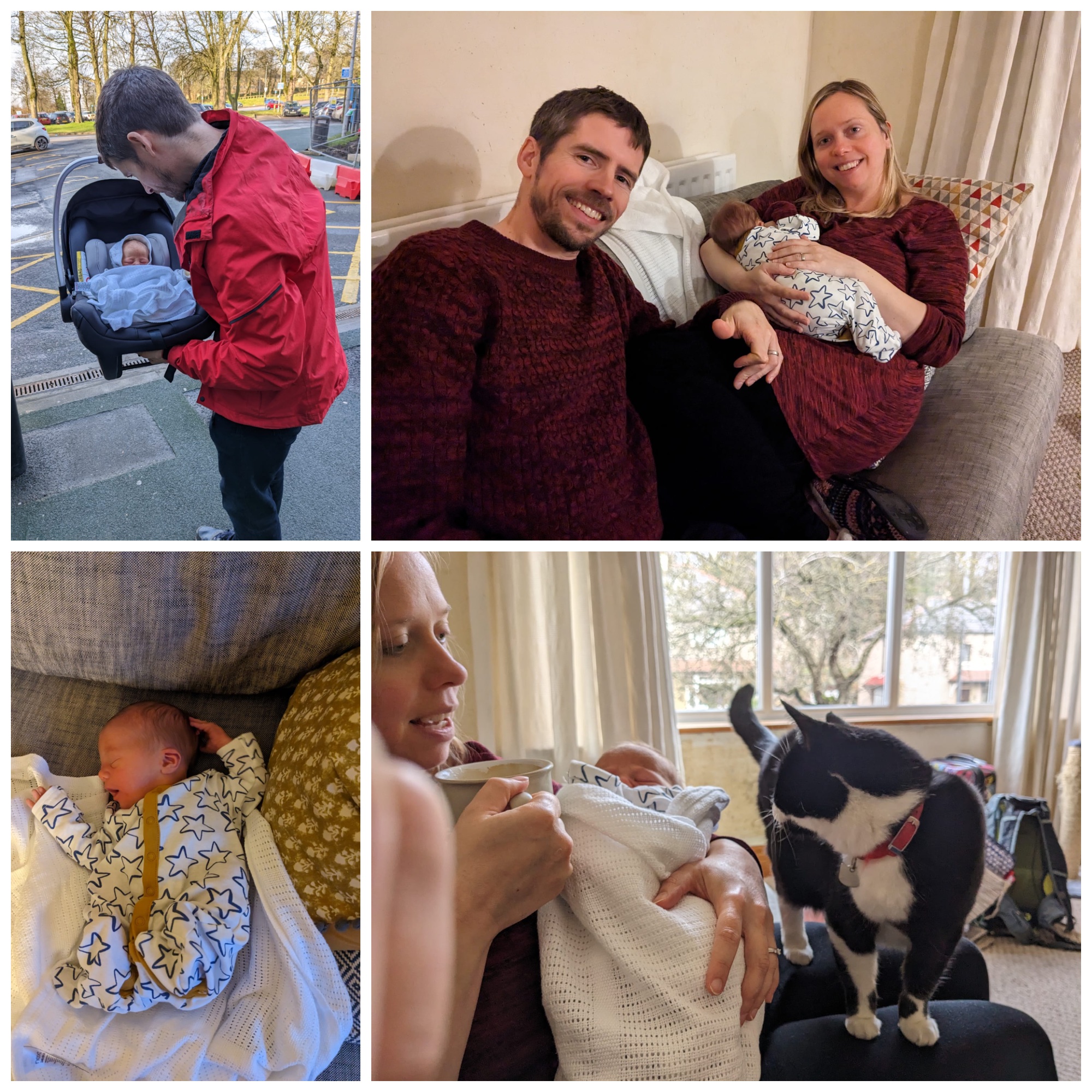
Welcome to the world, Sam


Filling dreams
And so, something unique happened this last week – unique to me, but an astonishingly common occurrence throughout history and across the world. But this thing has never happened to me before. I took on a new identity –  Grandfather/Grandad/Grandpa/Poppa/some other word – when a new member of my family arrived. I’m assuming Sam – for that is he – will decide what to call me at some point in the next few years. Sam is a lucky little guy arriving in a loving family in a lovely (new) home in a lovely corner of Planet Earth near shops, woods, a meadow, railways (big and miniature), a canal, a river, a valley, hills and dales and enough sky, clouds and wuthering weather to fill his dreams.
Arriving home


At first the infant
What can I say in a blog about my first grandchild? My brain, heart, guts and soul are rollercoasting with thoughts, imaginings and feelings. Shakespeare’s most famous quotation about babies is negative (but funny):
                                   All the world’s a stage,
And all the men and women merely players;
They have their exits and their entrances;
And one man in his time plays many parts,
His acts being seven ages. At first the infant,
Mewling and puking in the nurse’s arms….
Cuddle with Auntie Em


Things to look forward to….
Sam’s in his First Stage of Life and as well as mewling and puking, I’m sure he’ll do some drinking, feeding, looking, tracking, gurgling, babbling, chortling, biting, reaching, gripping, grabbing, staring, hugging, kissing, tickling, waving, clapping, dancing, pushing, pulling, rolling, sitting, crawling, holding, pointing, smiling, laughing…. And hopefully a goodly amount of sleeping. And that’s before this time next year. Until then, a couple of poems.
"I thought we'd agreed," said Cora, "it was just the three of us...."


Joy is my name

Infant Joy
by William Blake

‘I have no name.
I am but two days old.’
What shall I call thee?
‘I happy am.
Joy is my name.’
Sweet Joy befall thee!

Pretty Joy!
Sweet Joy but two day’s old.
Sweet Joy I call thee:
Thou dost smile.
I sing the while.
Sweet joy befall thee.

First Meetings
Dark, peaceful, sacred…
Although Carol Ann Duffy (like Blake, one of my favourite poets) writes the following to her daughter, it’s easy to imagine beyond the pronouns to any child, any time, any where, any when…

A Child's Sleep 
by Carol Ann Duffy
I stood at the edge of my child's sleep
hearing her breathe;
although I could not enter there,
I could not leave.

Her sleep was a small wood,
perfumed with flowers;
dark, peaceful, sacred,
acred in hours.

And she was the spirit that lives
in the heart of such woods;
without time, without history,
wordlessly good.

I spoke her name, a pebble dropped
in the still night,
and saw her stir, both open palms
cupping their soft light;

then went to the window. The greater dark
outside the room
gazed back, maternal, wise,
with its face of moon.
Samuel Miles Grimley


Monday, 11 November 2019

The Last Post

2019 Remembrance
Today is 11.11.19 – and exactly 100 years since the very first Remembrance Sunday in 1919. At the weekend, the great and the good (in particular the surviving veterans – very few now from The Great War, The War To End All Wars) laid wreaths at the Cenotaph in London and remembered “The Glorious Dead.” In addition to the current (imo unworthy) office holder, five former prime ministers attended – Sir John Major, Tony Blair, Gordon Brown, David Cameron and Theresa May – and, overlooking the ceremony from a balcony the one queen who has presided over 15 prime ministers (and grown up under a further six.)
No brainer
For me, I respect the concept of Remembrance. Apart from anything else, I believe the Royal British Legion to be a fantastically effective charity. Its campaigning and support – practical, financial, and emotional – are all essential, especially given the way successive governments have treated and continue to treat veterans and their families. All wars produce great art, and the poetry of the First World War is rightly lauded. In 2009, to commemorate the deaths of Henry Allingham and Harry Patch, two of the last few combatants surviving, Carol Ann Duffy used an extract from Wilfred Owen’s Dulce et Decorum Est to produce a poignant and cinematic rewinding riff on remembrance – if we could only wind back time and the dead could “lean against a wall.”
Last Post
by Carol Ann Duffy

'In all my dreams, before my helpless sight,
He plunges at me, guttering, choking, drowning.'

If poetry could tell it backwards, true, begin
that moment shrapnel scythed you to the stinking mud…
but you get up, amazed, watch bled bad blood
run upwards from the slime into its wounds;
see lines and lines of British boys rewind
back to their trenches, kiss the photographs from home –
mothers, sweethearts, sisters, younger brothers
not entering the story now
to die and die and die.
Dulce – No – Decorum – No – Pro patria mori.
You walk away.

You walk away; drop your gun (fixed bayonet)
like all your mates do too –
Harry, Tommy, Wilfred, Edward, Bert –
and light a cigarette.
There's coffee in the square,
warm French bread
and all those thousands dead
are shaking dried mud from their hair
and queuing up for home. Freshly alive,
a lad plays Tipperary to the crowd, released
from History; the glistening, healthy horses fit for heroes, kings.

You lean against a wall,
your several million lives still possible
and crammed with love, work, children, talent, English beer, good food.
You see the poet tuck away his pocket-book and smile.
If poetry could truly tell it backwards,
then it would.


Saturday, 1 June 2019

The Charlotte Stone

Brontë200
The past five years have been a bonanza for admirers of Haworth’s Brontë family with the Brontë200 five-year programme of bicentenaries: the Reverend Patrick Brontë’s invitation to become Haworth’s leading minister in 1819 and the births of Charlotte, Emily, Branwell and Anne (1816, 1817, 1818 and 1820.) As part of the celebrations, author Michael Stewart has devised a series of walks to visit monumental stones positioned in key places across Brontëland and Sally and I recently went on a pilgrimage to find The Charlotte Stone.
bog-burst of pain, fame, love, unluck.
The walk begins in Thornton near the remains of the Bell Chapel where Patrick was curate from 1815 to 1820. Over the road, the current St James’ Church contains an interesting exhibition about the Brontës. You ascend on tracks that pass Thornton Hall, probably the inspiration for Mr Rochester’s house in Jane Eyre. The wild and surprising views above Thornton carry you along high ridges that then descend to the Great Northern Railway trail where you cross the awesome 20-arch Thornton viaduct. The walk ends (inevitably) at the Brontë birthplace, now Emily’s café, and the site of The Charlotte Stone with a poem by Carol Ann Duffy. Officially “Easy,” I would describe the walk as “Strenuous” and we took all day, but that’s cos we included a lengthy picnic stop (or two) with hot bevarages and time to take in the Yorkshire views. 
Charlotte by Carol Ann Duffy
Walking the parlour, round round round the table,
miles; dead sisters stragglers till ghosts; retired wretch,
runty, pale, plain C.Brontë; mouth skewed, tooth-rot.
You see you have prayed to stone; unheard, thwarted.
But would yank your heart through your frock,
fling it as a hawk over the moors, flaysome.
So the tiny handwriting of your mind as you pace.
So not female not male like the wind’s voice.
The vice of this place clamps you; daughter; father
who will not see thee wed, traipsing your cold circles
between needlework, bed, sleep’s double-lock.
Mother and siblings, vile knot under the flagstones, biding.
But the prose seethes, will not let you be, be thus;
bog-burst of pain, fame, love, unluck. True; enough.
So your still doll-steps in the dollshouse parsonage.
So your writer’s hand the hand of a god rending the roof.

Saturday, 19 September 2015

Constant as the northern star....

Saltaire Festival

Saltaire Festival

A few times a year Saltaire, where I live, holds a street and park festival with beer tents, food stalls, craft and vintage stalls, live music and street performers. Some years there are arts trails, open garden trails and in recent years in the build-up to Christmas there has been a Window Advent Calendar hunt. All these events bring out the creative best in local people and the atmosphere is generally fantastic although the Festival now is a huge and crowded event and seems to get bigger every year. I am as proud of my adopted home, Saltaire, as I am of my birth city of Wakefield.


Proud of Wakefield

Wakefield Cathedral

Growing up, I loved Wakefield. I loved the open fields near Eastmoor Estate, the sense of history with Sandal Castle and the chantry chapel, the cathedral, the parks, the opportunities for both sports and the arts; as a teenager I played rugby and acted in a local amateur dramatic society – an odd combo looking back. One of the constants about Yorkshire through my life has been how quickly you can get to places of interest and beauty.


Harewood House

Harewood House near Leeds

A place like Harewood House, for example, has so many quirky aspects: the beauty of the house and grounds; the Bird Garden (complete with penguins); the terrace art gallery and café; the display about Britain’s history of slavery; and the painting of the “Scandalous” Lady Worsley, recently portrayed in a BBC TV drama by Natalie Dormer.


East Riddlesden Hall

East Riddlesden Hall between Bingley and Keighley

Along the road from my house is the National Trust-run East Riddlesden Hall complete with a huge ancient barn, legends of hauntings, at least three stages of building and a riverside walk.


Jervaulx Abbey

Jervaulx Abbey, North Yorkshire

Further afield is the tranquility of one of the great ruined abbeys of the north. You can take your pick in Yorkshire from Bolton, Byfield, Coverham, Easby, Fountains, Jervaulx, Kirkham, Monk Bretton, Mount Grace, Rievaulx, Roche, Whitby and York St Mary’s. The pictures above are from Jervaulx but they all are atmospheric and peaceful  places to visit.


Middleham Castle

Middleham Castle, North Yorkshire

And not far from Jervaulx is my favourite Yorkshire castle, childhood home of Richard III, Middleham, maintained by English Heritage. I visited Leicester cathedral recently to see the new burial site of Richard but it is Middleham where his heart seems to have been and where his positive reputation remains intact.

Linda Thompson's statue of Richard III at Middleham Castle
I have posted the poem below in a previous blog, but I think it’s a superbly crafted piece of writing:


Richard by Carol Ann Duffy
My bones, scripted in light, upon cold soil,
a human braille. My skull, scarred by a crown,
emptied of history. Describe my soul
as incense, votive, vanishing; you own
the same. Grant me the carving of my name.
These relics, bless. Imagine you re-tie
a broken string and on it thread a cross,
the symbol severed from me when I died.
The end of time – an unknown, unfelt loss –
unless the Resurrection of the Dead …
or I once dreamed of this, your future breath
in prayer for me, lost long, forever found;
or sensed you from the backstage of my death,
as kings glimpse shadows on a battleground.


Saturday, 21 March 2015

Who Murdered the Princes in the Tower?

The Return of the King

I couldn’t help being glued to the saga of the discovery of the bones of Richard III.  Philippa Langley’s Looking for Richard project demonstrated a tenacity and meticulousness that leaves me in utter admiration.
Philippa Bailey, 


The king in the car park

Channel 4’s documentary about the finding of the bones of Richard in the remains of the Greyfriars Priory was a riveting account, I thought, of English doggedness and sheer fluke.  The moments of revelation were handled well and the “host” Simon Farnaby delivered his dry and charming commentary with sensitivity and flashes of grim humour – “If that isn’t Richard III, that’s one unlucky monk!”
Jacqui Binns with her funeral pall

Shakespearean spin
As a lifelong Shakespeare devotee, should I be huffing and puffing like the pantomime historian, David Starkey, and trying to denigrate the Ricardians who were all anxious to give the bones a reinterment with honour and dignity?  Would any deviation from the Tudor view of the “poisonous bunchbacked toad” undermine Shakespeare’s brilliant creation?
Ian McKellen, Antony Sher, Simon Russell Beale, Jonjo O'Neill

Sharon Penman
Since reading Sharon Penman’s evocative fictionalised account of Richard’s life and seeing the Shakespeare Histories Octology staged in all its glory (five times now) I am an avid reader of Wars of the Roses material.  Growing up nearby – and regularly visiting – Sandal Castle in Wakefield also has something to do with my obsession with the Yorkist cause, I’m sure.
One of my favourite books

History is bunk – and marvellous at the same time
I wrote in an earlier blog (here) about my feelings about History.  No way can we ever truly know about the motivations and actions of anybody, let alone a long-dead historical figure.  Every bit of evidence will be tainted with bias.  Even recent figures (wholly alive) are elusive – and will remain so.  Who can prove with absolute certainty what motivated Tony Blair’s thoughts and actions during his time as Prime Minister?  There will be as many interpretations as there are commentators and even Tony B's own memory and brain will fashion and refashion what happened and how and why.  History is a narrative construct; all evidence is interpretative.

Ricardians
I find the Sharon Penman view of Richard III the most persuasive.  (Any work that explore four brothers is bound to get me – as I discovered when I read The Queen of Air and Darkness.)  Her sympathetic Richard, loyal to the north of England, and a loving brother, husband and father, is completely at odds with Shakespeare’s character of Richard III.  But Shakespeare’s “bottled spider” is a fictional villain, a study in tyranny and a theatrical tour de force.  I don’t watch Julius Caesar or Macbeth expecting a documentary study of those rulers.  Cleopatra in history, I’m 100% sure, was nothing like the Shakespearean character in Antony and Cleopatra.

So thank you to all those who contributed to the honour and dignity of bringing Richard’s bones to a more dignified resting place.  Of course I would have favoured a reinterment in York Minster – and I would have attended myself if it had been at Middleham Castle.  Where he belongs.  But I can accept him being in Leicester for all kinds of reason – I hope Richard’s presence there gives the city a boost.  That would chime with what I believe about Richard III’s sense of justice.  He knows Yorkshire loves him….  
Middleham Castle, a Ricardian paradise
Who murdered the Princes in the Tower?
Buckingham is a likely contender but my understanding of the time – and my reading of the evidence – points to the supporters of Henry VII.  Did they act on his orders?  Did Buckingham do the dirty on behalf of Henry VII?  Did the older boy die, and the younger boy survive to become Perkin Warbeck?  We will never know.  But we will never know, either, that Richard III definitively ordered their deaths.  Anyone expressing absolute certainty is simply giving an interpretation.  J’accuse Buckingam/Henry VII!  Final words to the brilliant Carol Ann Duffy:


Richard

My bones, scripted in light, upon cold soil,
a human braille. My skull, scarred by a crown,
emptied of history. Describe my soul
as incense, votive, vanishing; you own
the same. Grant me the carving of my name.

These relics, bless. Imagine you re-tie
a broken string and on it thread a cross,
the symbol severed from me when I died.
The end of time – an unknown, unfelt loss –
unless the Resurrection of the Dead …

or I once dreamed of this, your future breath
in prayer for me, lost long, forever found;
or sensed you from the backstage of my death,
as kings glimpse shadows on a battleground.

By Carol Ann Duffy