|
| The art world responds to the story of the dancing princess |
On 11th February 1896, at the Comédie-Parisienne in Paris, Oscar Wilde’s play of the Biblical story of Salomé received its premiere. Rehearsals for an earlier production had begun in 1892 starring the famous celebrity actress, Sarah Bernhardt, but the London production was banned, supposedly because the Lord Chamberlain (the censor of the day) decided that it was blasphemous to portray Biblical characters on the stage. By the time the play was staged in Paris, Wilde had been imprisoned as a result of a series of tragic miscalculations and the fervid homophobia of late Victorian Establishment.
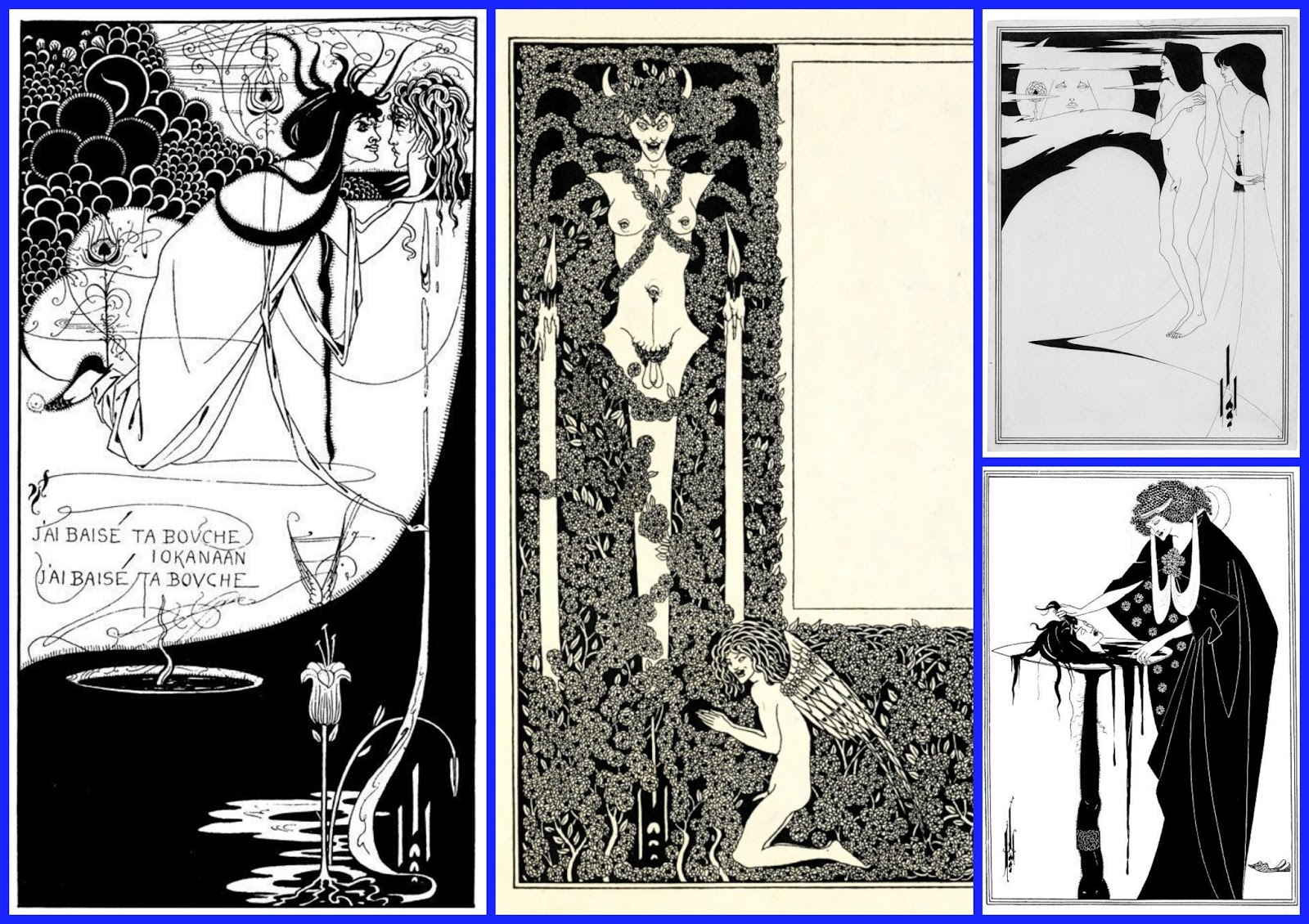 |
| Aubrey Beardsley's original illustrations include Wilde in the moon (top right) |
What the Bible says (Mark Ch 6: 14 – 28)
John the Baptist has been raised from the dead, and that is why miraculous powers are at work in him.”
15 Others said, “He is Elijah.” And still others claimed, “He is a prophet, like one of the prophets of long ago.”
16 But when Herod heard this, he said, “John, whom I beheaded, has been raised from the dead!”
17 For Herod himself had given orders to have John arrested, and he had him bound and put in prison. He did this because of Herodias, his brother Philip’s wife, whom he had married.
18 For John had been saying to Herod, “It is not lawful for you to have your brother’s wife.”
19 So Herodias nursed a grudge against John and wanted to kill him. But she was not able to,
20 because Herod feared John and protected him, knowing him to be a righteous and holy man. When Herod heard John, he was greatly puzzled; yet he liked to listen to him.
21 Finally the opportune time came. On his birthday Herod gave a banquet for his high officials and military commanders and the leading men of Galilee.
22 When the daughter of Herodias came in and danced, she pleased Herod and his dinner guests. The king said to the girl, “Ask me for anything you want, and I’ll give it to you.”
23 And he promised her with an oath, “Whatever you ask I will give you, up to half my kingdom.”
24 She went out and said to her mother, “What shall I ask for?” “The head of John the Baptist,” she answered.
25 At once the girl hurried in to the king with the request: “I want you to give me right now the head of John the Baptist on a platter.”
26 The king was greatly distressed, but because of his oaths and his dinner guests, he did not want to refuse her. 27 So he immediately sent an executioner with orders to bring John’s head. The man went, beheaded John in the prison,
28 and brought back his head on a platter. He presented it to the girl, and she gave it to her mother.
 |
| Images copyright RSC taken by Isaac James. Actors: Matthew Tennyson, Ilan Evans, Jon Tranchard, Christopher Middleton, Simon Yadoo, Bally Gill, Johnson Willis, Assad Saman, Andro Cowperthwaite, Ben Hall |
Influences and imaginative transformation
In crafting the play, Wilde:
- takes the text (above) from the Gospel of Mark and the shorter version in Matthew’s Gospel;
- considers the many classical paintings of the scene by da Vinci, Moreau, Rubens and Titian among others (rejecting some and admiring others);
- and, like Shakespeare, steals phrases and rhythms from a number of other writings (Scheffauer, J C Heywood, Flaubert, Huysmans, Maeterlinck) and even
- his own brother, Wiliam Wilde, who wrote a poem about Salomé in Trinity College magazine, in 1878.
 |
| Isaac James photographs. Actors: Assad Zaman, Matthew Tennyson, Gavin Fowler, Suzanne Burden and Company |
It at first glance seems perverse to give a female role to a male actor in a 2017 Roman plays season at the RSC, given the few numbers of (textually) female roles available in Antony and Cleopatra, Coriolanus, Julius Caesar and Titus Andronicus. But the decision absolutely works in the context of the rest of the production’s design and, in my opinion, gave Wilde’s play a frisson of repressed/unrequited/ambiguous/burgeoning love and sexuality that was wonderfully apt in this year of the 50th anniversary of the partial decriminalisation of gay (male) sex. Matthew Tennyson played Salomé with delicately eye-popping rage; he alternated between naïve expressions of desire, determined ferocity and intricate vulnerability. Standing up to his dementedly incestuous stepfather, Herod, played with lascivious cowardly torment by Matthew Pidgeon, Salomé was a heroic and tragic figure who struggled to know how to express her/his love. Circling them both was the accusatory Herodias played by Suzanne Burden with flamboyant gusto (often appealing to the audience directly and inviting us to judge what we were seeing.)
 |
| Isaac James photographs. Actors: Ilan Evans, Matthew Tennyson, Gavin Fowler, Matthew Pidgeon, Ben Hall, Bally Gill, Jon Trenchard, Christopher Middleton, Miles Mitchell, Andro Cowperthwaite, Robert Ginty, Byron Mondahl, Johnson Willis, Simon Yadoo |
Total theatre
The moon hung over this beautifully-lit and evocatively-costumed production, literally and imaginatively as the Roman soldiers, the Jewish and non-Jewish revellers and the Roman ambassador were all mystified about how to respond to both the dancing princess and the muscular prophet, Iokanaan (John the Baptist played by Gavin Fowler), emerging from his cistern beneath the stage smeared in dirt and booming out his intense warnings. The executioner, played by Ilan Evans, got to belt out the songs of Perfume Genius, an artist I didn’t know before this production but whose anthemic, heavily-percussive music seemed to fit the awesome, longing, desperate, romantic atmosphere of this theatrical presentation of the pangs of transgressive love.
 |
| Variations of the play: film, opera, Berkoff's adaptation |